Imagine walking into a high-stakes poker game where your life is the pot. Instead of seeing your own cards, you have to play based on the average hand of a thousand strangers who played the game last year. For decades, this has been the grim reality of chemotherapy. Doctors look at a patient’s tumor, check its type and stage, and then prescribe a "standard of care" cocktail. It is a calculated gamble - a statistical best guess that assumes your specific cancer cells will behave exactly like those of the "average" patient. But as any oncologist will tell you, cancer is not a monolith; it is a chaotic, evolving, and deeply personal adversary.
What if we could run the experiment before the treatment actually begins? What if we could take a tiny sample of a patient's own tumor and put it through a specialized biological flight simulator to see how it reacts to ten different drugs? This is no longer the domain of science fiction. By merging microfluidics (the study of fluids at a microscopic scale) and cellular biology, we are entering the era of the "tumor-on-a-chip." These tiny devices allow us to stop treating patients as statistical averages and start treating them as unique biological puzzles. We are creating a sandbox where we can defeat the cancer a dozen times over in a lab before the first drop of medicine ever enters a human vein.
The Architecture of a Biological Sandbox
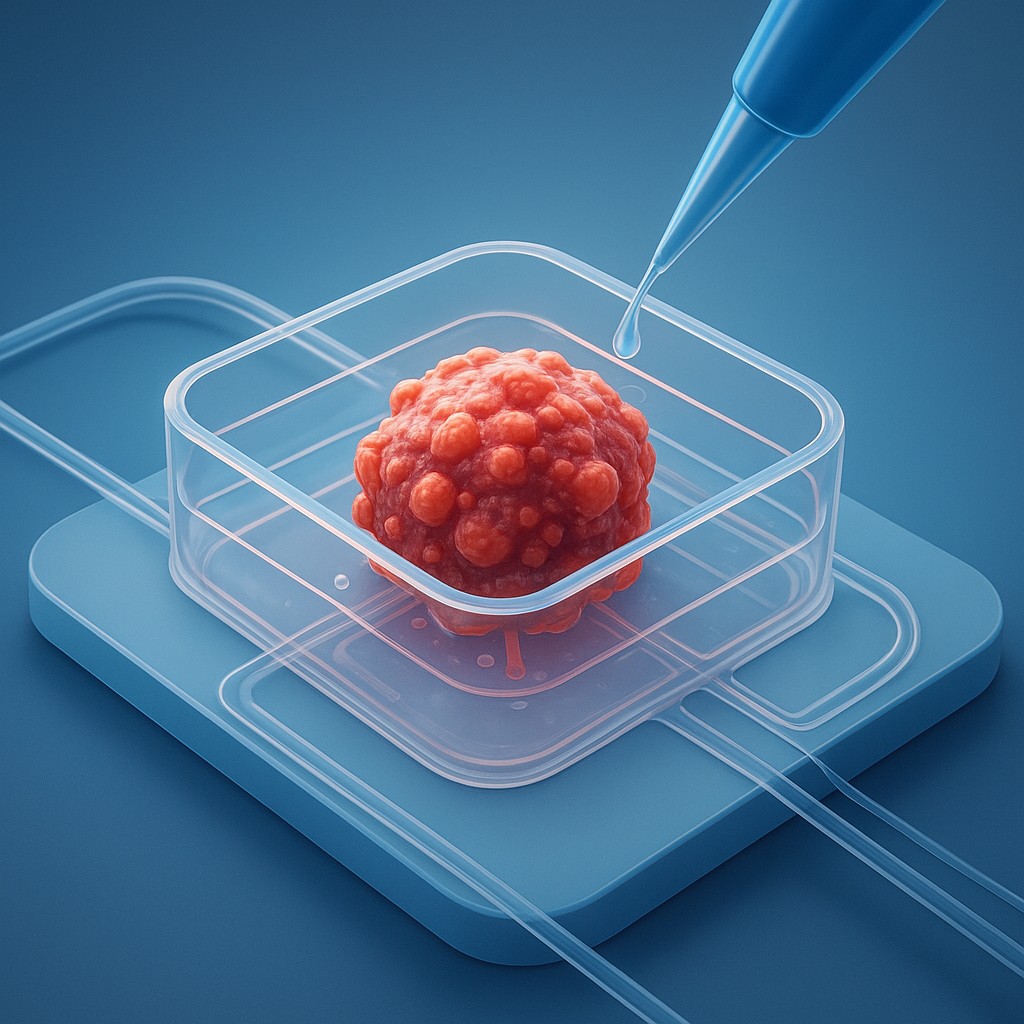
The "chip" in tumor-on-a-chip does not refer to a silicon microprocessor like those found in a smartphone. Instead, these are microfluidic devices, usually about the size of a thumb drive, crafted from a clear, flexible plastic. Inside these chips are hollowed-out channels, some as thin as a human hair, designed to move microscopic amounts of fluid with extreme precision. The magic happens when we "seed" these channels with living cells. By taking a biopsy from a patient, scientists can grow those specific cancer cells inside the chip, allowing them to cling to the walls and interact just as they would inside the body.
The genius of this design is that it replicates the physical environment, not just the chemical one. In a traditional petri dish, cells sit in a still puddle of nutrients, which looks nothing like the active environment of a human organ. On a chip, scientists can simulate blood flow, create oxygen levels that vary by area, and even apply physical stress, like the rhythmic stretching of lung tissue or the pressure of blood pulsing through a vessel. This "micro-environment" is crucial because cancer cells are notoriously sensitive to their surroundings. A cell that seems weak in a flat plastic dish might become incredibly resistant when nestled in the three-dimensional structure of a chip that mimics its home in the liver or bone marrow.
By creating these high-quality replicas, researchers can observe how a tumor grows in three dimensions. They can watch as it attempts to recruit nearby blood vessels or as it tries to break away and spread to other parts of the body, a process known as metastasis. Because the chip is transparent, every one of these moves can be monitored in real-time under a microscope. It is the difference between looking at a still photograph of a crime scene and watching a live video feed of the perpetrator. This visibility provides a window into "why" a cancer resists treatment, not just "if" it survives.
Moving Beyond the Limitations of Animal Testing
For over a century, the gold standard for testing new drugs has been the lab mouse. While mice have been invaluable to medical progress, they have one glaring flaw: they are not humans. A drug that successfully shrinks a human tumor transplanted into a mouse might fail miserably in a person because the mouse's metabolism, immune system, and organ structures are fundamentally different. Many promising "cures" have vanished during clinical trials because the results seen in rodents simply did not translate to the complex biology of a human being. This "translation gap" is one of the most expensive and time-consuming hurdles in modern medicine.
Tumor-on-a-chip technology offers a bridge over this gap. Because these chips use human cells - often the patient’s own - they bypass the biological "lost in translation" effect. We are no longer asking how a mouse handles a drug; we are asking how this person's cells handle it. This also addresses significant ethical concerns regarding animal testing. While we may never fully replace animal models in the near future, chips allow us to filter out toxic or ineffective treatments much earlier in the process. We can test thousands of variations on chips to find the one "winning" combination, ensuring that when we finally move to human or animal models, we are working with the best possible candidates.
The efficiency gain here is staggering. Developing a new cancer drug can take over a decade and cost billions of dollars, largely due to the high failure rate of drugs that look good in animals but fail in humans. By using these chips during the drug discovery phase, pharmaceutical companies can fail fast and fail cheap. If a drug is going to be toxic to human liver cells, the chip will show that in days, rather than waiting for years of clinical trials to reveal the danger. This accelerates the pace of innovation, bringing life-saving treatments to patients years ahead of schedule.
| Feature |
Traditional Petri Dish |
Animal Models (Mice) |
Tumor-on-a-Chip |
| Cell Structure |
2D Flat Layer |
3D Living Organism |
3D Engineered Tissue |
| Cell Source |
Generic Lab Lines |
Mouse Cells |
Patient-Specific Cells |
| Fluid Dynamics |
Static (Still) |
Dynamic (Natural) |
Controlled Micro-flow |
| Complexity |
Very Low |
Very High |
Medium-High |
| Speed and Cost |
Fast and Cheap |
Slow and Expensive |
Moderate and Scalable |
| Prediction Accuracy |
Poor |
Moderate |
High (for Human Response) |
The Mechanics of Personalized Simulation
Once a patient's cells are thriving inside the chip, the process becomes a high-speed simulation of the upcoming treatment. Oncologists can create a "treatment matrix," where different sections of the chip are exposed to various drugs or combinations of therapies. For example, one channel might receive standard chemotherapy, another might get an experimental immunotherapy, and a third might get a "cocktail" of three different drugs at varying doses. This is the ultimate "what if" machine for doctors.
The ability to test multi-drug combinations is perhaps the most transformative aspect of this technology. Cancer is a master escape artist; if you attack it with one drug, it often finds a biological workaround. To counter this, doctors often use "combination therapy," hitting the tumor from multiple angles at once. However, the number of possible drug combinations and dosages is nearly infinite. A doctor cannot realistically try five different combinations on a living patient, as the toxicity would be lethal. On the chip, however, we can test all five. We can see which combination kills the most cancer cells while leaving the healthy "bystander" cells (which can also be grown on the chip) unharmed.
This predictive power changes the conversation in the consulting room. Instead of saying, "We hope this works," a doctor can show a patient the data from their own chip-based simulation. They can identify "resistance patterns" early. If the chips show that the tumor has a specific protein that pumps a certain drug out of the cell before it can work, the doctor can switch to a different class of medication immediately. This saves the patient weeks or months of grueling, ineffective treatment, preserving their strength for the drugs that actually have a chance of winning the fight.
Challenges in Simulating the Human Ecosystem
Despite the incredible promise of this technology, a chip is still a simplified model. The human body is not just a collection of isolated organs; it is a vastly complex, interconnected ecosystem. Currently, one of the biggest challenges for researchers is simulating the immune system. Our white blood cells, T-cells, and antibodies are constantly patrolling the body, and their interaction with a tumor is a critical part of whether a cancer spreads or dies. While scientists are beginning to add immune cells to these chips, replicating the full, systemic immune response is incredibly difficult.
Another hurdle is the "multi-organ" problem. A drug that kills a lung tumor might be perfectly safe in a vacuum, but once it is processed by the liver, it might turn into a toxic byproduct that damages the heart. To solve this, researchers are developing "body-on-a-chip" systems, where multiple organ-mimicking chips (liver, heart, lung, kidney) are linked together by a shared fluid system. This allows scientists to see how a drug flows through the body, how it is broken down, and whether it causes "off-target" damage to other systems. We are essentially building a modular, transparent human being.
The scalability and standardization of these devices also remain a work in progress. Every lab currently has its own "recipe" for building these chips, which makes it hard for regulators like the FDA to create universal safety standards. However, the momentum is undeniable. In recent years, the FDA has shown a growing openness to using data from microfluidic chips in the drug approval process, especially for rare diseases where finding enough human participants for a trial is nearly impossible. As the technology matures and becomes more affordable, it will likely become a standard part of the diagnostic process in every major hospital.
The Future of Precision Warfare Against Disease
The implications of tumor-on-a-chip technology extend far beyond just picking the right chemotherapy. We are looking at a future where we can simulate the long-term effects of daily medications, test how a person's unique genetic makeup influences how they process drugs, and even study the "lag" time between a treatment and its side effects. This is the pinnacle of precision medicine: moving away from the "one size fits all" factory model of healthcare and toward a custom approach where every treatment is designed specifically for the individual.
Think of it as the difference between buying a suit off the rack and having one custom-tailored. The off-the-rack suit might get the job done, but it will never fit perfectly, and it might pinch in places you didn't expect. A custom-tailored treatment plan, validated by a simulation of your own biology, ensures that medical interventions are as precise as possible. It minimizes the collateral damage to the patient's body while maximizing the lethality toward the disease. In the war against cancer, we are finally moving the battlefield from the human body to the laboratory bench, giving patients the upper hand before the fight even begins.
The journey from a plastic chip to a cured patient is a testament to the power of teamwork across different fields. By combining engineering, fluid dynamics, and cellular biology, we have created a tool that respects the complexity of human life while providing the clarity of a scientific experiment. As we continue to refine these "living simulators," the "trial and error" phase of medicine will eventually become a relic of the past, replaced by the calm, data-driven certainty of the simulation.
The road ahead is filled with the promise of more personalized, effective, and humane medicine. Every chip that successfully predicts a patient's response is a victory for science and a beacon of hope for those facing a difficult diagnosis. We are no longer just guessing at the cards; we are rigging the game in favor of life. Some of the biggest revolutions are happening on some of the smallest scales, within the microscopic channels of a tiny plastic chip, where the future of your health is being simulated, one cell at a time.