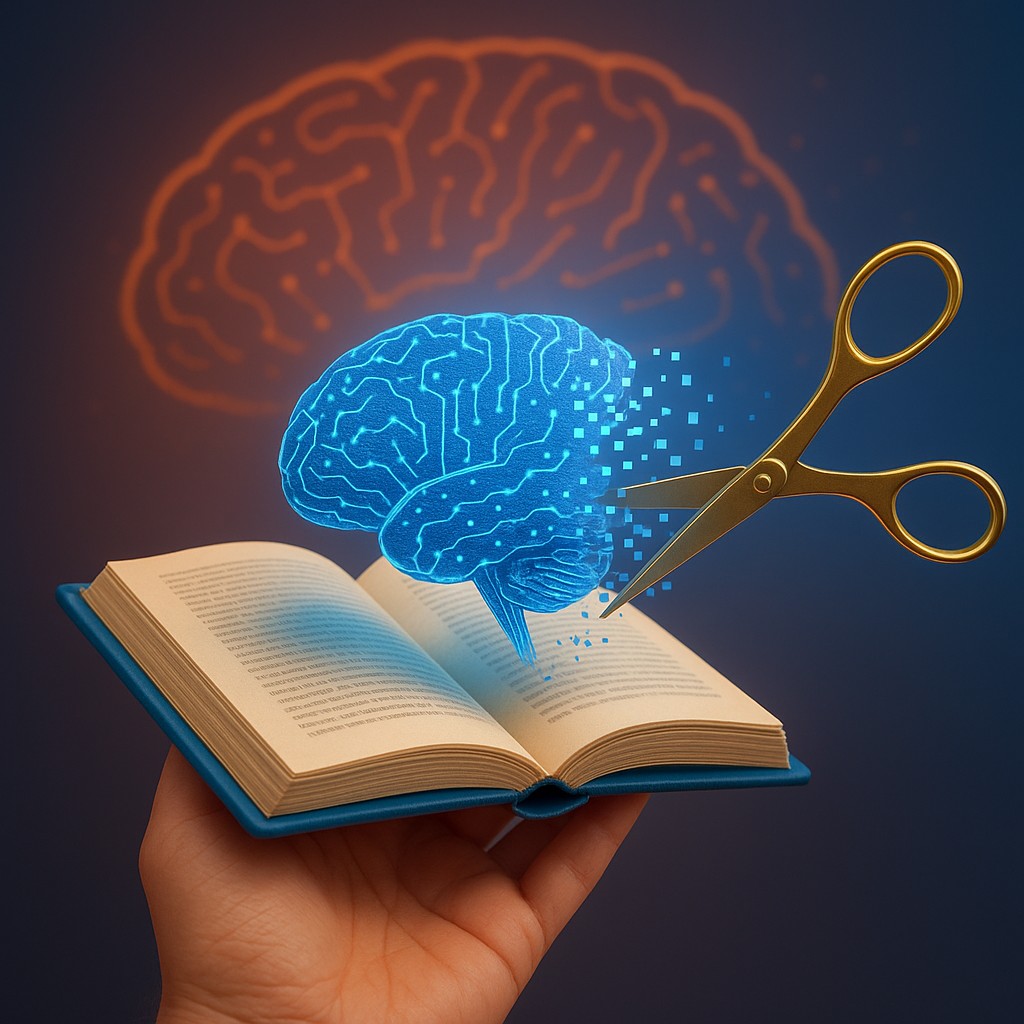
Imagine you are holding a pocket dictionary that somehow contains the collective wisdom of the entire internet. Usually, to use this magical book, you have to shout your question into a walkie-talkie, wait for a giant computer in a distant warehouse to find the answer, and then listen as it dictates the response back to you. This is how most AI, from ChatGPT to Gemini, works today. Your phone acts as a mere messenger, sending your private thoughts to a massive server farm and waiting for a reply. This process is slow, drains your battery, and requires a constant internet connection. That is a major downside if you are trying to translate a menu in a remote village or summarize a sensitive document while on a plane.
Engineers are now flipping the script by shrinking these massive digital brains until they fit comfortably inside your smartphone. The challenge is that a standard Large Language Model (LLM) is like a grand piano: it is beautiful and capable, but far too heavy to carry in your pocket. To make AI local, private, and lightning-fast, researchers are performing a kind of digital surgery called "parameter pruning." By identifying and removing redundant connections within an AI, they are creating "Small Language Models" (SLMs) that can think for themselves without ever needing to "phone home." This shift is turning our mobile devices from mere windows into the cloud into truly independent intellectual partners.
The Mathematical Weight of a Digital Brain
To understand why we need to prune, we first have to look at what makes an AI "heavy." When we say a model has 70 billion parameters, we are essentially talking about 70 billion individual knobs that can be turned to adjust how the model processes information. Each parameter is a numerical value that determines the strength of a connection between two "neurons" in the network. During a single request, the phone's processor must perform billions of multiplication and addition problems using these numbers. On a desktop computer with a massive power supply and a high-end graphics card, this is easy. On a smartphone, however, these math cycles generate heat and drain the battery faster than a high-end video game.
The problem is not just the sheer number of calculations; it is the "memory bottleneck." Every time the AI wants to predict the next word in a sentence, it has to move these billions of parameters from the phone's long-term storage into its active memory (RAM). Moving data around actually consumes more energy than the math itself. If the model is too large, the phone simply runs out of room, causing the app to crash or the keyboard to lag. Pruning is the art of looking at those 70 billion knobs and realizing that a huge chunk of them are set to nearly zero or are simply repeating what another knob is already doing. By "sniping" these useless connections, engineers can reduce the model's footprint without necessarily making it less intelligent.
The Botany of Binary Neural Networks
Pruning gets its name from gardening for a very specific reason. When a gardener prunes a hedge, they aren't just cutting it back randomly to make it smaller. They are removing dead wood and tangled branches so that the plant’s energy goes toward healthy, fruit-bearing limbs. In a neural network, many connections are "weak." During the training process, the model learns a billion different ways to say "The cat sat on the mat," but it might only need three of those pathways to actually get the point across. The rest are just noise that bloats the file size.
Engineers use two main ways to handle this digital landscaping: unstructured and structured pruning. Unstructured pruning is like picking individual needles off a pine tree. You look at every single parameter and, if its value is too tiny to matter, you turn it into a zero. This makes the model files much smaller, but it doesn't always make them faster. Computers are actually quite bad at skipping over millions of zeros scattered randomly; they prefer to process data in neat, predictable blocks. This is why many engineers prefer structured pruning, which involves cutting away entire "branches" or layers of the network. While it is harder to do without hurting the model’s intelligence, structured pruning allows the phone's hardware to skip entire chunks of math, leading to those instant responses we crave.
Balancing Brain Cells and Battery Life
The ultimate goal of pruning is to reach a "Goldilocks zone" where the model is small enough to be fast but large enough to remain smart. If you prune too aggressively, the AI starts to lose its grasp on nuance. It might still know that 2+2=4, but it might lose the ability to write a poem in the style of a 19th-century pirate. This creates a fascinating trade-off for developers. Do you want a model that is an expert in everything but takes five seconds to respond, or a model that is a specialized personal assistant and responds in milliseconds?
To help visualize how these compression techniques compare, it is useful to look at the different ways we "shrink" AI. Pruning is just one tool in a larger kit that includes "quantization," which is like lowering the resolution of a photo to save space. While pruning removes connections entirely, quantization just makes the numbers used to describe those connections less precise.
| Technique |
How it Works |
Primary Benefit |
The "Catch" |
| Pruning |
Deletes unnecessary connections or "neurons" entirely. |
Massive reduction in math cycles and faster speed. |
Can cause the model to "forget" niche facts if overdone. |
| Quantization |
Uses less precise numbers (e.g., 8-bit instead of 32-bit). |
Huge reduction in memory (RAM) usage. |
Slight drop in the smoothness or nuance of language. |
| Knowledge Distillation |
A large "Teacher" model trains a tiny "Student" model. |
Best way to maintain high intelligence in tiny packages. |
Requires a massive amount of expensive training time. |
| Low-Rank Adaptation |
Replaces large data tables with smaller, simpler versions. |
Simplifies the underlying math of the model layers. |
Only works well for specific types of model designs. |
Keeping Your Secrets on Your Silicon
The most significant benefit of these smaller, pruned models isn't just speed; it is privacy. In the current cloud-based AI era, every time you ask an AI to "Read this medical report" or "Draft an email to my boss," that data leaves your device. Even with the best encryption, that is a vulnerability. A pruned model running locally on your smartphone's NPU (Neural Processing Unit) - a chip dedicated to AI tasks - means your data never leaves the physical piece of glass and metal in your hand. The math happens in an isolated "sandbox" within your phone's processor, and once the answer is generated, the temporary data is wiped.
This local processing also solves the "latency" or lag problem. Have you ever noticed how Siri or Alexa sometimes takes a few seconds to respond, or says "I'm having trouble connecting to the internet"? That is the sound of a round-trip journey to a server. An SLM that has been pruned to perfection doesn't care if you are in a lead-lined basement or the middle of the Sahara. Because the "brain" is physically located on the storage chip right next to the processor, the response can begin appearing the very millisecond you finish typing. This transforms AI from a "search engine" experience into a natural extension of your own thoughts.
The Ghost in the Machine's Diet
A common misconception is that a smaller model is always a "dumber" model. Humans often equate size with power, but in the world of software, efficiency is often a sign of higher sophistication. When a model is pruned, it undergoes a process often called "fine-tuning" or "healing" immediately afterward. Engineers take the newly thinned-out network and run it through a brief period of extra training. This allows the remaining connections to "stretch" and compensate for the ones that were removed. It is remarkably similar to how the human brain exhibits neuroplasticity: if one area is damaged, other areas can often learn to pick up the slack.
In fact, some researchers argue that pruning makes models more robust. Large, unpruned models often suffer from "overfitting," where they memorize specific patterns in their training data rather than learning the underlying logic. By forcing the AI to work with fewer parameters, we are forcing it to prioritize the most important, general rules of language and logic. A pruned model can't afford to waste space on memorizing a random Wikipedia entry; it has to use its limited "brain cells" to understand the fundamental structure of how humans communicate. This results in an AI that is leaner, meaner, and surprisingly clever for its size.
The Future of the Pocket-Sized Genius
We are entering an era where the "Intelligence Per Watt" metric will define our technology. As pruning techniques become more advanced, we will see AI integrated into things far smaller than phones: smart glasses that can translate signs in real-time, hearing aids that can isolate a single voice in a crowded room, and even household appliances that understand complex verbal instructions without needing a Wi-Fi password. This "trimmed" AI represents a democratization of technology, moving the power of massive data centers into the hands of individual users.
The next time your phone suggests a perfectly phrased reply to a text or identifies a rare flower in a photo without a moment's hesitation, take a second to appreciate the invisible gardening at play. Thousands of digital "branches" were likely snipped away to make that moment possible. By embracing the philosophy of "less is more," engineers are ensuring that the future of artificial intelligence isn't just big; it is personal, private, and incredibly fast. We are no longer just building bigger brains; we are learning how to make them elegant, efficient, and ready to travel anywhere we go.