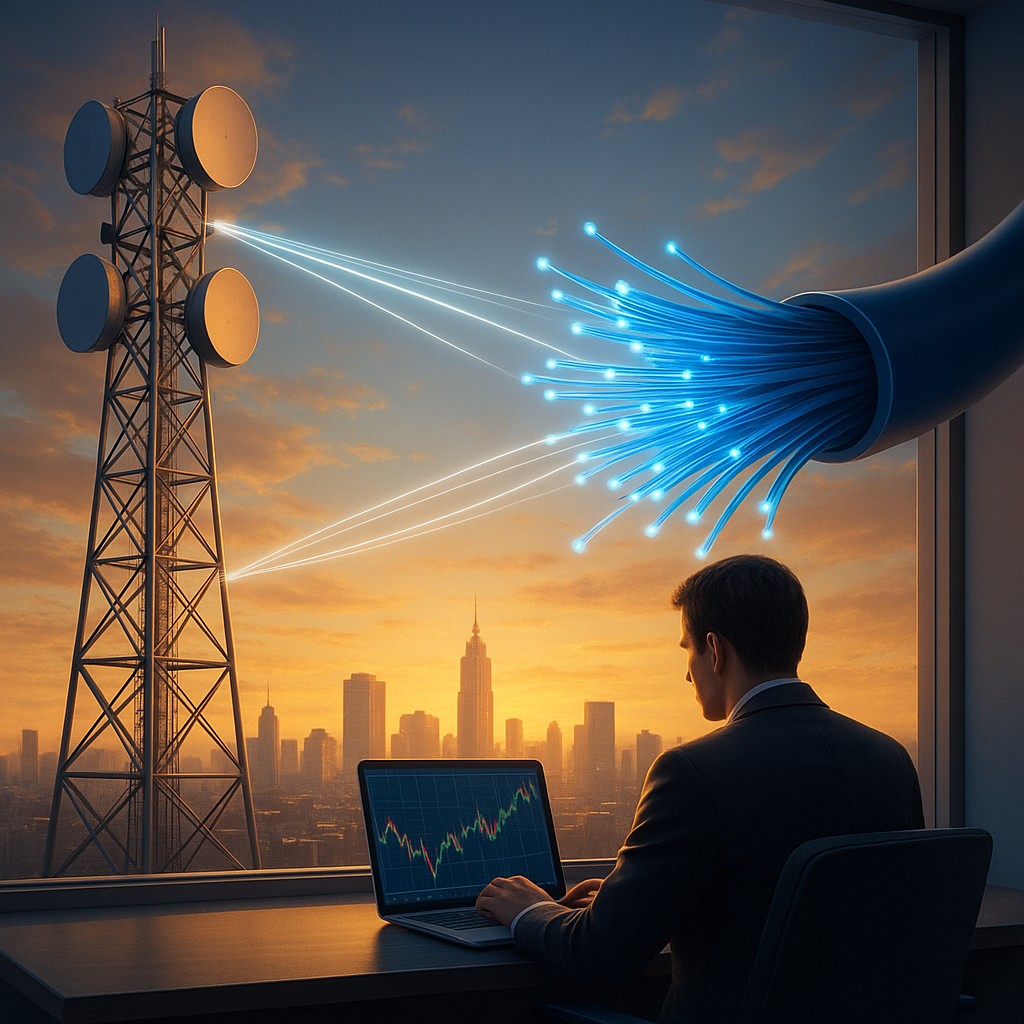
Imagine you are a high-speed trader in a sleek Manhattan office. Your computer just spotted a tiny price difference between a stock in New York and the same asset in Chicago. This gap will last for only a fraction of a second. To profit, your order must reach the exchange before anyone else’s. You hit enter, and your data begins a frantic race across the continent. Normally, that information would travel through underground fiber-optic cables. But while glass cables are great for streaming movies, they are frustratingly slow for a trader in your position.
In the world of high-frequency trading (HFT), people often call the speed of light the ultimate speed limit. That is a bit of a simplification. Light only hits its top speed of roughly 300,000 kilometers per second in a vacuum. When photons are forced through a glass cable, they must travel through a denser material, which slows them down by about 30 percent. To a trader, that delay feels like an eternity. This is why financial firms are spending millions of dollars to skip the cables entirely. Instead, they are building massive networks of microwave towers that beam data through the air. By sending signals through the atmosphere, where light moves at nearly its maximum speed, these firms shave milliseconds off their response times and fundamentally change how global markets work.
The Physical Limits of the Glass Ceiling
To understand why a microwave tower beats a high-tech fiber cable, we have to look at the physics of how light bends, or refraction. Fiber-optic cables work through "total internal reflection." Inside the cable, a core of ultra-pure glass carries pulses of laser light. Because glass is denser than air, the light slows down significantly, much like a person trying to run through waist-deep water instead of on dry land. In a fiber cable, light travels at about 200,000 kilometers per second. While that sounds fast, it creates a "latency floor," or a minimum delay, that cannot be lowered no matter how much you spend on better glass.
Furthermore, fiber-optic cables rarely run in a perfectly straight line. Because they are buried alongside railroads or highways, they follow the curves of the landscape and the twists of civil engineering. A fiber route between New York and Chicago might be several miles longer than a straight line because it has to weave around mountains, private property, and urban sprawl. In a race decided by milliseconds, these extra miles are a deal-breaker. Traders realized that to get faster, they had to move out of the ground and into the sky.
Shooting Straight Through the Atmosphere
Microwave trading networks solve the problems of both materials and geography at once. Instead of a winding cable, firms build towers that communicate via "line-of-sight." They install powerful microwave dishes on top of skyscrapers and rural hills, aiming them precisely at the next tower in the chain. Because the signal travels through the air, it moves at over 99 percent of the speed of light. This instantly cuts travel time by about one-third compared to fiber. By picking high points on the map, these firms also ensure the path is as straight as possible, minimizing the physical distance the signal must cover.
This infrastructure is hard to miss. If you drive through the plains of Indiana or Pennsylvania, you might see tall, slender towers covered in specialized drums and dishes. They look different from standard cell phone equipment. These are custom-built relay points designed for one thing: moved financial data from Point A to Point B with the least possible delay. Every microwave "hop" adds a tiny bit of latency as the signal is received and sent out again, so engineers work tirelessly to reduce the number of jumps in the chain. They are essentially building a private, invisible highway across the sky to move capital.
A Comparative Look at Transmission Methods
When evaluating these technologies, it is helpful to look at the trade-offs. No single method is perfect; choosing one involves balancing speed against reliability and the amount of data it can carry.
| Feature |
Fiber-Optic Cable |
Microwave Transmission |
Shortwave (HF) Radio |
| Medium |
Glass Silica |
Air (Atmosphere) |
Ionosphere / Skywave |
| Speed |
~67% Speed of Light |
~99% Speed of Light |
~99% Speed of Light |
| Reliability |
Very High |
High (Weather Sensitive) |
Low (Solar Sensitive) |
| Bandwidth |
Massive (TB/s) |
Moderate (GB/s) |
Very Low (KB/s) |
| Directness |
Winding / Curvy |
Straight Line-of-Sight |
Global / Over-the-Horizon |
As the table shows, fiber is slower but can carry nearly infinite amounts of data and stays stable during a thunderstorm. Microwave is much faster but can suffer from "rain fade," where heavy storms absorb the signal. This is why trading firms never truly get rid of their fiber connections; they keep them as a backup. If a storm hits and the microwave link drops, the system instantly switches back to the slower fiber line. It is like having a Ferrari for sunny days and a reliable SUV for when it snows.
The Logic of the Millisecond Monopoly
You might wonder why a few milliseconds actually matter. After all, the human eye blinks in about 100 to 400 milliseconds. To a human trader, the difference between a microwave signal and a fiber signal is impossible to notice. However, modern markets are not run by humans; they are run by algorithms that can make thousands of decisions in the time it takes you to click a mouse. In this world, whoever sees the "new" price first can act on it, buying up all the available shares at the old price before the rest of the market can react.
This creates a "winner-take-all" environment. If Firm A is one millisecond faster than Firm B, Firm A wins the trade every single time. There is no silver medal in high-frequency trading. This race has even pushed some firms to explore shortwave radio, which can bounce signals off the upper atmosphere (the ionosphere) to connect continents like Europe and North America. While shortwave data is poor and the capacity is tiny, the speed is unmatched for long distances. They aren't sending photos or long emails; they are sending tiny "buy" or "sell" triggers that need to arrive first at any cost.
The Infrastructure of the Invisible Grid
The physical side of these networks involves a surprising amount of old-school engineering. To get the most direct path, firms often lease space on historical landmarks or negotiate with farmers to put a 300-foot steel mast in a cornfield. In some cases, historical societies have fought these towers because they ruin the view. In the United Kingdom, for example, there was a famous debate over a tower near a scenic area that was essential for connecting the London Stock Exchange to Europe. These towers are more than just tech; they are legal and political battlegrounds.
Beyond the towers, the equipment inside data centers must also be perfect. Even the length of the wiring inside a server rack is measured. If your competitor has one foot less of copper wire between their computer and the microwave dish, they might have a nanosecond advantage. Engineers often use "hollow-core" fibers for short segments inside a building. These use air-filled tubes to keep the signal moving at top speed even for those last few meters. It is a game of tiny gains where every centimeter of distance and every microchip's work cycle is tracked in pursuit of a head start.
Turning Latency into a Strategic Advantage
When you step back, these towers represent the physical skeleton of the modern economy. They show a world where information is the most valuable commodity, and speed is the primary tool for profit. While it might seem absurd to spend millions to save a fraction of a second, the efficiency of global markets depends on these nearly instant connections. They ensure that prices in London, New York, and Tokyo stay synchronized, preventing chaos and providing the "liquidity," or available cash, that allows large institutions to move money around the world.
As you go about your day, remember there is a silent conversation happening above your head. Thousands of dishes are whispering to one another across the horizon, carrying the heartbeat of the global financial system at the speed of light. The next time you see a strange tower on a distant hill, you aren't just looking at a stack of metal. You are looking at a monument to human ingenuity and our drive to beat the constraints of physics. This pursuit of the millisecond reminds us that in the digital age, being "fast enough" is a moving target, and the sky is no longer the limit-it is the highway.