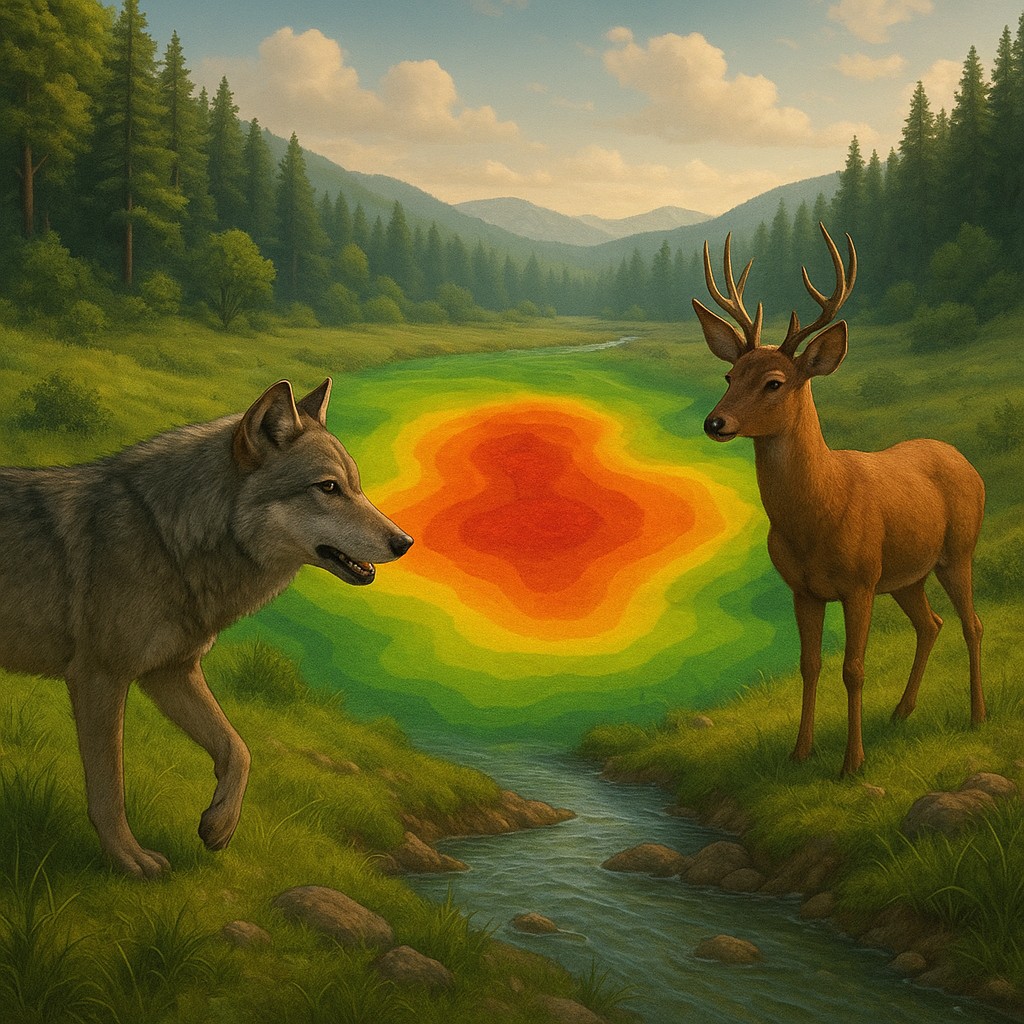
Think of an ecosystem not as a simple collection of animals, but as a complex stage play where every character is constantly looking over their shoulder. For decades, we believed that a predator like a wolf or a shark only influenced its environment through the act of killing. We assumed that if a wolf didn’t catch an elk, it hadn't changed anything that day. However, modern ecology has revealed a much more subtle reality. The mere "vibe" of danger can be just as transformative as the hunt itself, dictating where animals sleep, how they eat, and even how rivers flow.
This phenomenon is built on a psychological force known as the "landscape of fear." It suggests that an animal's map of its world isn't just a physical layout of trees and streams, but a high-stakes heat map of risk. When a top-tier predator is nearby, herbivores become tactical strategists rather than mindless lawnmowers. They begin to avoid specific spots where they feel vulnerable, such as narrow canyons with no escape or open plains where they are easy to spot. This shift in movement creates a ripple effect, known as a trophic cascade (the process by which predators at the top of the food chain impact plants and soil at the bottom), that reshapes the entire physical landscape.
The Psychological Fence of the Wild
In traditional ecology, we often focused on "numeric effects." This is a clinical way of saying that predators help the earth by eating the things that eat the plants. While it is true that a wolf pack reduces the number of elk, the far more interesting impact is what scientists call "trait-mediated effects." This refers to the change in the behavior of the prey. When an elk knows there are wolves in the area, it stops lounging in the middle of a lush valley for six hours at a time. It takes a few bites and moves on, constantly scanning the horizon. This creates a psychological fence that keeps the elk moving, preventing them from grazing any single patch of land to death.
This constant state of vigilance is a heavy mental burden for a wild animal. It forces them to make trade-offs between the quality of their food and the safety of their location. An elk might see a patch of incredibly nutritious willow by a riverbank but decide it is too risky to enter because the thick brush provides perfect cover for a stalking predator. By choosing to stay on higher, drier ground where visibility is better, the elk inadvertently grants that river bank a "get out of jail free" card. The plants there are finally allowed to grow to their full height, providing nesting grounds for birds and materials for beavers.
The fascinating part of this dynamic is that the predator doesn't even have to be actively hunting to exert this influence. The scent of urine, the sound of a distant howl, or even the memory of a previous attack can keep the landscape of fear active. It is a form of spatial tension that ensures no single species becomes too comfortable. When herbivores are too relaxed, they can become agents of destruction, stripping the land bare and leaving nothing for the other species that rely on a diverse habitat.
How a Wolf Changes the Shape of a River
One of the most famous examples of a landscape of fear in action occurred in Yellowstone National Park after gray wolves were reintroduced in 1995. Before the wolves returned, the elk population had become somewhat "lazy" and sedentary. They spent a great deal of time in the valleys, eating young aspen and willow trees until the hillsides were nearly bald. This wasn't just bad for the trees; it was a disaster for the entire physical structure of the park. Without tree roots to hold the soil in place, the riverbanks began to erode, making the water muddy and shallow.
When the wolves arrived, the geography of the park effectively changed overnight in the minds of the elk. They began avoiding "high-risk" zones near the water where they could be easily trapped. Almost immediately, the trees in those areas began to recover. As the willows and aspens grew taller, they stabilized the soil with their expanding root systems. This led to narrower, deeper, and more stable river channels. The return of the trees also brought back beavers, who used the wood to build dams, creating ponds that became homes for otters, muskrats, and various fish.
This sequence of events highlights how a predator can act as a "geographic engineer." By simply existing and being scary, the wolf managed to physically reshape the rivers and diversify the wildlife. It wasn't just about the number of elk being eaten; it was about where the surviving elk were afraid to go. This shows that a healthy ecosystem isn't just a balance of calories or populations; it is a balance of movement and pressure that prevents any one area from being exhausted.
| Ecosystem Component |
Behavior Without Predators |
Behavior With Predators |
Ecological Result |
| Herbivores (Elk/Deer) |
Stay in one place; long feeding times in one spot. |
High mobility; constant vigilance; avoiding "traps." |
Grazing is spread out, preventing plant death. |
| Vegetation (Willow/Aspen) |
Stunted growth; many plants die from overgrazing. |
Rapid growth in "high-risk" zones where herbivores won't go. |
More plant life, better carbon storage, and more habitat. |
| Soil and Water |
Eroded banks; shallow and muddy riverbeds. |
Roots stabilize banks; deeper and clearer channels. |
Healthy aquatic life and sturdy watersheds. |
| Secondary Species |
Low diversity (few birds, no beavers). |
Influx of birds, beavers, and small mammals. |
Higher biodiversity and complex food webs. |
The Dangers of the Safe Zone
While the landscape of fear generally promotes health and diversity, it can sometimes create unintended "sacrifice zones." Ecology is rarely a story of perfect harmony, and the pressure of a predator can occasionally backfire. If the terrain is particularly restrictive, herbivores might huddle together in a "safe zone" that is so small they end up completely destroying it. If an entire herd of deer is too terrified to enter the forest and instead crowds into a single open field, they will eat every blade of grass and every seedling, leading to localized desertification, where the land turns to barren dust.
This phenomenon is particularly visible in fragmented habitats. In many parts of the world, human development has carved nature into tiny islands of green surrounded by roads and fences. In these small pockets, there is often nowhere for the herbivore to run. If a predator is introduced into a very small, confined area, the "landscape of fear" becomes a "landscape of panic." The animals have no "low-risk" zones to retreat to, which can lead to extreme stress, lower birth rates, and the collapse of the herbivore population entirely.
Furthermore, we must consider the "memory" of fear. Research has shown that even after a predator is removed, the prey species may continue to avoid certain zones for generations. This "ghost of predators past" can delay the recovery of an ecosystem or prevent animals from using valuable resources even when it is perfectly safe. This tells us that the psychological impact of a predator is incredibly durable. Managing a landscape requires understanding the mental state of the animals just as much as their biology.
Misconceptions of the Brutal Hunter
A common myth about apex predators - those at the top of the food chain - is that they are "killing machines" that exist solely to keep populations down. This view frames them as biological vacuum cleaners, sucking up excess animals. In reality, predators are often surprisingly unsuccessful at actually catching their prey. A wolf might fail nine out of ten times it tries to hunt an elk. If the only impact a wolf had was the kill, it would be a relatively inefficient member of the ecosystem. Its true power lies in the fact that the elk doesn't know which hunt will be the successful one.
Another misconception is that the landscape of fear is a simple "on/off" switch. People often assume that if you have wolves, you have fear, and if you don't, you don't. In truth, the landscape of fear is a shifting map that changes with the seasons, the time of day, and even the weather. On a bright, clear day with a steady breeze, an elk might feel safe in an area where it can smell a predator coming from miles away. On a foggy, still night, that same area becomes a terrifying labyrinth.
We also tend to focus exclusively on large mammals like wolves and bears, but the landscape of fear exists at every scale. Scientists have observed this same dynamic in coral reefs, where the presence of sharks keeps fish from overgrazing certain patches of seaweed. It even happens in gardens, where the scent of a ladybug causes aphids to stop feeding and drop off a plant to escape. The "scare factor" is a universal language in the natural world, and it serves as a constant, invisible regulator of life.
Navigating the Invisible Map of Risk
Understanding the landscape of fear changes how we think about conservation and land management. It suggests that simply protecting a piece of land isn't enough; we have to ensure that the "psychological infrastructure" of the land is intact. When we remove a top predator, we aren't just losing one species; we are removing the tension that keeps the entire system organized. Without that tension, the boundaries between different habitats begin to blur, and the landscape loses its structural integrity.
This framework also offers a fascinating lens through which to view our own history. Humans were once prey, and our ancestors lived within their own landscapes of fear. Much of our early behavior, from where we built our shelters to how we moved across the savanna, was dictated by the perceived risk of large cats and other predators. While we have largely removed ourselves from this dynamic, the biological "hardware" for mapping risk still exists within our brains. We are still hyper-aware of dark alleys or thick woods, proving that the psychological impact of potential danger is a foundational part of life on Earth.
By studying these landscapes, we learn that the most important parts of nature are often the things we cannot see. A healthy forest isn't just a collection of trees and animals; it is a complex web of perceptions, decisions, and cautious movements. When we look at a thriving meadow or a clear, winding river, we are often seeing the result of an animal that decided not to eat there because it was worried about a wolf. That worry, that invisible pressure, is what keeps the world green.
As you move through your own environment, whether it is a city park or a deep forest, try to imagine it not as a static map, but as a living grid of safety and risk. Consider how the "scary" parts of nature are actually the things that allow the delicate parts to survive. The lion doesn't just provide balance by hunting; it provides balance by existing as a possibility in the mind of the gazelle. In the grand theater of life, fear isn't just a survival mechanism; it is the silent architect of our world's most vibrant and resilient landscapes.