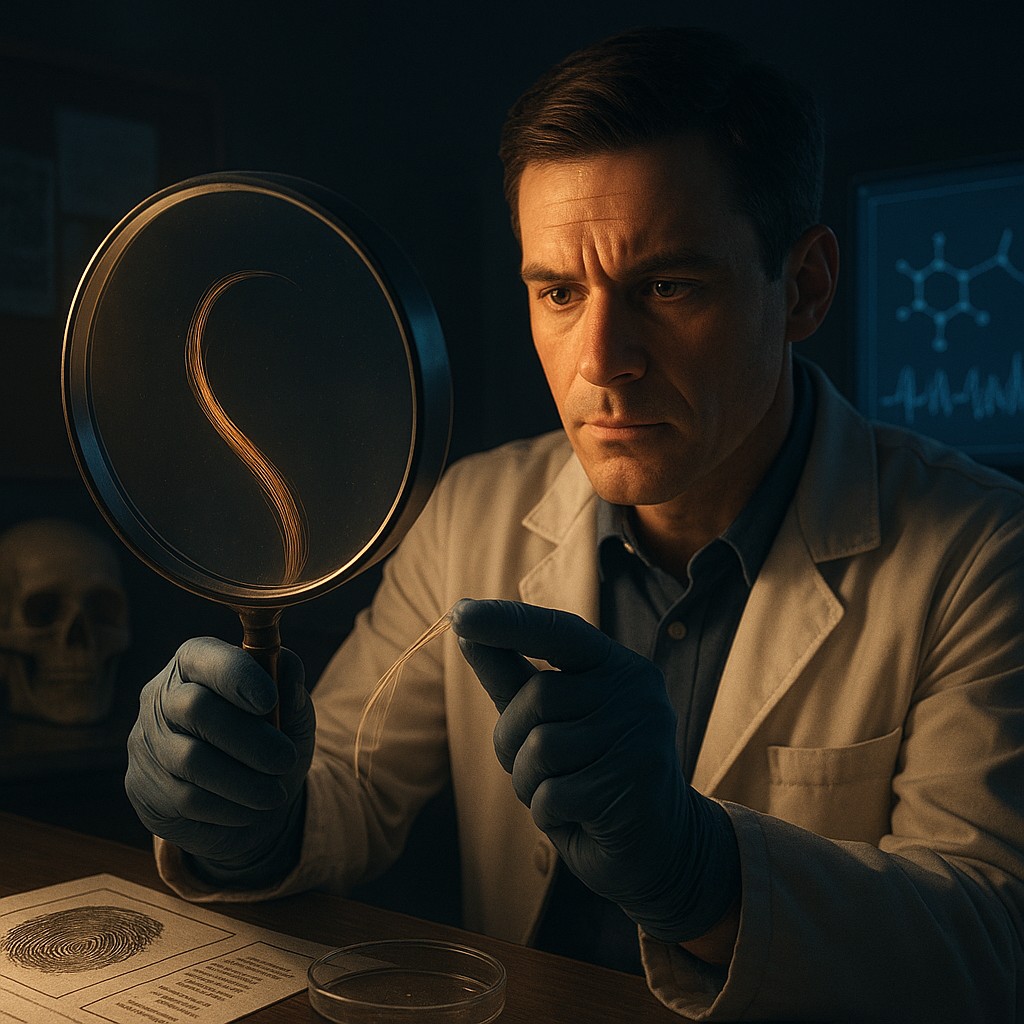
Imagine a cold case investigator staring at unidentified remains. There are no fingerprints on file, the DNA doesn’t match any database, and the labels have been cut out of the clothing. In past decades, this would be a dead end, a file destined for a dusty basement. However, modern forensic science can now turn a single strand of hair into a detailed travel log, revealing exactly where a person spent their final months. It sounds like a plot point from a high-budget spy thriller, but it is actually the result of clever chemistry involving the water we drink and the air we breathe.
Every time you take a sip of tap water, you are unknowingly swallowing a geographic signature unique to your location. This signature is written in isotopes, which are versions of chemical elements that vary in weight. As your body builds new proteins to grow hair, it weaves these isotopes directly into the keratin. Because hair grows at a predictable rate of about one centimeter per month, a long strand acts like a biological tape recorder. By analyzing the chemistry from the root to the tip, scientists can reconstruct a timeline of your movements, essentially turning your body into a geochemical GPS.
The Microscopic Library of the Human Body
To understand how a hair can tell us if someone moved from Seattle to Phoenix, we first have to look at stable isotopes. Most people hear the word "isotope" and think of radioactivity or glowing vats of green goo. However, stable isotopes are perfectly safe and non-radioactive. They are simply variations of elements like hydrogen and oxygen that exist naturally in the environment in different proportions. For example, an oxygen atom usually has eight neutrons, but a small percentage of them have ten. These "heavy" versions of oxygen behave differently during the water cycle, creating predictable patterns across the globe.
When clouds move inland from the ocean, they lose their heavier isotopes first through rainfall. By the time a cloud reaches the center of a continent or climbs a high mountain range, the water it carries is "lighter," meaning it contains fewer heavy isotopes. This creates a continental map of isotope ratios often called an "isoscape." Your body is roughly 60 percent water, and most of that comes from the local supply. When your scalp produces keratin, it locks those specific local hydrogen and oxygen ratios into a permanent, solid form. Once the hair grows, that chemical record is set in stone, or rather, set in protein, protected by the hair’s tough outer layer.
Reading the Chemical Timeline from Root to Tip
The real power of this technique lies in its timing. If a forensic team finds a ten-centimeter strand of hair, they aren't just looking at a single data point. They can slice that hair into tiny segments, just a few millimeters long, and analyze each one. Since the hair at the scalp is the newest and the hair at the tip is the oldest, this process creates a chronological story. If the isotope levels are steady for the first five centimeters but then shift dramatically for the next five, the investigator knows exactly when that person moved from one climate to another.
This method provides "exclusionary data." While it might not point to a specific street address, it can definitively rule out entire states or provinces. If the isotope signature suggests a person was living in a cold, high-altitude environment, but the victim was found in a tropical coastal city, police can narrow their search to regions that match the "cold" signature. It acts as a filter, clearing away the noise of thousands of missing person reports to focus on the few individuals who were actually in the right place at the right time.
| Feature |
Isotopic Analysis |
DNA Profiling |
| Primary Goal |
Travel paths and location history |
Personal identity and family ties |
| Data Source |
Environmental hydrogen and oxygen |
Inherited genetic markers |
| Timeline |
Provides a history of months or years |
Static (never changes) |
| Precision |
Regional (state or climate zone) |
Absolute (specific individual) |
| Dependency |
Relies on local water patterns |
Relies on matches in a database |
Overcoming the Challenges of a Liquid World
While the science is reliable, it does have its complications. One might wonder if drinking imported bottled water or soda would ruin the results. Fortunately for investigators, most people are creatures of habit who get the vast majority of their hydration from local sources, including the water used to cook pasta, brew coffee, or wash vegetables. While a single bottle of imported sparkling water won’t change the results, a permanent move or a long-term habit of drinking only distilled water can occasionally cloud the data. Scientists have to account for these "biochemical offsets" when reading the results.
Another factor is the "humidity effect." In very dry environments, water evaporates through our skin and breath at different rates, which can slightly concentrate certain isotopes. Forensic geochemists use sophisticated math to correct for these bodily factors. They also consider the seasons. Because the chemistry of rain changes between winter and summer, a person staying in the same city for a year will show a slight, rhythmic "wave" in their hair chemistry. This is actually a gift for investigators, as it provides a built-in calendar to verify how fast the hair was growing.
The Framework for Mapping a Location
When a lab receives a sample, they follow a systematic plan to turn raw chemical numbers into a lead. This isn't a simple "X marks the spot" calculation, but a process of elimination and probability involving four major stages.
- Cleaning the Sample: Hair absorbs oils, shampoos, and pollution. The first step involves a deep cleaning with solvents to strip away everything except the internal keratin. Only the isotopes locked inside while the hair was growing are useful.
- Mass Spectrometry: The hair is burned into a gas and sent through a magnetic field that bends the path of the atoms. Heavier isotopes bend less than lighter ones, allowing a machine to count the exact ratio of atoms with incredible precision.
- Mapping the Results: The ratios are compared to global and regional maps of water isotopes. This creates a probability map where the brightest colors represent the most likely locations the person lived.
- Combining Clues: Forensic teams combine these maps with other evidence. If the isotopes suggest the person lived in either Florida or coastal Texas, but the victim is wearing a shirt from a local festival in Galveston, the search area shrinks significantly.
Beyond the Lab and Into the Field
The impact of this technology reaches far beyond crime scenes. It is a vital tool for human rights groups trying to identify migrants who have died in remote border regions. By learning where a person started their journey, authorities can work with international consulates to return their remains to their families. Ecologists also use it to track animal migrations, such as bats or butterflies, which are too small for heavy GPS collars. A single whisker or feather can reveal a journey across entire continents.
There are some common misconceptions about how much hair is needed. People often think you need a thick lock, but modern equipment is so sensitive it can work with just a few milligrams. However, the limitation is the "zoom" of the map. Because isotope signatures are based on weather, two cities with similar climates and distances from the ocean, like Portland and parts of Ireland, might look the same. It is a tool for narrowing things down, not a magic wand for finding a specific house.
As we improve our maps of the world’s chemical fingerprints, the accuracy of this tracking will only get better. We are moving toward a future where our environment is so deeply written into our biology that no one is truly "unidentified." It reminds us that we are not separate from the world we inhabit; we are literally built from the water and air of the places we call home. Every glass of water you drink is a stitch in the fabric of your own history, waiting to tell your story. Even the most mundane parts of your daily routine are leaving a lasting legacy in the very fibers of your being.