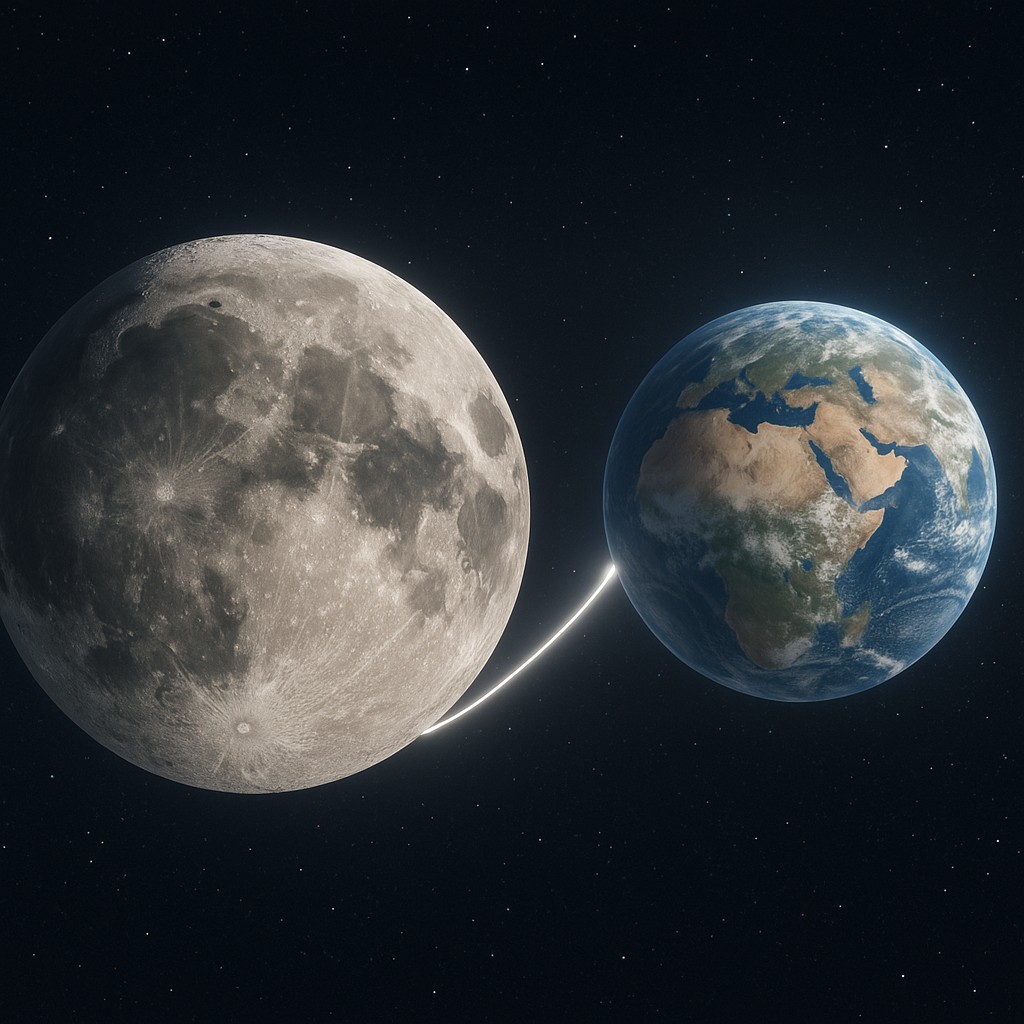
Imagine looking up at the night sky and realizing that for every human being who has ever lived, from ancient cave dwellers to modern astronauts, the Moon has always worn the same face. We see the same craters, the same dark volcanic plains called "maria," and the same patterns that look like a "Man in the Moon." It feels as though the Moon is a frozen sculpture pinned against the velvet black of space, refusing to turn its head. This isn't a coincidence, nor is it because the Moon is standing still. In fact, the Moon is spinning quite rapidly, but it does so with a level of precision that would make a master watchmaker weep with envy.
This celestial standoff is a phenomenon called tidal locking. It is a cosmic dance where gravity acts as both the music and the choreographer, slowly grinding down the wild rotations of heavenly bodies until they are perfectly synchronized with their orbits. While we notice it most with our own lunar companion, this process happens all across the universe. It dictates the fate of moons around Jupiter and could create bizarre, two-faced worlds orbiting distant stars. Understanding tidal locking is like peeking behind the curtain of the universe's mechanics to see how gravity exerts a subtle, persistent torque (a twisting force) on everything it touches, eventually forcing even the most rebellious planets into a state of permanent stillness.
The Invisible Tug of War
To understand how a massive rock like the Moon gets "locked" into place, we first have to look at gravity not as a simple point of light pulling on another, but as a stretching force. Gravity follows a rule where the closer you are to something, the harder it pulls on you. When the Earth pulls on the Moon, it doesn't pull on the whole thing with equal strength. The side of the Moon facing Earth is about 3,474 kilometers closer to us than the far side. Because of this gap, Earth's gravity pulls significantly harder on the "near side" than it does on the "far side."
This difference in pull creates what physicists call tidal forces. These forces literally stretch the Moon into a slightly oval shape, like a football. We call these protrusions "tidal bulges." If the Moon weren't rotating, these bulges would just sit there, pointing toward Earth. However, the Moon is spinning (or at least, it used to spin much faster). As the Moon rotates, its momentum tries to carry those bulges away from the line connecting Earth and the Moon. This creates extreme physical tension. Imagine trying to spin a hula hoop that has a heavy lead weight attached to one side; the weight wants to stay at the bottom, and your efforts to spin it are met with a jerky resistance.
Earth’s gravity acts like a set of brake pads on these moving bulges. Every time the Moon’s rotation tries to move the bulge out of alignment with Earth, our planet’s gravity pulls it back, tugging against the direction of the spin. Over millions of years, this friction-like interaction turned the Moon's rotational energy into heat, slowly draining its speed. Eventually, the rotation slowed down so much that the bulge could no longer "outrun" Earth's pull. The spin speed finally matched the orbital speed, and the bulge became permanently locked, facing us forever.
Debunking the Myth of the Dark Side
Perhaps the most persistent myth in astronomy is the existence of a "dark side" of the Moon. We can thank Pink Floyd for the catchy title, but the science tells a different story. Tidal locking means we see only one side of the Moon, but it does not mean the other side is always hidden in shadow. Just like Earth, the Moon experiences day and night. The only difference is the length of the "lunar day." Because the Moon takes about 27.3 Earth days to rotate once on its axis, any given spot on the Moon spends roughly two weeks in sunlight and two weeks in darkness.
When we see a New Moon in our sky (when the Moon appears totally dark to us), the "far side" is actually bathed in full, glorious sunlight. Conversely, during a Full Moon, the far side is experiencing its lunar night. The term "Far Side" is much more accurate than "Dark Side." In fact, there is a subtle irony here: because the far side is always shielded from the Earth, it is actually the "quietest" place in our local neighborhood for radio astronomy. It is protected from the constant "noise" of Earth’s radio, television, and satellite signals, making it an ideal spot for future telescopes to peer into the deep reaches of the early universe.
The far side also looks remarkably different from the side we see. While our side is covered in large, dark plains of volcanic rock, the far side is rugged, mountainous, and heavily cratered. Scientists believe this is because the crust on the far side is much thicker. When the Moon was young and molten, the Earth was also a blazing hot ball of rock. The side of the Moon facing the Earth stayed hot longer because of the heat radiating from our planet, while the far side cooled faster. This formed a thicker crust that was more resistant to the volcanic eruptions that created the dark plains we see today.
A Universe of Two-Faced Worlds
Tidal locking isn't just a quirk of our local Earth-Moon relationship; it is a fundamental rule for any two bodies orbiting close to one another. In our own solar system, almost all major moons are tidally locked to their parent planets. Jupiter’s moons Io, Europa, Ganymede, and Callisto all show the same face to the gas giant. This creates a chaotic environment for moons like Io, where the intense gravitational squeezing from Jupiter generates so much internal friction that the moon's interior stays molten. This makes it the most volcanically active body in the solar system.
However, the most extreme examples of tidal locking likely exist beyond our solar system. Many of the planets we have discovered orbit very close to small, cool stars called Red Dwarfs. Because these planets are so close to their suns, the tidal forces are incredibly powerful, locking them into a permanent day-night cycle. Imagine a planet where the sun never moves in the sky. On one half of the world, it is forever high noon, with a blistering sun beating down on a permanent desert. On the other half, it is a perpetual, frozen midnight where the stars never move.
Between these two extremes lies a narrow strip of land known as the "terminator line" or the "twilight zone." This is the region where the sun is forever stuck on the horizon, potentially creating a habitable ring of temperate weather between the scorched day-side and the frozen night-side. Weather on these worlds would be unlike anything on Earth. Intense heat from the day-side would cause air to rise and rush toward the cold side, creating constant, planet-wide gale-force winds.
| Feature |
Tidally Locked Planet |
Non-Locked Planet (like Earth) |
| Rotation vs Orbit |
Period of rotation equals period of orbit |
Rotation is independent of orbit |
| Sun Position |
Fixed at one point in the sky |
Moves from East to West |
| Temperature |
Permanent hot and cold hemispheres |
Daily temperature cycles |
| Atmospheric View |
One side never sees the host star |
All sides eventually see the host star |
| Commonality |
Common for moons and close-in planets |
Common for planets far from their star |
The Giant Brake and the Long Goodbye
While the Moon is already locked to the Earth, the process hasn't stopped there. Gravity is a two-way street. Just as the Earth’s gravity slowed the Moon’s rotation, the Moon’s gravity is currently working to slow the Earth. Every time the tides go in and out, the friction of all that water rubbing against the ocean floor acts like a tiny brake on our planet. As a result, Earth's days are getting longer by about 1.7 milliseconds every century. It doesn't sound like much, but back in the time of the dinosaurs, a day was only about 23 hours long.
As the Earth slows down, it loses momentum. Because physics dictates that momentum cannot simply vanish, it has to go somewhere. That energy is transferred to the Moon, which uses it to boost itself into a slightly higher orbit. We are literally pushing the Moon away from us at a rate of about 3.8 centimeters per year. Eventually, billions of years from now, the Earth's rotation would slow down enough to match the Moon’s orbital period. At that point, the Earth would become tidally locked to the Moon.
In this distant future, the Earth and Moon would be like two dancers holding hands, spinning in perfect unison and always facing one another. If you were standing in Africa, the Moon would stay fixed in the sky forever, never rising or setting, while someone in South America would never see the Moon at all. This "mutual locking" already exists in our solar system with Pluto and its moon, Charon. They orbit a common center of gravity like a pair of celestial dumbbells, perpetually staring at one another across the void.
Gravity as the Great Synchronizer
Learning about tidal locking changes the way we see the night sky. It reveals that the "silence" and "stillness" of the Moon are actually the result of a violent, eons-long struggle between momentum and gravity. We are living in a temporary window of time where the Moon is close enough to look large and beautiful, yet far enough that the Earth still spins freely beneath it. Every time you look at the Moon, you are witnessing the aftermath of a massive energy transfer, a cosmic stabilization that has turned a chaotic, spinning rock into a loyal, steady companion.
This concept humbles our understanding of "normalcy." We think of the rising and setting of the sun as a constant, but for many worlds in the galaxy, the sun is a permanent fixture in the sky, and the stars are things the inhabitants may never see. Our 24-hour day and our changing moon phases are just one part of a much larger mechanical process that eventually leads every satellite toward a state of rest. As you go about your day, remember that the very ground beneath your feet is gradually slowing down, and the Moon is taking a tiny, invisible step away from us every year, all thanks to the patient pull of gravity.