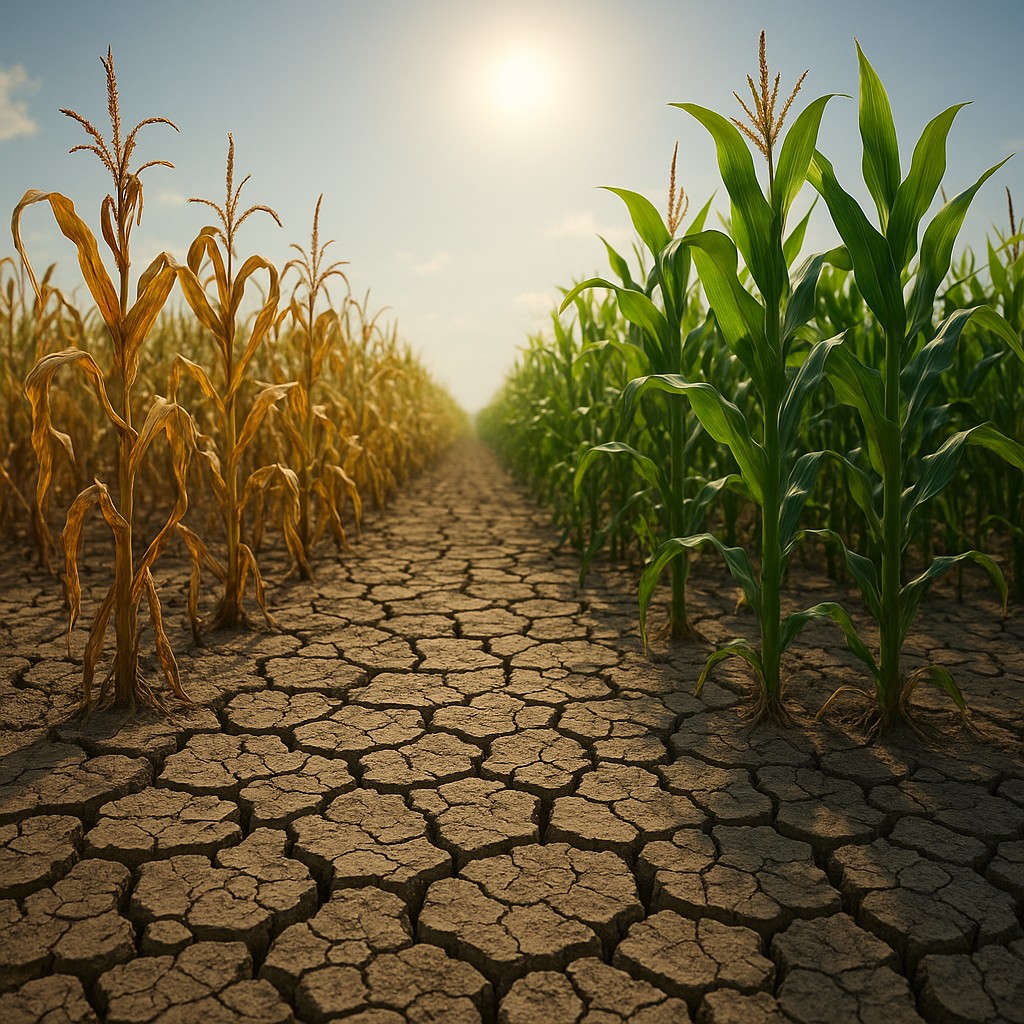
Imagine you are standing in a lush cornfield under a blistering July sun. The temperature is rising, the air is bone-dry, and the soil has cracked into a mosaic of thirsty, gray plates. In a typical field, this is where the tragedy begins. The corn leaves would start to curl like scorched parchment, turning a sickly yellow as the plant enters a desperate defensive crouch. This happens because plants, much like humans, are mostly water. When the environment becomes drier than the plant itself, the laws of physics dictate that water must leave the cells to balance the scales. This loss of internal pressure, known as turgor, is what causes a plant to wilt, effectively ending its ability to grow or produce food.
However, a few rows over, a new experimental variety of corn stands tall and stubbornly green. To the naked eye, it looks defiant, as if it has found a hidden straw reaching deep into the earth. In reality, the "magic" isn't just in the depth of the roots, but in a sophisticated bit of internal chemistry called osmotic adjustment. Agricultural researchers are currently engineering crops to act like tiny, intelligent sponges. By flooding their own cells with specific molecules, these plants create a chemical "vacuum" that pulls water out of the parched ground with more force than the dry soil can pull it away. This silent, microscopic tug-of-war is the front line of a global effort to secure our food supply against an increasingly unpredictable climate.
The Microscopic Physics of a Thirsty Plant
To understand why plants wilt, we first have to understand osmosis. In the natural world, water is a restless traveler that always moves from an area of high concentration (watery and diluted) to an area of low concentration (salty or sugary). For millions of years, this worked in the plant’s favor. The soil was usually wetter than the inside of the plant, so water naturally flowed into the roots. Once inside, that water fills the plant's vacuoles, which are like large, liquid-filled balloons inside every cell. When these balloons are full, they push against the cell walls, creating the "turgor pressure" that allows a soft-stemmed flower to stand upright without a skeleton.
When a drought hits, the script is flipped. The soil becomes so dry and concentrated with minerals that it begins to act like a giant piece of blotting paper. Suddenly, the water inside the plant's cells "sees" a more concentrated environment outside and begins to leak out through the cell membranes. As those internal balloons deflate, the cell walls lose their support and sag. This is more than just a cosmetic issue; it is a physical catastrophe. Without turgor pressure, the plant's stomata (the tiny pores on the leaves) close up to prevent more water from escaping. While this saves water, it also cuts off the intake of carbon dioxide, effectively starving the plant of the raw materials it needs to create energy through photosynthesis.
Engineering the Chemical Counter-Punch
The goal of modern breeding programs is to give plants a way to fight back against this osmotic pull. Instead of letting the water leave, the plant is encouraged to build up "compatible solutes" within its own cells. These are molecules like proline (an amino acid), glycine betaine, and various soluble sugars. Plant biology relies on these specific substances because they are non-toxic even at high concentrations. They don't interfere with the delicate machinery of the cell's enzymes, but they do change the math of the environment. By packing its cells with these solutes, the plant lowers its own "osmotic potential."
Think of it as a financial strategy for water. When the market (the soil) gets tough and starts demanding more "currency" (water), the plant artificially raises its own internal demand. Because the inside of the cell is now "saltier" or "sugarier" than the dry soil outside, the physical laws of osmosis are satisfied, and the water stays put. In fact, if the plant does this well enough, it can actually suck moisture out of soil that would be considered "empty" by traditional crop standards. This allows the plant to keep its pores open, keep its leaves expanded, and continue the vital work of capturing sunlight even when the weather is trying to shut the factory down.
A Comparison of Survival Strategies
Not all plants handle dryness the same way. Before the arrival of specialized osmotic adjustment breeding, plants generally fell into two categories: "avoiders" and "endurers." Avoiders are the sprinters of the botanical world, completing their entire life cycle in a few weeks when rain is plenty and then hunkering down as seeds. Endurers simply shut down and wait for better days. The new wave of osmotically adjusted crops represents a third path: the "proactive maintainer."
| Strategy |
Primary Mechanism |
Pros |
Cons |
| Drought Escape |
Rapid growth and early flowering |
Finishes before the heat hits |
Very low yield; tiny plants |
| Drought Avoidance |
Closing pores; thick waxy leaves |
Conserves every drop of water |
Stops growing; can overheat |
| Osmotic Adjustment |
Accumulating sugars and amino acids |
Maintains growth and photosynthesis |
Costs extra energy to build solutes |
| Deep Rooting |
Massive vertical root structure |
Accesses deep water tables |
Useless if the deep soil is also dry |
While it might seem like accumulating sugars and amino acids is a "free lunch," it actually costs the plant energy to create those molecules. This is where the skill of the agricultural researcher comes in. If a plant spends all its energy making solutes, it won't have enough left to produce large ears of corn or heavy heads of wheat. The trick is to breed varieties that only ramp up this production when they sense the specific chemical signals of an oncoming drought. This "just-in-time" manufacturing ensures that the plant remains efficient during good years while being armored for the bad ones.
The Role of Genetics and Modern Breeding
In the past, breeding for drought resistance was a bit like throwing darts in the dark. Farmers would find the three plants that didn't die during a dry spell and save their seeds. Today, the process is far more surgical. Researchers use "marker-assisted selection" to identify the specific genes responsible for the pathways that create proline or transport sugars. By mapping the genetic code of wild relatives of our food crops, many of which have lived in deserts for millennia, scientists can find the blueprints for high-performance osmotic adjustment and move those traits into high-yield commercial varieties.
There is also a fascinating move toward "phenomics," where researchers use high-tech sensors and drones to measure the "canopy temperature" of different plant varieties. A plant that is successfully performing osmotic adjustment will be cooler than its neighbors because it is still "breathing" (releasing water vapor) through its leaves. This cooling effect is a visible sign of internal success. By combining genetic data with this real-time physical performance, breeders can accelerate the development of climate-ready crops, shortening a process that used to take decades down to just a few years.
Addressing Common Myths About Thirsty Crops
One of the most common misconceptions is that drought-resistant plants simply "need less water." In truth, almost every plant requires a baseline of moisture to grow. A drought-resistant corn plant isn't necessarily a cactus; it is simply a plant that is better at managing its bank account. It doesn't use less water to make a pound of grain; it is just much more aggressive at finding water and much more stubborn about letting its physical structure collapse when water is scarce.
Another myth is that these plants will taste sugary or salty because of the concentrated solutes. While the concentrations of sugars and amino acids are high at a cellular level, they are still microscopic in the context of the entire fruit or grain. Furthermore, many of these solutes are used up or broken down once the drought passes or the plant reaches maturity. The goal isn't to change the flavor of our food, but to ensure that there is food at all. Osmotic adjustment is a survival tool, not a flavoring agent, designed to bridge the gap between thriving and total crop failure.
The Future of Global Food Security
The implications of this research extend far beyond the laboratory. As traditional farming belts shift and rainfall patterns become less predictable, the ability to maintain cell pressure becomes a matter of international stability. In regions where a single failed harvest can lead to famine or mass migration, a crop that can "think" its way through a dry spell is a powerful tool for peace. We are moving toward a future where our food isn't just a passive victim of the weather, but an active participant in its own survival.
As we look toward the horizon, the marriage of chemistry and botany offers a hopeful story. We aren't just waiting for the rain to fall; we are teaching the crops of the future how to find the hidden moisture already beneath their feet. Every time you see a green field standing tall against a shimmering heatwave, remember that there is a complex chemical ballet happening inside every leaf. By mastering the tiny forces of osmotic pressure, we are building a more resilient world, one cell at a time, ensuring that the dinner tables of the future remain full regardless of the clouds above.