Why Isaac Newton still feels like a secret superpower in your life
Imagine standing on a busy street and being asked why apples fall, why planets keep their dance, or why your morning coffee swirls when you stir it. You would be surprised how many of those everyday movements are explained by a single mind that lived more than three centuries ago. Isaac Newton did not just write formulas, he invented a language that lets us predict, build, and understand physical reality in precise ways. That language quietly runs the modern world, from architecture and satellites to smartphones and sports analytics.
Newton’s story matters because it shows how curiosity, stubbornness, and method combine to change what people think is possible. He grew from a curious, stubborn child into a thinker who transformed mathematics, physics, and experimental science. The curiosity that made him notice a falling apple is the same curiosity that made him question accepted ideas about light, motion, and even God. Understanding Newton lets you see how big ideas are born from small observations joined to relentless, careful thinking.
This is not a dry biography stuffed with dates and names. Instead, think of this as a guided tour through Newton’s workshop, where we will open drawers of experiments, inspect blueprints of theories, and try some of his thinking exercises ourselves. Along the way, we will cut through myths, discover what he really did, and pull out practical habits you can use to think more clearly and creatively. By the end, you will be able to explain why a falling apple and an orbiting moon are two faces of the same law, and you will have steps to apply Newton-style thinking in your own life.
If you enjoy stories with math, history, secrets, and a little human drama, you are in the right place. Prepare to meet the person behind the Principia, peek into his notebooks, and borrow methods that helped transform natural philosophy into modern science. The goal is practical clarity, not hero worship - we will admire Newton, but also learn from his mistakes and his routines.
From a country farm to Cambridge - how a restless curiosity became a discipline
Newton’s early life provides a window into how unusual attention to detail develops. He was born on December 25, 1642 in a small farmhouse in Woolsthorpe, England, and his father died before he was born. His mother remarried and left him with his grandmother for several years, which some biographers link to his solitary habits and concentration. He returned to school and eventually to Trinity College, Cambridge, where he found the intellectual tools and the time to translate curiosity into rigorous thought.
At Cambridge, the university was steeped in classical learning but was starting to open to new natural philosophies. Newton immersed himself in mathematics, physics, and natural history, using both the library and the experimental apparatus he could improvise. His approach was not only about theory, but about building models, computing, and experimenting to see how nature behaved. This combination of hands-on curiosity and systematic study set the stage for his later breakthroughs.
When the Great Plague closed Cambridge in 1665, Newton retreated to his family home for more than two years, what he later called his annus mirabilis - his "year of wonders." In that period he developed the foundations of calculus, the laws of motion, and early ideas about gravitation. That time shows a crucial lesson: concentrated, interruption-free effort, paired with play and experimentation, often yields profound creativity.
Newton’s path reminds us that genius is not only inspiration, it is an investment in skills, tools, and solitude. He had talent, but he also devoted long hours to calculation and experiment, which turned flashes of insight into reliable knowledge. If you trace his steps, you can pick practical habits to emulate - deep work, careful notes, and the willingness to test ideas.
How Newton turned motion into mathematics: the big ideas behind the laws
One of Newton’s most famous contributions is his three laws of motion. These laws do not read like poetry, but they convert everyday intuition into precise rules that can be calculated and applied. The first law establishes the idea of inertia - objects keep doing what they are doing unless a force acts on them. The second law gives a quantitative rule - force equals mass multiplied by acceleration, often written as F = ma. The third law rewards us with a symmetrical and surprising insight - for every action there is an equal and opposite reaction.
These laws are powerful because they let us connect forces and motion in a way that predicts outcomes. For engineers designing bridges, for athletes analyzing motion, or for astronauts plotting spacecraft trajectories, Newton’s formulation provides the computational backbone. But Newton did not stop at laws; he unified them with a universal principle of gravity. He proposed that the same force that makes an apple fall also governs the motion of the Moon and planets, and he showed how to calculate orbits using his laws.
This unification is the hallmark of what we now call the Principia, Newton’s masterwork. It turned disparate observations - falling objects, projectiles, tides, and planetary motions - into a single framework. The genius was not merely in creating equations, but in using physical reasoning and geometry to show that the same rule operated at all scales. That insight changed the shape of natural philosophy and set a new standard for explanation.
Calculus: the secret tool Newton invented for motion and change
Newton’s other revolutionary tool was calculus, or the "method of fluxions" as he called it. Calculus provides a language to describe continuous change: rates, slopes, accumulation, and motion. Before calculus, many physical problems were essentially unsolvable because the quantities involved changed smoothly rather than in neat steps. Newton developed techniques to handle infinitesimally small changes and to compute precise answers for motion, areas, and more.
He used calculus to derive trajectories, to understand how velocities change under forces, and to express the mathematics behind the laws of motion. Calculus made it possible to transform geometric problems into algebraic solutions that computers today perform effortlessly. The invention of calculus marks a turning point in mathematics because it offers a toolkit that converts intuitive notions of "how fast" and "how much" into computable formulas.
It is important to remember there was a heated priority dispute with the German mathematician Gottfried Wilhelm Leibniz, who developed his own notation and approach to calculus. The dispute was bitter and affected reputations and careers, but mathematically the world benefited from both strands: Newton’s methods and Leibniz’s notation combined to produce the modern calculus we use today. This episode is a reminder that scientific progress can be messy, with credit and egos complicating clear ideas.
Light, color, and the prism: Newton’s experiments that brightened optics
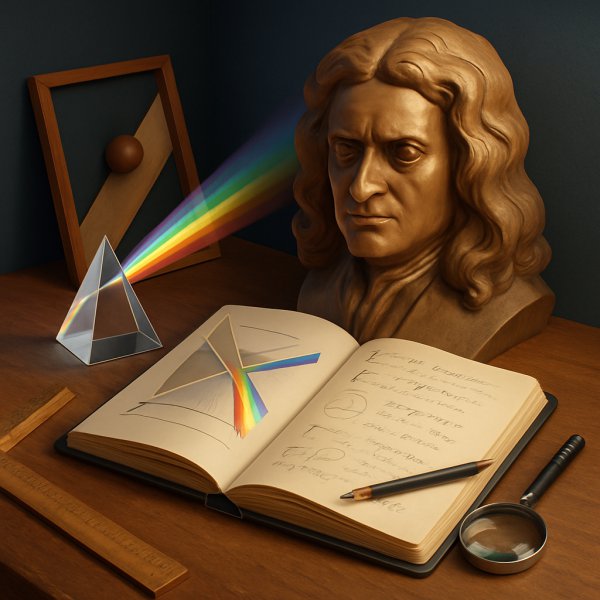
Newton’s experiments with prisms are a delightful example of his experimental mindset. He passed sunlight through a prism and observed that white light splits into a spectrum of colors. He showed that the colors could be recombined into white light, which demonstrated that white light is not pure, but a mixture of spectral colors. This led him to propose a corpuscular theory of light, where light is made of particles, and to develop explanations for reflection and refraction.
His book Opticks is less mathematical than the Principia, but it is full of ingenious experiments and careful reasoning. Newton used lenses, prisms, and carefully controlled setups to test ideas about color and light. He also developed practical tools like reflecting telescopes to reduce chromatic aberration, improving astronomical observation. Opticks illustrates his ability to move between experiment and theory, and to let carefully designed observations shape conclusions.
While later developments favored wave models of light, and eventually quantum theories introduced particle-wave duality, Newton’s optical research laid important foundations: experimental method, precision, and the habit of testing hypotheses against observations. He demonstrated that a good experiment must isolate variables and produce reproducible results, a principle central to modern science.
A table to map Newton’s major works and why they mattered
| Work and date |
Core focus |
Method or style |
Why it changed things |
| Philosophiae Naturalis Principia Mathematica, 1687 |
Laws of motion, universal gravitation |
Geometric reasoning, mathematical proofs |
Unified terrestrial and celestial mechanics, predictive power for orbits and engineering |
| Opticks, 1704 |
Nature of light and color, experiments |
Experimental method, controlled prisms and lenses |
Demonstrated spectrum, advanced experimental science and instrument design |
| Mathematical papers on fluxions (1665-1670s) |
Calculus, rates of change |
Algebraic methods, infinitesimal reasoning |
Provided tools to model change, underpinning physics and engineering |
| Alchemical and theological notebooks (various) |
Chemistry, religion, chronology |
Qualitative experiments, manuscript study |
Revealed Newton’s broader interests and the historical context of scientific thinking |
Newton’s methods: how he thought, experimented, and argued
Newton’s method combined mathematics, experiment, and a relentless focus on clarity. He used reductionism - breaking complex systems into simpler parts - and then recombined them using precise laws. He also valued empirical proof, designing experiments that could confirm or refute hypotheses. When geometry was the common language of rigorous argument, he used it to express relationships, and when algebra made a task simpler, he did not hesitate to employ it.
Another hallmark of his work was the use of thought experiments: imagining scenarios and following the logic to its consequences. This method allowed him to test the coherence of ideas before or in addition to doing physical experiments. He also kept extensive notes and calculations, which helped him check the arithmetic and logic and avoid careless errors. That discipline in documentation is one habit any thinker can replicate.
Newton’s communication was sometimes terse and cryptic, partly because he preferred geometry’s clarity and partly because he liked to preserve intellectual mystery. He was an exacting writer who protected his methods behind rigorous structures, which sometimes made his work harder to penetrate for contemporaries. Nonetheless, his insistence on logical rigor helped formalize the way scientific arguments are made today.
Personality, rivalries, and the human side of the great mind
Newton was not a cheerful social butterfly. He was famously private, stubborn, and sometimes vindictive when his ideas were challenged. The priority dispute with Leibniz left scars, and Newton used his influence to shape scientific opinion in Britain. He could be generous intellectually, but he could also hold grudges and express sharp criticism. This human complexity makes him relatable rather than mythic.
Beyond rivalries, Newton had wide-ranging interests: theology, biblical chronology, and alchemy occupied as much of his private life as physics did his public life. He spent years decoding ancient texts and pursuing chemical experiments that today look eccentric, but these pursuits reflect a mind that sought unity across subject areas. In his later life, he served as Master of the Mint and succeeded in reforming England’s coinage, a public duty that showed his ability to apply precision to administration.
Recognizing Newton as a full, flawed human being helps us take a balanced view. He was brilliant and diligent, but not immune to ego or error. That perspective frees us from naive hero worship, and instead invites us to learn practices and habits that brought his successes.
Myths, mistakes, and what history often gets wrong
The apple story is a mixture of truth and embellishment. Newton himself mentioned an apple incident in later recollections as a moment that triggered a question about gravitational attraction, but he did not claim the apple literally fell on his head and instantly produced the law of universal gravitation. The story has been dramatized into a tidy origin myth, which misses the long, patient mathematics behind his discovery. The reality is more instructive: curiosity plus years of calculation.
Another common misconception is that Newton worked alone in an intellectual vacuum. In truth, he built on prior work by Kepler, Galileo, Descartes, and others, and he engaged in a lively scientific community that included correspondence and debate. The Leibniz feud shows how ideas circulate and get contested; science is communal as well as individual. Finally, Newton’s alchemy and religious writings are often ignored or ridiculed, but they shaped his thought and show how early modern science grew from a broader intellectual milieu.
Recognizing these myths clarifies the real lessons: bold questions, rigorous methods, patient work, and engagement with peers matter more than single dramatic moments. The process matters more than the narrative.
How to borrow Newton’s thinking habits and use them tomorrow
You do not need a telescope or a seventeenth century printing press to think more like Newton. Start with three simple habits that replicate his productive patterns. First, keep a working notebook: record questions, sketches, calculations, and failed attempts. This externalizes thought and makes insights retraceable. Second, cultivate a ritual for deep work - set aside at least one undisturbed block of time each day to focus on a single problem, free from email and distractions.
Third, design simple experiments to test your ideas. If you are learning a new skill, create measurable small tests; if you are solving a problem at work, prototype a low-cost experiment. Complement experiments with simple mathematical estimates - order-of-magnitude calculations reveal whether an idea is plausible before you overinvest. Finally, read widely but critically: combine theory with practice, and be willing to revise your beliefs when evidence demands it.
A practical mini-course to try this week: pick a real-world question - for example, why a bicycle feels harder to pedal up a hill. Spend thirty minutes making a list of factors, forty-five minutes designing a simple experiment or measurement you can do, and one hour writing calculations or sketches that model the problem. At the end, write a short summary of what you learned and what you would test next. That microcycle mimics Newton’s loop of curiosity, measurement, math, and revision.
Reflection questions to make this personal and active
- What everyday phenomenon do you think about often, and how could you reframe it as a testable question?
- When was the last time you kept a detailed notebook of your thinking, and what might you discover if you did that for a month?
- Which of Newton’s methods - deep work, experiment, mathematical modeling, or thought experiments - do you find most accessible to start practicing?
- How does understanding Newton’s human flaws change the way you admire scientific achievement?
- Can you identify a current "long-standing" belief in your field that might benefit from a Principia-style unification?
Spend time writing brief answers to two of these questions. The act of answering will convert passive reading into engaged practice.
Quick exercises to practice Newton-style thinking
- Observation exercise: Spend twenty minutes watching a simple physical system - for example, a pendulum, a dripping faucet, or traffic at an intersection - and write down everything that seems regular, irregular, or surprising. Formulate one testable hypothesis.
- Quantify exercise: Choose a household object and estimate its parameters - mass, speed, energy cost to move it a meter. Use rough arithmetic and compare to actual measurements. This builds intuition for order-of-magnitude thinking.
- Small experiment: Build a simple pendulum using string and a weight, vary the length, and record the period. Use your measurements to see the relationship between length and period, practicing measurement and plotting skills.
These small projects help you internalize the link between observation, measurement, and mathematical expression that Newton mastered.
Why Newton’s legacy still matters, and how to carry it forward
Newton gave us tools and habits that turned confusion into calculation, and wonder into disciplined inquiry. His laws and calculus laid foundations that enabled engineers, explorers, and scientists to build a modern world. But more than formulas, he left a model for how to combine curiosity with discipline, experiment with theory, and persist through painstaking calculation. Adopting his habits does not guarantee genius, but it raises the odds for clear thinking and original results.
Approach problems like Newton by asking precise questions, doing careful measurement, using simple math to test plausibility, and keeping a long-form notebook of progress and mistakes. Treat curiosity as a muscle that needs practice, solitude, and occasional collaboration. Remember that great advances often come from connecting two previously unlinked ideas, so cultivate both breadth and depth.
Newton was an imperfect human who changed everything. Learning from him is less about imitation and more about integration - take his best habits, discard what does not serve you, and apply his rigorous curiosity to the questions you care about. If you practice that, you will find that the world starts to make more sense, and you will feel a little closer to the delicious thrill of discovery.
A short, inspiring close to get you started
Think of Newton’s life as a recipe rather than a myth - the ingredients are curiosity, careful work, experiments, and a dash of stubbornness. You can start with small experiments and a simple notebook, and build upward from there. The next time you notice something odd - a streak of color, a strange motion, or a practical problem that keeps nagging you - pause, record it, sketch a simple model, and test one small prediction. That practice will make you smarter, more creative, and quietly revolutionary in your own projects. After all, big changes often begin with the courage to ask questions and the discipline to follow them to the end.