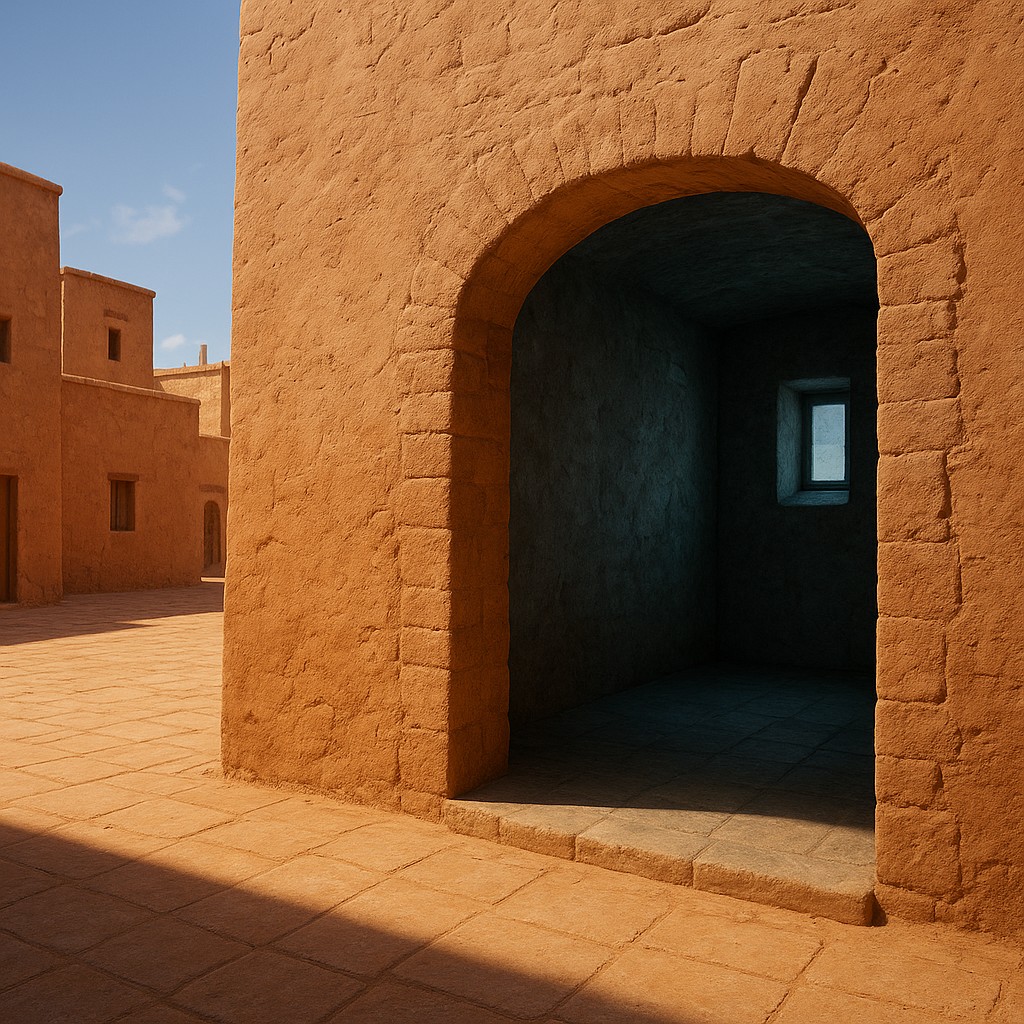
Imagine standing in the middle of a sun-scorched plaza in a desert city like Marrakech or Santa Fe. The air is so dry it feels like it might crack, and the sun beats down with an intensity that softens the asphalt under your shoes. You step through a doorway into an old building made of thick adobe or heavy stone, and suddenly, the world changes. It is not just the shade that greets you, but a deep, distinct chill, like walking into a mountain cave. There are no humming air conditioners or whirring fans nearby, yet the interior feels twenty degrees cooler than the street.
This phenomenon is not magic, though it feels like it when your skin finally stops sizzling. It is the result of a physical property called thermal mass, a concept humans mastered long before we knew how to harness electricity or compress refrigerant gases. By using exceptionally heavy and dense materials, ancient builders turned their walls into a sophisticated climate control system. These buildings do not just block the sun; they engage in a slow-motion tug-of-war with the environment, capturing heat during the day and holding onto it with a stubborn grip that keeps the interior calm and stable.
The Architectural Battery
To understand why a heavy stone wall behaves differently than a thin wooden one, we have to look at it as a form of energy storage rather than just a boundary. Most modern houses are built with lightweight materials like timber, drywall, and fiberglass insulation. These materials are excellent at stopping heat from moving through them quickly, but they cannot actually hold much heat themselves. They are like a thin windbreaker jacket: they keep the breeze out, but they do not stay warm once you take them off. In contrast, massive materials like stone, brick, concrete, and earth act like a giant battery for heat.
When the sun hits a thick adobe wall, the outer surface begins to heat up immediately. However, because the wall is so dense and heavy, the heat cannot just zip through to the other side. Instead, the wall begins to absorb that energy, molecule by molecule. It takes a tremendous amount of energy to raise the temperature of a ton of stone by even a single degree. Consequently, the wall acts as a heat sink, pulling the warmth away from the air and storing it deep within its own structure. While the outside of the wall might be hot enough to bake a tray of cookies, the inside remains cool because the heat is still busy "charging" the middle of the stone.
Calculating the Kinetic Delay
The most fascinating aspect of this process is the "phase shift." In physics and engineering, a phase shift is the delay between a peak in an outside condition and the peak of its internal effect. If you have a thin metal shed, the phase shift is almost zero; as soon as the sun comes out, the inside gets hot. But with a thick masonry wall, that delay can be eight, ten, or even twelve hours long. This delay is the secret to desert architecture. The goal is to time the "arrival" of the heat so that it reaches the living space exactly when you actually want it.
Think about the cycle of a typical desert day. It is blistering at noon and freezing at midnight. By building a wall with a twelve-hour phase shift, you are essentially delaying the noon heat until it is midnight. By the time the warmth finally crawls all the way through the stone and radiates into the room, the sun has gone down and the desert air has turned chilly. The wall, which spent all day soaking up sun, now acts like a giant radiator, keeping the residents warm through the night. By morning, the wall has finally finished releasing its heat and is cool once again, ready to start the cycle over by soaking up the new day's sun.
Choosing the Right Geological Tools
Not every material is suited for this type of thermal alchemy. To be effective, a material needs a high volumetric heat capacity, which is just a technical way of saying it needs to be both dense and good at holding onto warmth. Wood is actually decent at holding heat per pound, but because trees are relatively light compared to rocks, a wooden wall simply does not have enough heft to do the job. You would need a wooden wall several feet thick to match the performance of a much thinner stone one. This is why tradition and physics have made certain materials the gold standard for natural cooling.
| Material Type |
Density (kg/m³) |
Thermal Performance Role |
Best Use Case |
| Adobe / Earth |
1,500 - 1,700 |
High mass, slow transfer |
Hot, dry climates with cold nights |
| Granite / Stone |
2,600 - 2,800 |
Very high mass, slow transfer |
Large monuments, public squares |
| Concrete |
2,200 - 2,400 |
High mass, predictable |
Modern city heat management |
| Timber |
400 - 700 |
Low mass, high insulation |
Mild climates needing quick heat |
| Glass |
2,500 |
High mass but transparent |
Greenhouses and solar collectors |
While stone and concrete are champions of density, the speed of heat transfer, known as thermal diffusivity, also matters. If a material is too conductive, like certain metals, the heat moves through too fast regardless of the weight. The brilliance of adobe and thick brick is that they hit a "Goldilocks zone" where they are dense enough to store energy but resistant enough to ensure the heat moves through at a snail's pace. It is this specific combination of storage and resistance that creates the comfortable indoor climates of the Mediterranean and the American Southwest.
Surviving the Urban Heat Island
Understanding thermal mass is not just an exercise for history buffs. It is a vital framework for solving modern urban problems. You might have noticed that cities often stay much hotter at night than the surrounding countryside. This is known as the Urban Heat Island effect. It happens because we have paved our world in concrete and asphalt, both of which are high-mass materials. During the day, our roads and skyscrapers soak up massive amounts of solar energy. At night, instead of cooling down quickly like a grassy field, the city begins to "bleed" that stored heat back into the atmosphere.
This creates a self-sustaining loop in the summer. We use massive amounts of electricity to pump heat out of our buildings with air conditioners, which dumps even more heat into the streets, while the concrete is already radiating the previous day's sunshine back at us. Modern architects are now trying to hack this system by using thermal mass more strategically. By using lighter colors to reflect the sun or using "night purging," where cool night air is circulated through a building to pre-chill the concrete slabs, we can use physics to our advantage rather than fighting against it.
Correcting the Insulation Misconception
A common mistake is to treat thermal mass and insulation as the same thing, but they actually behave in opposite ways. Insulation, like the pink fluffy material in an attic, works by trapping tiny pockets of air to stop heat from moving. It is light, airy, and has almost no mass. Thermal mass, as we have seen, works by being heavy and soaking heat up. If you live in a climate that is always hot, like the tropics, thermal mass can actually be your enemy. If the night air never gets cool enough to "reset" the wall, the stone will eventually just get hot and stay hot, turning your house into a permanent oven.
This is why traditional tropical houses are often made of lightweight bamboo or wood with plenty of gaps for breezes. They do not want to store heat at all; they want to let it pass through as quickly as possible. Thermal mass only works as a cooling system when there is a significant "diurnal swing," which is the difference between the high temperature of the day and the low temperature of the night. In the desert, where it might be 100 degrees at noon and 50 degrees at midnight, thermal mass is the ultimate technology. It acts as a bridge, leveling out the extremes of the environment into a steady, manageable baseline.
The Art of Natural Resonance
When you look at a building through the lens of thermal mass, you stop seeing it as a static box and start seeing it as a living participant in the local weather. There is something deeply satisfying about the idea that we can achieve comfort simply by choosing the right materials and the right wall thickness. It requires us to pay attention to the rhythms of the sun and the specific personality of the local soil. It is a form of design that respects the laws of physics rather than trying to overpower them with expensive machinery and endless fuel.
As we move toward a future where energy efficiency is no longer optional, looking back at these "heavy" solutions provides a roadmap for a more resilient world. We can build structures that are naturally intelligent, using the weight of the earth to keep us cool. By embracing the slow, steady hum of thermal mass, we can rediscover the quiet dignity of buildings that do not just shield us from the world, but harmonize with it. The next time you walk past a thick stone wall on a hot day, reach out and touch it. That coolness you feel is the physical evidence of a twelve-hour delay, a gift from the physics of density to the comfort of humanity.