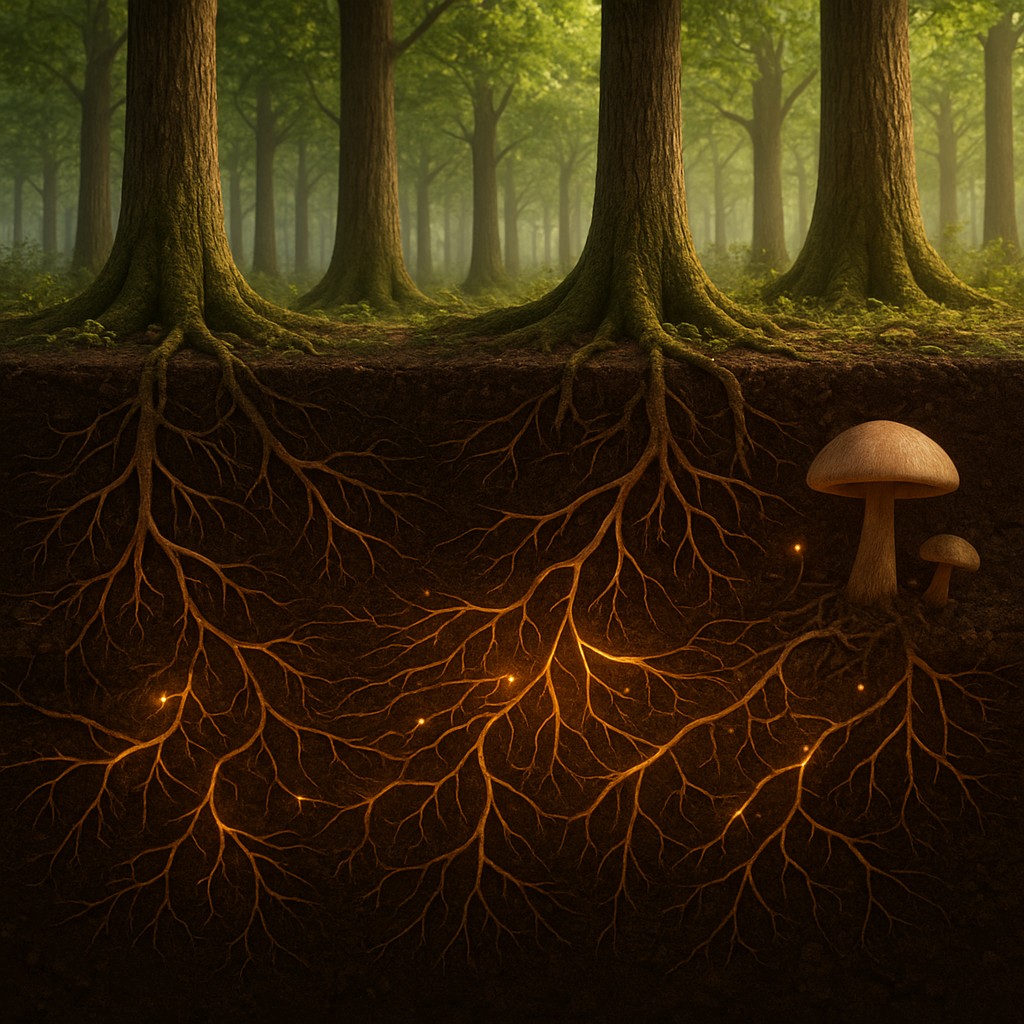
When you stand in the middle of an ancient forest, the scene usually strikes you as a quiet, stoic arrangement of independent monarchs. Each tree ascends toward the canopy, seemingly engaged in a solitary, slow-motion race to hoard the golden rays of the sun. We are conditioned to view the natural world through a lens of "survival of the fittest," where every living thing is a rival elbowing its way through the undergrowth for a slightly better patch of dirt or a sliver more light. This view, while poetic, turns out to be remarkably incomplete. It misses the hyper-connected, bustling metropolis unfolding just inches beneath your hiking boots.
There is a hidden, subterranean infrastructure operating with the complexity of a modern financial market, where silent negotiations and high-stakes resource trades occur by the second. This is the realm of the wood wide web, a sprawling, cross-kingdom enterprise involving trees, fungi, and bacteria. Instead of a lonely struggle, the forest operates as a collaborative, albeit strictly transactional, network. By peering into this fungal interface, we shift our perspective from the myth of the rugged individual to the reality of an interconnected system, revealing that even the mightiest oak is part of a complex, interdependent economy.
The Mycorrhizal Mechanism of Trade
At the heart of this subterranean network are mycorrhizae, the symbiotic associations - or mutually beneficial partnerships - between plant roots and specialized fungi. To picture this, imagine an inverted world where the root system of a tree is not just a structural anchor, but a massive biological trading floor. The fungi involved, known as mycorrhizal fungi, extend tiny, hair-like threads called hyphae into the soil, reaching spaces that are far too narrow for plant roots to navigate. Because these threads are incredibly thin and dense, they provide a massive surface area. This makes them world-class scavengers for minerals like phosphorus and nitrogen, which are usually locked away in the soil in forms that plants cannot easily absorb.
The deal is elegant in its simplicity, even if the biology is dizzyingly complex. The trees are masters of photosynthesis, effectively mining sunlight to produce liquid carbon in the form of sugars. The fungi, meanwhile, are masters of soil chemistry. The trees trade a portion of their precious sugar reserves to the fungi in exchange for the minerals they have painstakingly scavenged. Neither party is doing this out of the goodness of their hearts, as this is a strictly governed market. If a tree does not provide enough carbon, or if a fungus fails to deliver minerals, the connection can be pruned or deprioritized, ensuring that only the most efficient partnerships thrive.
Dispelling the Myth of Woodland Altruism
In recent years, popular science has often anthropomorphized these networks, painting the forest as a grandmotherly web where older trees intentionally sacrifice their own well-being to coddle younger saplings. It is a lovely image, but it is important to temper our romanticism with scientific scrutiny. While it is true that nutrients can move from one tree to another through these fungal conduits, characterizing it as purely selfless help is misleading. We must remember that nature is rarely driven by altruism in the human sense, but rather by stable evolutionary strategies that benefit the system as a whole.
When a large tree helps a seedling, it is often a matter of maintaining the stability of the grove, which in turn preserves the fungal life support system the parent tree depends on. A nursery of healthy younger trees ensures the long-term viability of the site, preventing local collapses that would be catastrophic for everyone involved, including the fungi. Think of it less as charity and more as a long-term capital investment. By keeping the younger generation alive, the dominant tree is effectively insuring its own future by diversifying the biological population of its patch. It is a strategic move, not a sentimental one. Understanding this distinction allows us to appreciate the sophistication of the forest without falling into the trap of projecting human emotions onto botanical processes.
The Economic Structure of the Subterranean Market
To better visualize how these subterranean transactions differ from our typical view of forest life, we can categorize the participants and their primary contributions to the economy. This exchange is not localized to just two species but exists as a multidimensional web involving several types of fungi and various types of plants.
| Participant |
Primary Contribution |
Benefit Received |
| Mature Trees |
Excess carbon (sugars) via photosynthesis |
Mineral access and soil moisture |
| Mycorrhizal Fungi |
Phosphorus, nitrogen, and water |
Essential carbon for metabolic growth |
| Seedlings |
Information signals and connectivity |
Early access to established fungal networks |
| Soil Bacteria |
Breakdown of organic matter into nutrients |
Access to root exudates and stable habitats |
This table illustrates the hierarchy of the exchange. The mature trees act as the primary carbon producers, effectively serving as the venture capitalists of the ecosystem. The fungi act as the logistics and procurement specialists, moving goods where they are needed. The seedlings are the startups, relying on the infrastructure built by their predecessors to gain a foothold on the competitive nursery floor. It is a highly fluid and complex system that constantly adjusts based on local humidity, soil composition, and the health of the individual trees involved.
Navigating the Nuance of Ecosystem Connectivity
One common misconception is the idea that these fungal networks create a singular, unified super-organism that behaves with a collective consciousness. While the connectivity is undeniable, we must remain cautious about over-interpreting the scope of these interactions. Scientific evidence suggests that these networks are incredibly patchy and dynamic; they shift, break, and reform in response to changing environmental stressors. They are not a static internet that covers the globe in a predictable way, but rather a series of local, opportunistic pathways that exist only as long as they offer a clear competitive advantage to the individuals involved.
Furthermore, we must be careful not to ignore the competition that still exists within this structure. Even while trees trade nutrients, they are simultaneously competing for light and space in ways that are entirely antagonistic. A tree might provide carbon to a common fungal network while, at the same time, using its canopy to shade out a neighbor to prevent it from photosynthesizing. The secret success of the forest lies in this paradox, where competition and cooperation exist side by side, perfectly balanced by the reality that living in a crowded, resource-stressed environment necessitates shared infrastructure.
The Lessons for Our Own Infrastructure
As we study these fungal networks, we uncover a profound blueprint for resilience. Trees have evolved to sustain their own lives through the sustenance of their neighbors, recognizing that their health is inextricably linked to the prosperity of the territory they inhabit. This decentralized model, where the strength of the whole provides a buffer for the individual, is a model that we often overlook in our desire for singular, top-down systems. We spend much of our intellectual energy designing rigid machines that fail at the first sign of stress, while the forest has spent millions of years perfecting a modular design that thrives on fluid, decentralized resource distribution.
You can carry this lesson into your own perspective of the wider world. Whether viewing a business, a neighborhood, or your own local park, start looking for the connections that stay invisible. Ask yourself how seemingly independent agents are actually locked in a hidden trade of resources that keeps the entire system from tipping into ruin. By recognizing these subterranean architectures, you stop seeing the world as a dry, binary list of individual entities and begin to see it as a vibrant, breathing web of mutual reliance. You are not just looking at a collection of trees standing in the dirt; you are witnessing a sophisticated, ancient, and highly efficient marketplace that has survived precisely because it understands that there is no such thing as truly going it alone.