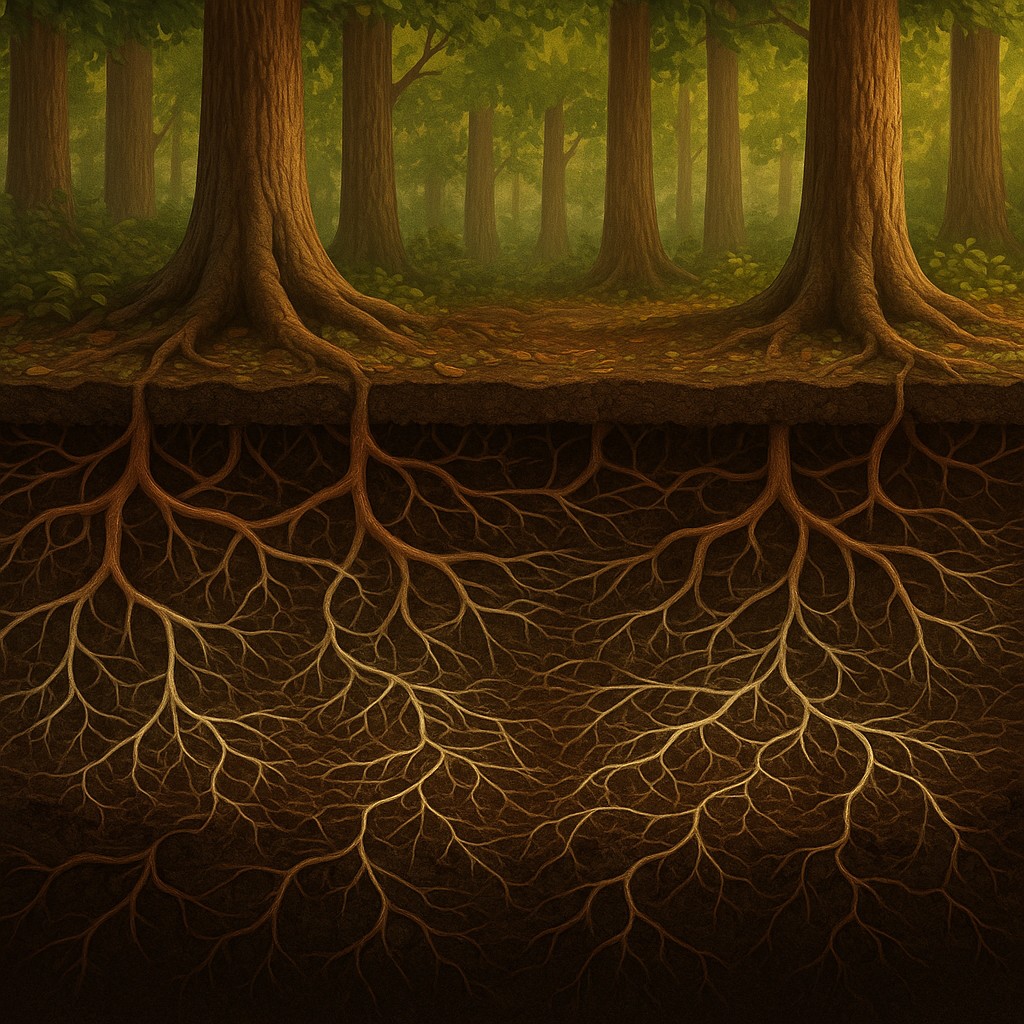
When you walk through a lush, silent forest, it is easy to assume you are witnessing a collection of solitary giants, each competing fiercely for sunlight and moisture. We tend to view a forest like a crowded bus stop, where every passenger focuses on their own comfort and ignores the stranger standing next to them. However, looking at the forest floor with the naked eye is like trying to understand the internet by looking at a telephone pole. You see the hardware, but you completely miss the massive, frantic exchange of data happening just beneath your boots.
Beneath that layer of leaf litter and topsoil lies a sprawling, underground superhighway that turns the forest into a singular, integrated, and surprisingly social entity. This is the world of mycorrhizal networks, a partnership between trees and fungi that has evolved over hundreds of millions of years. This network changes everything we thought we knew about plant behavior. It suggests that trees are not merely static statues in the landscape, but active participants in an ancient, underground economy that prioritizes the long-term survival of the group over the isolated goals of the individual.
The Architecture of the Subterranean Social Club
To understand how trees talk, you first have to understand the primary contractor: the mycorrhizal fungi. These fungi are not parasites in the traditional sense, nor are they freeloaders. Instead, they are the essential infrastructure engineers of the botanical world. They extend their microscopic, hair-like threads, known as hyphae, deep into the soil and coil them around the roots of trees. This creates a high-surface-area interface, where the fungi provide the tree with hard-to-access minerals like phosphorus and nitrogen, which the fungi scavenge from the soil with ease.
In return, the trees - which are essentially solar-powered carbon factories - pass a portion of their sugary, photosynthesized bounty back to the fungi. It is a mutually beneficial trade that fuels both parties. However, the true genius of this arrangement is that these fungal threads do not stop at one tree. They connect one root system to another, bridging the gaps between individuals. When you see a grove of trees, you are essentially looking at a local area network where the fungi act as fiber-optic lines, physically linking the trees together into a massive, interconnected grid that spans miles.
The Economy of Resources and Nutrient Redistribution
One of the most fascinating aspects of these networks is how they handle the inequity of the forest environment. Consider a sturdy, established "hub" tree standing in the center of the forest. Because of its height, it has full access to the sun, allowing it to produce far more sugar than it could ever hope to consume. Meanwhile, a few yards away, a tiny sapling struggles to survive in the deep, dark shade of the canopy, receiving barely enough sunlight to maintain its own metabolic functions. Without help, many of these saplings would simply wither and die.
Through the underground network, the hub tree can intentionally - or at least effectively - export its excess carbon toward these struggling youngsters. By pumping sugars through the fungal highways, the established trees acting as donors help keep the next generation alive during their most vulnerable years. This is not just charity. It is a calculated, evolutionary strategy to maintain a stable, dense forest. By investing in the growth of younger trees, the older forest members ensure the long-term viability of their own species and the continued stability of the local microclimate, which in turn protects the network that sustains them both.
Chemical Alarms and the Forest Defense System
Perhaps the most dramatic function of this network is its role in forest-wide security. If a tree is attacked by a swarm of beetles, aphids, or a fast-moving pathogen, it does not just stand there and take it. It initiates a complex chemical response, producing defensive compounds designed to make its leaves less palatable or outright toxic to the invaders. But the tree can also send a signal through the fungal network to its neighbors, acting as a warning beacon.
When the neighboring trees receive these chemical alerts, they do not wait for the beetles to reach them. Instead, they begin priming their own defense mechanisms in advance, expressing resistance genes and producing chemical repellents before they see a single intruder. This is essentially an early-warning system. By the time the insects move from one tree to the next, they are met with a hostile environment that is already prepared for their arrival. This collective defense drastically lowers the overall damage to the forest, turning what would have been a catastrophic outbreak into a mild, manageable inconvenience.
Clearing Up Common Misconceptions
While the idea of an intelligent, conscious "Wood Wide Web" makes for a compelling story, we must be careful not to mistake biological complexity for human-like intention. A common misconception is that trees are altruistically thinking, feeling beings that decide who gets a snack and who gets a warning. In reality, these processes are likely governed by gradients, chemical concentrations, and evolutionary hardwiring. A tree does not necessarily "choose" to share its sugar. It simply functions within a system where sugar moves from areas of high concentration to areas of lower concentration, often mediated by the fungi themselves.
Another point of contention is the level of "cooperation" occurring. Some critics argue that the term "cooperative" is an overreach and that the networks are more often sites of competition. In these cases, trees might even use the network to sabotage their neighbors by sending toxins or growth-blocking substances. The truth is likely a nuanced combination of both, a messy reality where altruism and selfishness happen simultaneously, depending on the species involved, the environmental stress levels, and the specific fungal partners. We are looking at a system of incentives rather than a system of ethics.
| Feature of the Network |
Biological Reality |
Human Analogy |
| Data Exchange |
Chemical signals and hormones transmitted through fungal hyphae. |
A decentralized, fiber-optic internet connection. |
| Resource Shifting |
Movement of carbon, water, and minerals via osmotic pressure. |
An automated, balanced power grid. |
| Warning Signals |
Defensive compounds triggered by herbivore stress. |
A neighborhood watch alarm system. |
| Fungal Role |
Symbiotic exchange of nutrients for carbohydrates. |
The utility company providing the infrastructure. |
The Complexity of Shared Existence
It is also important to note that these networks are not universal. Different forest ecosystems rely on different types of fungal relationships. Some trees use "arbuscular mycorrhizas," which are generally shorter-lived and more localized, while others rely on "ectomycorrhizas," which tend to form the larger, more robust networks that we see in temperate and boreal forests. The strength, range, and efficiency of these networks vary wildly depending on the soil chemistry, the tree species involved, and the climate.
Moreover, the scientific community is still in the process of mapping these systems. While there is solid evidence for the exchange of nitrogen, carbon, and alarm signals in controlled laboratory settings, showing exactly how much of this matters at a landscape scale in a wild forest is much harder. Many of the most famous examples of tree-to-tree interaction come from controlled experiments with a limited set of variables. Predicting the behavior of a living, breathing forest with thousands of interacting species, while keeping track of millions of fungal threads, remains one of the great frontiers of modern ecology.
Seeing the Woods for the Network
When we stop viewing trees as competing individuals and start viewing them as nodes in a greater biological architecture, the entire forest becomes a much more dynamic, resilient place. We begin to see the landscape as a tapestry of hidden connections where every leaf and root is part of a larger conversation. This perspective shift changes how we think about conservation. Saving a single tree is no longer enough if the fungal network supporting it is disrupted by urbanization, heavy tilling, or chemical overuse.
To protect a forest, you must protect the invisible infrastructure beneath it. The resilience of the woods is not found in the strength of just one mahogany or pine, but in the strength of the connections between them. The next time you find yourself wandering beneath the canopy, take a moment to consider the silent, frantic, and incredibly complex hum of data moving beneath your feet. You are walking over a masterpiece of evolutionary cooperation, a system that has been fine-tuning its resource management and defense strategies long before human civilization ever scratched the surface of the earth.
Ultimately, the lesson of the mycorrhizal network is one of radical interconnectedness. It reminds us that survival is rarely a solo act, even in the harshest environments. Whether through the sharing of excess sugar or the transmission of vital warnings, the most successful organisms in the natural world are those that weave themselves into the fabric of their neighbors. By understanding this, we gain a deeper respect for the hidden labor that sustains all life, encouraging us to look closer at the world around us and realize that nothing in nature truly exists in isolation.