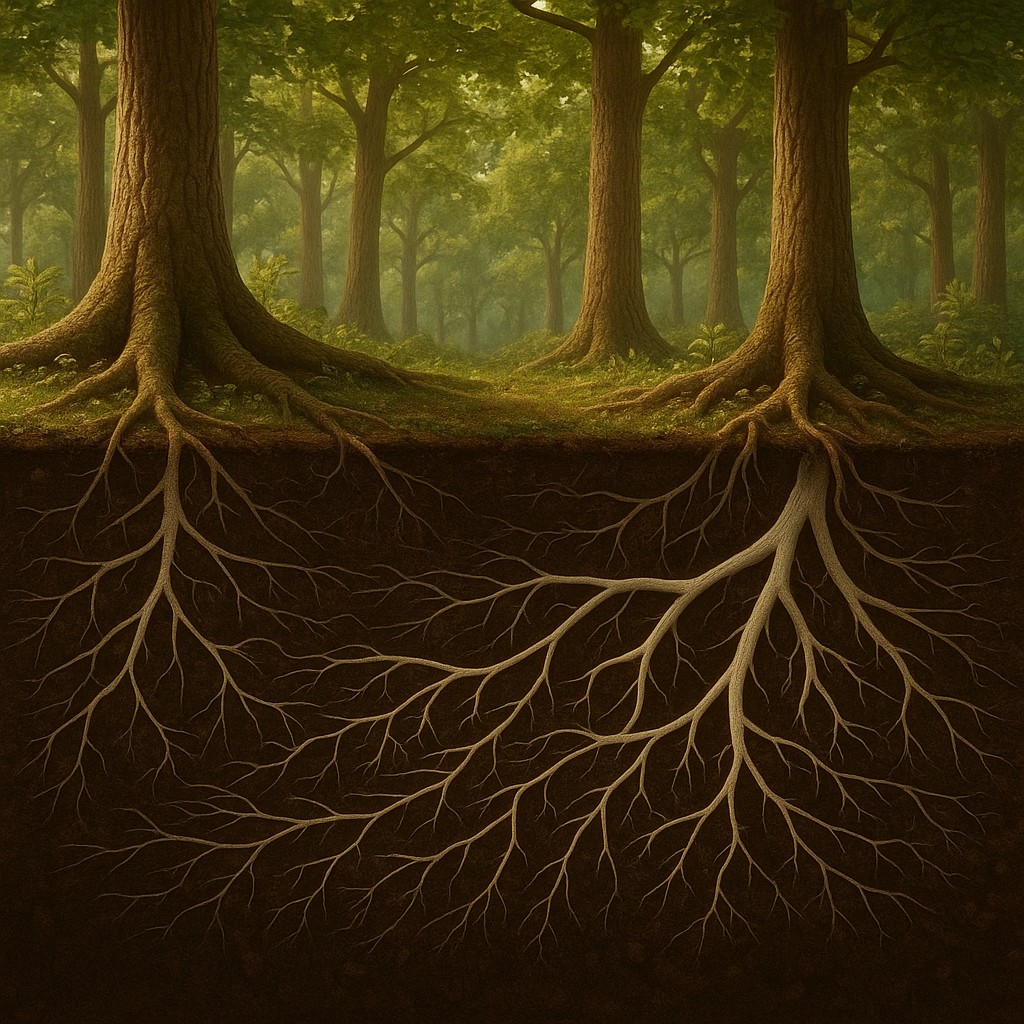
If you walk through an ancient woodland, you will likely find yourself looking up, mesmerized by the vaulted ceiling of branches and the competitive scramble for a patch of sky. For centuries, we have been taught that the forest is a battlefield - a slow-motion survival contest where every oak and maple fights to overshadow its neighbor. In this traditional view, the winners are those that hoard the most sunlight and water, while the losers wither away in the shadows. It is a story of rugged individualism, a biological “survival of the fittest” where the tall prosper and the small perish.
However, if you could peel back the top layer of soil and see through the dirt, you would discover that this cutthroat competition is only half the story. Beneath the moss and leaf litter lies a massive, intricate, and surprisingly social infrastructure that links the giant with the sapling. It is a biological internet made of fungal threads, and it turns the forest from a collection of rivals into a single, cooperative organism. Here, the struggle for life is managed by an underground welfare system that ensures the survival of the group, proving that in the natural world, the best way to thrive is often to share.
The Invisible Fabric of the Forest Floor
To understand how trees talk to each other, we first have to meet the middleman: mycelium. Mycelium consists of thousands of tiny, thread-like strands called hyphae that belong to various species of fungi. These threads are incredibly thin, often just a single cell wide, but they are so dense that a single teaspoon of forest soil can contain miles of them. These fungi aren't the enemy of the tree. Instead, they form a mutually beneficial relationship called a mycorrhiza. The name literally translates to “fungus-root,” and it represents one of the oldest and most successful partnerships in the history of life on Earth.
When a fungal spore meets a tree root, they don't fight; they negotiate. The fungus cannot perform photosynthesis, meaning it cannot create its own sugar from sunlight. The tree, meanwhile, is a sugar-producing factory but often struggles to find enough minerals like phosphorus and nitrogen in the soil. Under the ground, they strike a deal. The fungus weaves itself into or around the tree’s root cells, effectively extending the tree’s reach a thousand times over. In return for the sugars the tree pumps down from its leaves, the fungus scans the soil at a microscopic level, harvesting nutrients and water to send back up to its host.
This partnership is not a closed loop between one tree and one fungus. Because a single fungal network can attach itself to many trees of different species, it creates a bridge between them. This bridge is the foundation of what scientists often call the “Wood Wide Web.” Through these connections, trees do something truly radical: they swap resources. If a Douglas fir has plenty of carbon while a nearby birch is struggling in the shade, the fungal network acts as a straw, shifting the surplus from the “have” to the “have-not.”
A Biological Social Welfare System
The existence of this network flips our understanding of forest dynamics upside down. In a purely competitive model, a large “Mother Tree” should want to hoard all the resources to ensure its own offspring eventually take over. But studies using traceable isotopes have shown that these massive, older trees actually use the fungal network to serve as the hubs of the forest. They are connected to hundreds of other trees and actively recognize their own relatives, pumping extra sugar and nutrients toward their own saplings to help them survive the lean years in the deep shade of the canopy.
This isn't just about family, though. The network encourages cooperation between different species that benefits the entire ecosystem. Consider a forest during a change of seasons. In the summer, leafy trees like birches are covered in foliage and full of sugar, while evergreens like firs might be less active. In the winter, the evergreens take the lead. Research has shown that carbon flows back and forth between these species depending on who has extra to give. This ensures that the forest remains stable and healthy as a whole, rather than suffering if one particular species collapses.
This resource sharing acts as a buffer against disaster. When a tree is attacked by beetles or disease, it can actually send chemical warning signals through the mycelium to its neighbors. Upon receiving the “alert,” the neighboring trees start to build up their internal chemical defenses before the pests even reach them. This makes the forest a much harder target for any single threat. It is a system of mutual aid where the collective strength of the group outweighs the vulnerability of any single tree.
The Fungal Central Bank and Transaction Fees
While it is tempting to view this network as a selfless act of plant charity, there is a practical, economic side to the story. The fungi are not doing this for free. They act as the “bankers” or “delivery drivers” of the forest, and like any good service provider, they take a commission. In exchange for transporting carbon from a healthy tree to a struggling one, the fungi keep a portion of that sugar for themselves to fuel their own growth and reproduction.
This creates a fascinating set of incentives. The fungi have a personal stake in the health of the entire forest. If the canopy dies, the sugar supply dries up. Therefore, the fungi actively manage resources to ensure as many trees survive as possible. It is a regulated economy where the “currency” is carbon and the “infrastructure” is the mycelium. The following table summarizes how the different players contribute and what they gain from this underground marketplace.
| Participant |
Contribution to the Network |
Primary Benefit Received |
Role in the Ecosystem |
| Established Trees |
Excess sugars (carbon) from photosynthesis |
Mineral nutrients (Nitrogen/Phosphorus) |
High-capacity donors and hubs |
| Young Saplings |
Minimal carbon (limited by shade) |
Survival nutrients from older trees |
Future canopy replacements |
| Mycorrhizal Fungi |
Soil-scavenging labor and transport |
Sugar payment for energy |
The infrastructure and broker |
| The Ecosystem |
Biodiversity and stability |
Resistance to pests and climate stress |
The result of cooperation |
Correcting the Myth of the Lone Giant
One of the most persistent myths in biology is that cooperation is a secondary behavior, something that only happens after competition is settled. We often think of the forest as a place where the strong survive by crushing the weak. However, the Wood Wide Web suggests that the “strong” actually survive because they support the weak. If a giant tree allowed all the smaller trees around it to die, the soil would lose moisture, the fungal network would shrink, and the giant would eventually find itself isolated and more vulnerable to wind and drought.
We also tend to think of trees as static, silent objects that just exist in a place. Understanding the fungal network forces us to see trees as active members of a complex social life. They respond to their environment, recognize their neighbors, and plan for the future by investing in the next generation. “Survival of the fittest” doesn't necessarily mean the survival of the most aggressive; it often means the survival of the best integrated. The trees that are most connected to the network are often the ones that live the longest and recover the fastest from environmental shocks.
This realization has massive implications for how we manage forests. When we clear-cut a forest and leave only a few “seed trees” behind, we aren't just removing wood; we are severing an ancient communication network. Without the Mother Trees to provide the fungal infrastructure and the initial nutrient boost, new saplings struggle to grow. Modern forestry is beginning to learn that to save the trees, we have to save the dirt, the fungi, and the invisible threads that bind them together.
The Mathematics of Mutualism
If we look at this through the lens of mathematics or systems design, forest cooperation is an optimization strategy. In a high-risk environment with unpredictable weather and pest cycles, a “winner-take-all” strategy is actually very risky. If a single dominant tree hoards all the resources but then falls victim to a specific disease or insect, the entire local patch of forest collapses. By sharing resources, the forest spreads its risk.
This is similar to how a diversified investment portfolio works. By supporting a variety of species and ages through the fungal network, the forest ensures that no matter what happens - a dry summer, a cold winter, or a local pest outbreak - there will always be some trees robust enough to keep the system going. The fungal network essentially smooths out the peaks and valleys of resource availability. It is a natural version of a social safety net that prevents shaded trees from going “bankrupt” or dying, keeping them available for when the canopy opens up and their growth is needed.
The fungal network also handles the trash. Fungi are the primary recyclers of the forest, breaking down fallen logs and dead leaves to release minerals back into the system. In this way, the network is both a supply chain for new growth and a waste management system for the old. It is a closed-loop economy that has been running successfully for hundreds of millions of years, long before humans ever dreamed of global trade networks or the internet.
Rooted in a New Perspective
Learning about the hidden life of trees changes the way we look at the world. It reminds us that what we see on the surface is rarely the whole story and that the most powerful forces in an environment are often the hardest to detect. The forest is not just a collection of timber; it is a living, breathing community where the success of the individual is tied to the health of the whole. It is a testament to the fact that while competition can drive innovation, it is cooperation that provides resilience.
Next time you step out into nature, imagine the chaotic, beautiful, and busy world beneath your boots. Every tree you see is plugged into an underground switchboard, sending and receiving signals, trading sugar for life, and participating in a grand, silent conversation. There is a profound comfort in knowing that even the smallest sapling in the deepest shade has a lifeline, and that the giants of the forest are reaching out, not just to touch the sky, but to hold onto one another in the dark. This perspective doesn't just make us smarter about biology; it invites us to reconsider our own connections and how we might better support the networks that sustain us.