Psychological Thriller
The Wolf, the Clown, and the Red Balloon That Chose Mercy
September 24, 2025
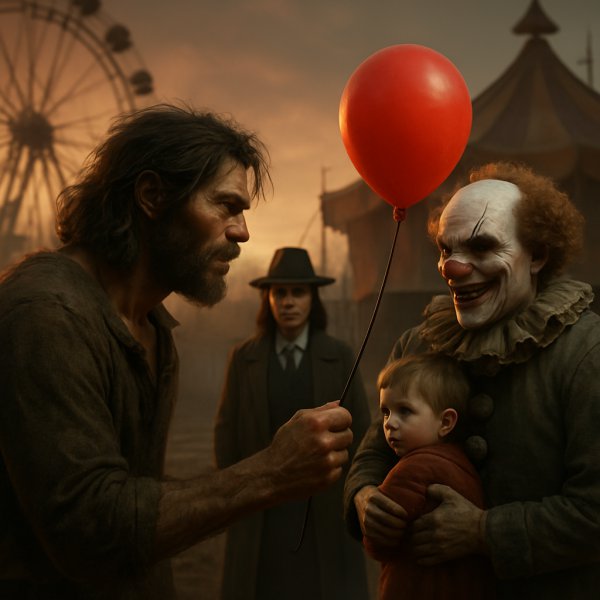
The red balloon was tethered to the chain-link fence of the schoolyard like a punctuation mark. It bobbed in the gray breath of dawn, latex skin cold and smelling faintly of helium and cheap sugar. A single small backpack lay beneath it on the bench, zipper half-open, a tiny sneaker peeking out. He could see the imprint of a thumb in the sand where someone had knelt. For a second Johny John was a child again, crouched in a thicket, listening to wolves blow their breath into the world. He touched the wolf-tooth at his throat without thinking, thumb rubbing the old notch until the raw metal caught the chill.
He had not wanted this life. He had been good at vanishing. The city had carved him into a legend without his consent: a tracker, a loner, the man they whispered about when someone needed proof that something existed beyond the law. He kept to the alleys, to the rooftops - to the memory that wolves taught him in the dark: scent first, sound next, patience last. So when the first balloon appeared, harmless as a child's party promise, it felt like someone had thrown a flint into his quiet.
Detective Mara Reyes told him not to touch anything. Her voice was a rasp, like someone who drank coffee through a sieve. Her hand returned again and again to the chipped silver locket beneath her blouse - a nervous habit he noticed as they worked the scene. "You shouldn't be here," she said, closing the zipper with the corner of her badge. Her visible goal was clear: find the child, secure the scene. Her eyes, though, flicked to the wolf-tooth and then away; there was a new kind of fear there, the fear of failing a child she could not save.
"You said the same last week," Johny said, breath cold in the open air. He kept his voice low, practiced. The city slept on one side and simmered on the other; his training kept the tremor out of his hands. He did not ask why a clown would send a balloon or why the sneaker had no matching pair. Instead he asked the only question that mattered in situations that smelled like bait: Who ties the knots?
Mara's answer was a name no one wanted to speak. "They call him Grin," she said. "Or 'Finn'—Ezekiel Finn on most of the old reports. He leaves a piece of himself at the scene. A trinket, a note, a joke. He stages it." Her fingers touched the locket as if to steady a pulse. "This time he left a balloon."
They found the trinket five blocks away, in the gutter where taxi lights smear like jellyfish. It was a cracked pocketwatch, its face frozen at 11:11, cheap brass scalloped like a carnival token. Someone had smeared the glass with lipstick and drawn a crooked smile that matched the way Finn's photographs had always sat—eyes rings of makeup, mouth a permanent grin. The watch smelled of oil and old tobacco. Johny's thumb found the notch of the tooth under his shirt and his other hand moved, as though the wolf inside him expected to scent the killer's sweat, to follow.
Rising tethered to rising panic. The city turned the clown into weather - a headline that stuck to walls, sticky with fear. Streets hummed with whispers. Finn moved like a poem in the margins, appearing on CCTV as a smear of striped fabric, as a balloon bobbing past. Each scene was quieter than the last, staged to watch. He did not kill in public spectacle alone; he left riddles, a game of mirrors. Johny followed the clues the way wolves follow a broken scent - small, clean decisions laid out like steppingstones. He read the mouths behind closed curtains, learned the rhythm of the city's breath. But the killer's taunts cracked the armor between him and the city's children, and that was a new, sharp kind of danger.
Evidence began to point at him.
It started with a sliver of fur caught in a sewn piece of a clown suit; DNA that matched a scientific curiosity someone had once taken from him at an old police hearing—a hair from the past, plucked without consent when a child raised by wolves was a curiosity on a leaflet. Then a photograph surfaced online, shared by a faceless account: Johny at the edge of a fairground, young, hair long, wolf-tooth visible, the caption calling him wolf-man, the city's old boogeyman. Someone had taken his life and pasted it into a poster. The papers picked up the line and chewed it. Johny watched himself become a direction for fingers.
His hidden fear had always been a private thing - the slow sliding away from the small human he had kept beneath his fur. Raised by wolves, he had learned how to flood his senses with smell and sound until the city was a layered thing. He had also learned how to stop hunting pleasurelessly. The thought of losing that small decision - of waking one morning and finding his teeth used for nothing but killing - was an ache in the marrow. The public wanted a predator. The killer wanted Johny in the role.
Mara's visible goal shifted. Her badge became a cleaver; she started with a demand to bring him in. "Until we can clear your prints," she said. Her locket warmed against her chest when she lied. Her hidden fear was more human than any press release: that Johny was exactly what the city feared and that she would fail to stop another child from being taken. She'd touched the inside of her shirt where the locket lay, as if to keep her promise to a younger version of herself.
Johny had a choice. Report to the station and be booked while the city chewed on his name or slip into the shadows and follow the trail at his own pace. He chose the latter because he could not stand papers with headlines that read 'Wolf Kills Clown' while a child's laughter was folded into a zip lock on evidence shelves. He left without permission, and in that departure he made himself something the city could point at with horror: an ungoverned thing.
The map he built out of clues led to the riverfront where an old traveling carnival had died a slow death, rusting in the damp. He prowled the perimeters like a ghost, the smell of grease and damp canvas flaring in his nose. Ferris wheel scaffolding scraped the sky in skeletal teeth. A sign still swung above the entrance - faded letters that once promised wonders. The smell of damp popcorn drifted up from a collapsed tent like the ghost of childhood.
Johny found the tent with mirrors inside, the ground littered with flattened ticket stubs. The mirror maze smelled of cleaning fluid and stale breath. He moved through it like a wolf through a thicket - silent, eyes flat, listening. Then the voice came, soft and close and wrong in its cheer.
"Thank you for coming, wolf," Finn said, his voice like tin under paper. He had the cracked pocketwatch in one hand, the other hand wrapped around a red balloon string. He had the habit of winding the watch every few moments, a small, compulsive ritual. It was his talisman. His visible goal was theatre - to make an audience of terror, to see people rearrange themselves in front of his act. His hidden fear - of being ordinary and invisible - leaked around the edges in the way his smile refused to reach his eyes. He fiddled with the watch in a way that was almost tender. "You've been invited to save a child," he said.
The reversal came hard and cold. There was movement beyond the mirrors, the muffled sound of a child sobbing. John rounded a glass and the maze snapped shut behind him; a piece of clothing, familiar in its cut, caught on a nail - a child's hoodie with a cartoon wolf on the front. The knives of his life and the city's law were close to crossing. He should have called Mara, but the badge in her hand had become an accusation. The choice narrowed: he could trust the police and wait, or he could step into an arrangement he knew too well - a trap and a life on the line.
He stepped into the trap.
When the mirrors closed, Finn spread the show wide. He wanted to show Johny who he could be - not a savior but an animal slick with the juice of killing. He wanted to mirror him until the wolf wore the clown's grin. The hallway multiplied their faces into control and chaos. "You're half a myth and half a man," Finn said, the watch ticking. "Which half will you be when the city finally sees?"
The fight was less a flurry of fists and more a test of restraint. Johny moved like he had always moved - precise, efficient, with the wolf's economy. He used sound - a bottle smashed to the left to lure Finn into an angle; he used scent - an ember from a cigarette on his breath to mask the copper trace in the air. He could have torn Finn apart in seconds. He had spent a life making killing quick. But something older tugged at him - not the pack's hunger, but a human thread: the memory of a child's hand in his own once, the small human cry the wolves had not silenced when they raised him.
He pinned Finn to the floor by the collar, wolf-tooth heavy at his throat, and for the first time he let himself look into the man's human eyes. Finn had the face of a person who had never been clasped for mercy. His grin fell away like a mask. "You think you save them by tearing?" Finn whispered, breath sour with cheap perfume. "You think strip the city of its filth and you'll be praised? They will stone you anyway."
The choice crystallized. Johny could become what the city feared - a voiced monster - and perhaps end the clown's reign with blood, or he could do the harder thing: bind and reveal the man, let him be judged in a room of daylight, to let the human institutions that had once failed him move slow and flawed and at least accountable. Mercy as a tactic, not a weakness.
He tied the pocketwatch with a strip ripped from his own shirt, pressed Finn's face into the dirt so the clown's smile puddled in dust, and for a long minute Johny listened to a child's breathing soften behind a tarp. He carried the child out of the maze like a ghost shouldering a small body, the child heavy with fear but alive. He handed the child to Mara when she burst into the carnival, breathless and wet-eyed.
Mara did not arrest him at once. The badge trembled in her hand; the locket warmed against her chest. She had to decide whether to put shackles on the man who had saved a child while the city called him a monster. "Did you do this?" she asked, not to him but to the air, to the world that had made a myth out of a man.
He did not answer. He turned his face away, wolf-tooth between his teeth for a moment as if to taste the metal of the decision. Finally he let the word out, low and simple. "I don't want to be one of them."
Mara's visible goal shifted again - protect the child, preserve the public's trust, and yet also to keep the truth from being swallowed by spectacle. Her hidden fear was written in the moisture that glistened in her eyes: that no matter what she did, the public's hunger for monsters would override the facts. She unhooked a zip tie Finn had used and let the man stay bound until transport could come. She touched her locket and whispered something to a photograph no one saw.
They brought Finn to daylight and unmade his theater. The camera crews harshed like flies. Finn's watch lay on a table, ticking with the tempo of the city. Johny's hair smelled of dust and river. Reports chewed the edges of the story into shapes they liked: wolf-savior, clown-runner, vigilante. Some nights he imagined headlines that read 'Wolf Humbled', others that read 'Monster Hidden.' He tasted every version like rain.
The lesson lay in the aftermath. The city did not straighten overnight. Some called for Johny to be jailed for his vigilantism; others left tiny bouquets at the fences of playgrounds. The media loved an answer and then hated it. Finn's trial moved at the rhythm of a sluggish public justice - lots of noise, the machinery of law grinding public into a shape. Johny waited, and in waiting he re-learned the city one small interaction at a time.
He began to sit in the park where the balloon had hung, not to haunt the place but to watch. Children came and went, their laughter a thin, fragile thing. An old woman on a bench brought bread for pigeons and smiled at the wolf-tooth flashing at his throat. The wolves had taught him survival; the city taught him to read faces and the small mercies that stitch people together. He touched his pendant less often. It was a habit that eased rather than defined him now.
On a rooftop months later, the river below catching light like a string of coins, Johny slipped a small red balloon from his pack and tied it to the wire fence. He did it because children still needed to see color in gray mornings. He watched the balloon bob, a tiny laughter in plastic, and remembered the boy he had carried out of the maze. He pressed the small tooth at his throat and felt how both halves - the animal and the human - could hold the same space.
Mara came up behind him, hands in the pockets of her coat, the locket warm under cloth. "You could have been taken," she said quietly, more a statement than a question. Her goal now was different; she wanted to know he would stay among them. Her fear still hummed, but less like a siren and more like a tune she could set.
He did not answer immediately. The city spelled itself below them in tiny lights. "I almost wasn't," he said, then tilted his head toward the balloon, toward the small human business of tying two words together: safety and kindness. "But I chose it."
They watched the balloon until a gust tugged it loose and it drifted away, snagging on an electricity wire with a tiny, harmless pop that made them both start. It hummed there, a scarlet punctuation against the coming dark. For a moment they were both simply two people on a roof, breath puffing and warm against the chill.
When Johny rose to leave it was with something he had not known he still wanted - to be seen not as a legend or a villain but as a person who could keep a promise. He took one step, and for a sliver of a second he let the city catch him whole.
Below, a child laughed. The sound pried the last cold out of him. He tucked the wolf-tooth under his shirt and walked toward the stairwell, the memory of the mask and the watch and the maze folding behind him like a closed book. The balloon sagged on the wire, color dimming, a bright bruise against the night sky. He glanced up, touched the notch in the tooth one more time, and left with the small, stubborn certainty that a life can be remade by choosing men over monsters, every single morning.
Psychological Thriller