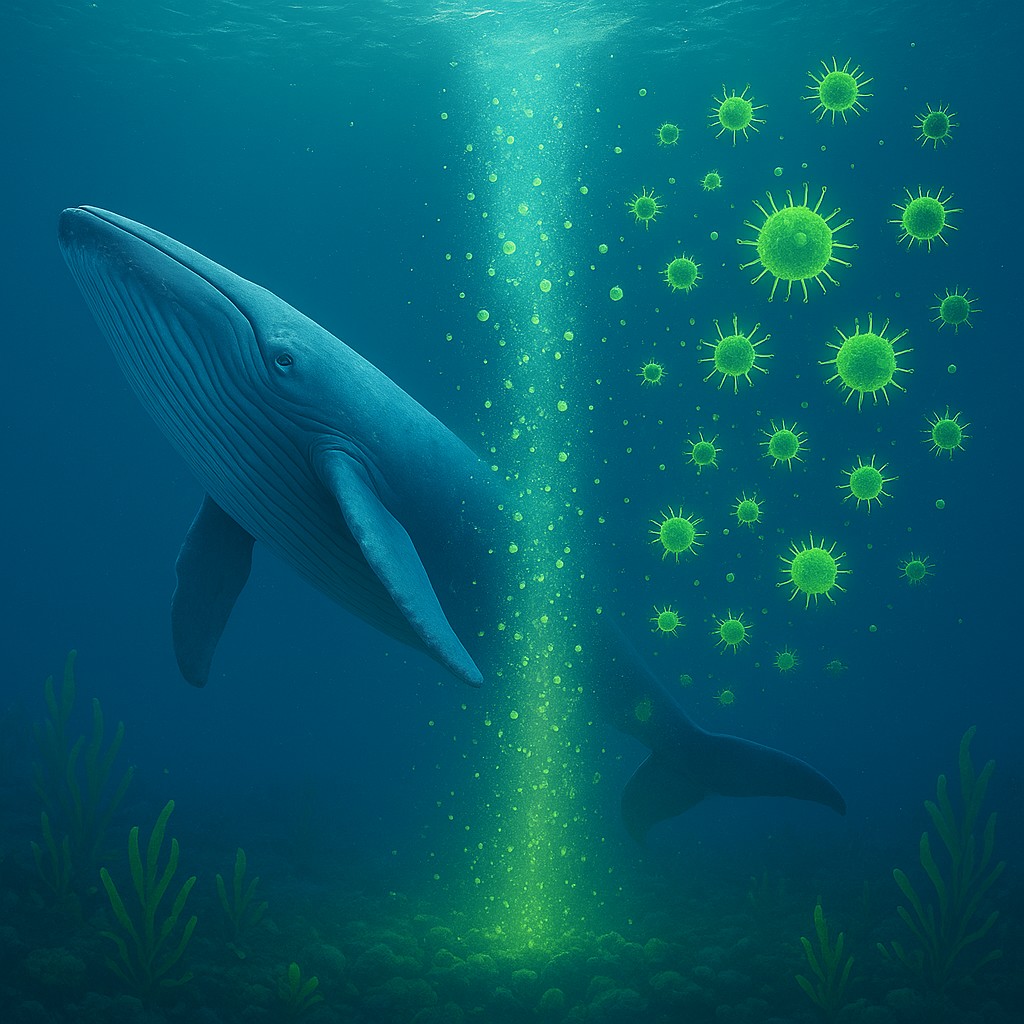
When we think about the heavy hitters of climate change, we usually imagine vast wind farms, futuristic carbon-capture factories, or billions of trees planted across the equator. We rarely look to the horizon to find a ninety-ton biological machine that lives on a diet of tiny shrimp. Yet, the great whales are performing a feat of geoengineering that rivals our most sophisticated technology. They are not just passive residents of the deep; they are active architects of the atmosphere. By moving through the water in a steady, rhythmic cycle, whales help the ocean breathe in carbon dioxide and exhale the oxygen we need to survive.
This process is a beautiful example of how nature connects life across impossible scales. On one hand, you have the blue whale, the largest animal to ever live. On the other, you have phytoplankton, microscopic organisms that drift in the sunlit upper layers of the sea. These two extremes are bound together in a partnership that keeps the planet cool. Without the whale, phytoplankton would starve in many parts of the ocean. Without the phytoplankton, the whale would have nothing to eat. At the heart of this relationship is a mechanism called the "whale pump" - a vertical conveyor belt of life-sustaining minerals that proves even the most majestic creatures are essentially giant, helpful gardeners of the sea.
The Problem of the Sunlit Desert
To understand why whales matter so much, we first have to understand why the ocean is often a desert despite being full of water. The top layer of the sea, known as the photic zone, is the only place sunlight can reach. This is the only spot where photosynthesis - the process plants use to turn light into energy - can happen. Phytoplankton, which form the base of the entire marine food web, need two things to grow: sunlight and nutrients. Sunlight is plentiful at the surface, but the minerals they crave, such as nitrogen, phosphorus, and especially iron, have a frustrating habit of sinking. Because these minerals are heavier than water, they gradually drift down into the dark, cold depths where no plants can grow.
This creates a biological disconnect. All the solar energy is at the top, but all the "fertilizer" is at the bottom. In much of the open ocean, the surface water becomes nutrient-poor, which stunts the growth of phytoplankton. This is a problem for us because these microscopic plants are the planet's primary carbon scrubbers. They soak up as much carbon dioxide as all the world’s forests combined. If they lack the minerals to grow, they cannot do this vital job, and carbon stays in the atmosphere, trapping heat. The ocean needs a way to bring those sunken minerals back up to the light, and that is exactly what the whale pump does.
Diving for Dinner and Rising for Relief
Whales are mammals, which means they must breathe air, but their food is often located hundreds or even thousands of feet down. A sperm whale, for instance, might dive nearly two miles deep to find squid. While they are down there in the dark, they eat massive amounts of food. However, nature has designed their bodies in a way that is very convenient for the planet: whales generally do not "go to the bathroom" at great depths. The intense pressure of the deep ocean makes it difficult for them to release waste. Instead, they wait until they return to the surface to breathe.
When the whale finally reaches the sunlit photic zone and takes a breath, it releases a massive plume of fecal matter. To a human, this might seem like a trivial biological byproduct, but to the ocean, it is liquid gold. These "fecal plumes" are incredibly rich in iron and nitrogen, the exact nutrients missing from the surface. By feeding at the bottom and releasing waste at the top, the whale acts as a vertical biological pump. It effectively mines the deep ocean for minerals and transports them back to the surface where the phytoplankton are waiting. This injection of fertilizer triggers massive blooms of plankton, which immediately begin sucking carbon dioxide out of the sky.
Comparing Natural and Artificial Carbon Solutions
It is helpful to see how this biological process stacks up against the technological ways we try to fix the climate. While we often focus on industrial solutions, the whale pump is a self-sustaining, circular economy that has worked for millions of years.
| Feature |
Industrial Carbon Capture |
The Whale Pump |
| Primary Mechanism |
Chemical filters and fans |
Biological nutrient cycling |
| Energy Source |
Electricity (often fossil fuels) |
Solar energy (via plankton) |
| Byproducts |
Concentrated gas to be stored |
Fish, krill, and healthy oceans |
| Scalability |
Limited by money and steel |
Limited by whale population size |
| Cost |
Hundreds of dollars per ton |
Essentially free (if protected) |
The Iron Paradox and the Southern Ocean
The importance of the whale pump is most visible in the Southern Ocean surrounding Antarctica. For decades, scientists were baffled because the Southern Ocean is full of nitrogen and phosphorus but relatively empty of life. This is known as the "High Nutrient, Low Chlorophyll" paradox. It turns out the missing ingredient is iron. Iron is like a spark plug for a car; no matter how much fuel (nitrogen) you have, the engine won't start without that spark. In the open ocean, iron is usually delivered by dust blowing off the land, but the Southern Ocean is far from any dusty continents.
In this region, whales are the primary source of iron. Research shows that whale poop contains concentrations of iron millions of times higher than the surrounding seawater. When a whale defecates, it isn't just releasing waste; it is "seeding" the ocean with the one ingredient needed to kickstart the entire ecosystem. This creates a positive feedback loop. More iron means more phytoplankton. More phytoplankton means more krill, the tiny crustaceans that eat the plankton. More krill means more food for the whales, which then produce more iron. This cycle sustains a level of life that would be impossible in a dormant, un-pumped ocean.
Beyond Poop: The Whale Fall and the Carbon Grave
A whale's contribution to the climate does not end when it stops swimming. Over its long life, a whale accumulates a staggering amount of carbon in its massive body. They are essentially giant, swimming carbon sinks. When a whale dies of natural causes, its carcass usually sinks to the seafloor. This event is known as a "whale fall." Because the deep ocean is so cold and under such immense pressure, that carbon is effectively buried for centuries.
A single whale carcass can carry about 33 tons of carbon dioxide to the bottom of the sea. To put that in perspective, a typical tree absorbs about 48 pounds of CO2 per year. This means one whale fall is equivalent to the annual carbon storage of thousands of trees. Once on the bottom, the carcass becomes its own ecosystem, feeding hundreds of species of deep-sea scavengers for decades. This "blue carbon" storage is one of the most efficient ways nature has found to remove greenhouse gases from the air and lock them away where they cannot cause warming.
The Critical Threshold of Population Density
While the whale pump is powerful, it only works if there are enough whales to keep it running. Before industrial whaling began, there were millions more whales in the ocean than there are today. Some species, like the blue whale, were hunted until less than one percent of their original population remained. When whale populations are sparse, the pump breaks down. Each whale can only move a certain amount of material. If there aren't enough whales to cover a wide area, nutrients remain trapped in the deep, phytoplankton blooms shrink, and the ocean’s ability to absorb carbon fades.
This is why protecting whales is not just a matter of animal welfare or kindness; it is a matter of keeping our atmosphere stable. Recent studies suggest that if whale populations recovered to their original levels, they could trigger the storage of hundreds of millions of tons of extra carbon every year. This "rewilding" of the ocean offers a path toward climate goals that doesn't require inventing new machines, but rather allowing old, effective biological systems to heal and get back to work.
Connecting the Deep and the Distance
Whales do not just move nutrients up and down; they also move them horizontally across the globe. Many species of great whales engage in massive migrations, feeding in nutrient-rich polar waters during the summer and traveling to nutrient-poor tropical waters to breed in the winter. During these journeys, they act as a global distribution system. By the time they reach the tropics, they have carried a "backpack" of nutrients in the form of their own body mass and waste.
In the tropics, where the water is warm but often lacks minerals, migrating whales provide a boost to local reefs and coastal ecosystems. This horizontal transport links the health of the Antarctic to the health of the Caribbean or the South Pacific. It reminds us that the ocean is not a collection of separate puddles, but a single, pulsing organism. The movements of these giants ensure that life is not just concentrated in a few lucky spots, but is spread as widely as possible, maximizing the planet's total capacity for growth.
Reimagining the Giants as Climate Allies
Looking at whales as a "nutrient pump" changes our entire relationship with them. They are no longer just beautiful, distant creatures; they are essential infrastructure for a living planet. They are the engines of the sea, the farmers of the sunlit zones, and the guardians of the carbon cycle. Every time a whale breaches or dives, it is performing a service that benefits every person on land, whether they live on the coast or in the middle of a desert.
Understanding this system gives us a sense of hope. While the climate crisis often feels like a problem of staggering complexity, nature has already provided us with elegant, time-tested solutions. The whale pump reminds us that the best way to fix a broken system is often to step back and let the original inhabitants do what they do best. By ensuring the oceans remain a safe home for whales, we are investing in a global air purification system that has been running perfectly for millions of years. The more we learn about these majestic gardeners, the clearer it becomes that saving the whales is, in a very literal sense, a way of saving ourselves.