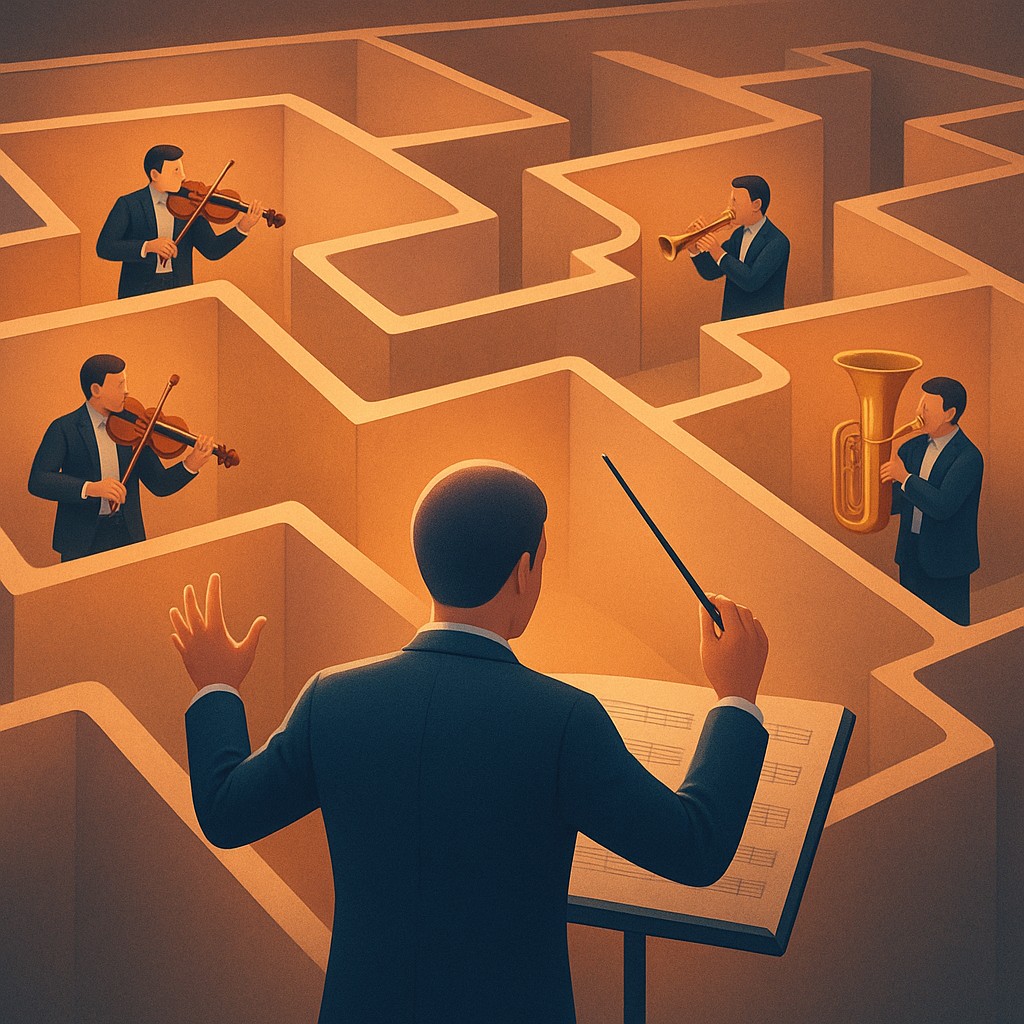
Imagine you are trying to lead a massive symphony orchestra where every single musician is in a different room. To make matters worse, the hallways connecting these rooms are all different lengths. Some are short and straight, while others are long, winding, and filled with obstacles. If you start the beat and expect everyone to play their note at the exact same moment, the sound reaching the audience would be a chaotic mess. The violinist in the closest room might hit their note instantly, but the tuba player three hallways away will be a fraction of a second late. In the world of high-speed computing, this "Wait-for-Me" effect is exactly what happens with electricity. If we didn't have a way to manage it, your smartphone would be little more than a very expensive, glass-covered heater.
We often think of electricity as moving at the speed of light, but inside the microscopic cityscape of a silicon chip, physical reality is much messier. Signals encounter resistance, they have to charge up tiny pools of electrons called capacitance, and they have to travel through wires of varying lengths. This means that if a computer asks two different parts of its "brain" to solve a problem and send the results to a third part, those two answers almost never arrive at the same time. This timing gap creates a dangerous window of uncertainty. If the receiving component acts too quickly, it might catch a "glitch" or a half-baked signal, leading to a math error that could crash an app or corrupt your photos.
The Physical Reality of the Digital Dash
To understand why timing is such a headache for engineers, we have to look at what is actually happening inside a logic gate. A logic gate is essentially a group of transistors that acts like a tiny, extremely fast light switch. For example, an "AND" gate will only output a "1" signal if both of its inputs are also "1." If Input A arrives on time but Input B lags behind because it had to travel through a longer wire, the gate might briefly output a "0" because it hasn't "seen" the second "1" yet. This tiny, unintended flicker is called a hazard or a glitch. It lasts for only a billionth of a second, but in a machine that performs billions of operations every second, a billionth of a second is an eternity.
This delay is not just about the length of the wire; it is also about the "laziness" of the transistors themselves. A transistor takes a tiny amount of time to switch from off to on, a period known as propagation delay. Furthermore, signals can be slowed down by "crosstalk," which is when the electrical field of one wire interferes with the signal in a neighboring wire. This is much like how a loud conversation in one room can make it harder to hear the person right next to you. Engineers have to map out every single path a signal can take to find the "critical path." This is the longest, slowest route in the entire circuit. The speed of the whole computer is held hostage by this one path, because the system can only move as fast as its slowest member.
The Digital Conductor and the Logic of Waiting
To solve this chaos, computer scientists use a technique called synchronous logic. They introduce a "clock signal," which is a steady, rhythmic pulse that acts like a digital metronome. Instead of letting every gate fire whenever it feels like it, they place "latches" or "flip-flops" between the major sections of the circuit. These are like tiny airlocks that only open when the clock "ticks." This forced patience ensures that even if a signal arrives early, it has to sit and wait at the door until the clock gives the signal that it is safe for everyone to move to the next stage together.
The clock signal ensures that all the messy transitions and flickers have settled down before any data is actually recorded. Imagine a group of people trying to agree on where to go for dinner. If you recorded their opinions while they were still arguing, you would get a confusing mix of "Pizza," "Tacos," and "I'm not sure." But if you wait ten minutes for the argument to finish and then ask for the final vote, you get a clear, stable answer. The clock provides that ten-minute buffer, scaled down to the nanosecond level. This period of waiting is the secret to reliability, turning a chaotic flow of electricity into a predictable stream of information.
The Fine Print of Timing Constraints
When engineers design these circuits, they live and die by two specific rules: setup time and hold time. These rules define the "safety zone" around the clock's heartbeat. If these rules are broken, the computer enters a terrifying state called metastability. In this state, a circuit cannot decide if a signal is a 1 or a 0, leading to unpredictable behavior and system freezes.
| Timing Term |
Definition |
What Happens if Broken? |
| Propagation Delay |
The time it takes for a signal to travel from input to output. |
The system runs too slowly to keep up with the clock. |
| Setup Time |
The minimum time a signal must be "quiet" before the clock ticks. |
The gate catches a "choppy" signal, causing a crash. |
| Hold Time |
The minimum time a signal must stay "quiet" after the clock ticks. |
The gate might accidentally record the next instruction too early. |
| Clock Skew |
The difference in arrival time of the clock signal at different gates. |
The "conductor" is out of sync, creating total chaos. |
Setup time is like making sure you are standing still before someone takes your photo. If you are still moving when the shutter clicks, the image is a blur. Hold time is the requirement that you stay still for just a moment after the shutter clicks to make sure the light has fully hit the sensor. In a processor, if a signal changes too close to the clock tick, the hardware effectively "blurs" the data. This is why overclocking, the practice of pushing a computer's clock faster than its rated speed, is so risky. If you make the "metronome" tick too fast, you don't give the signals enough time to reach their destination and settle down, leading to the "blue screen of death."
The Heat Trap and the Speed Limit of Silicon
You might wonder why we don't just keep making the clock faster and faster. If we can do 3 billion cycles per second (3 GHz), why not 30 or 300? The answer lies in the physics of moving electrons. Every time a clock ticks and a logic gate switches from "off" to "on," it consumes a tiny burst of energy. Most of this energy is lost as heat. As you increase the clock speed, you are asking those transistors to switch more often, which generates more heat.
Eventually, the heat becomes so intense that it cannot be moved away from the silicon chip fast enough, even with high-end fans or liquid cooling. If the chip gets too hot, the physical properties of the silicon change. Resistance increases, which actually makes the signals travel even slower, worsening the "Wait-for-Me" effect. This creates a vicious cycle: you want more speed, so you increase the clock, which creates more heat, which slows down the signals, which causes timing errors. This thermal wall is the primary reason why processor speeds have mostly stayed in the 3 GHz to 5 GHz range over the last decade. Instead of making the conductor beat the drum faster, engineers have started building more "orchestras" (dual-core and quad-core processors) to get more work done at the same speed.
Embracing the Complexity of Modern Computing
Understanding the "Wait-for-Me" effect changes the way we look at the devices in our pockets. We tend to think of computers as magical boxes that exist in a world of pure logic, but they are deeply tied to the messy laws of the physical world. Every time you send an email or play a game, billions of tiny electrical pulses are racing through a maze of microscopic wires. They are performing a perfectly timed ballet where being even a billionth of a second late is a catastrophic failure.
Next time your computer feels a bit warm or a heavy program takes a second to load, remember the silent conductor holding everything together. We have mastered the art of forcing trillions of tiny switches to wait for one another, creating a symphony of synchronization that allows our modern world to function. It is a testament to human ingenuity that we can take something as chaotic as a bolt of electricity and discipline it into a tool that calculates with near-perfect precision, all by teaching it the simple, vital importance of waiting its turn.