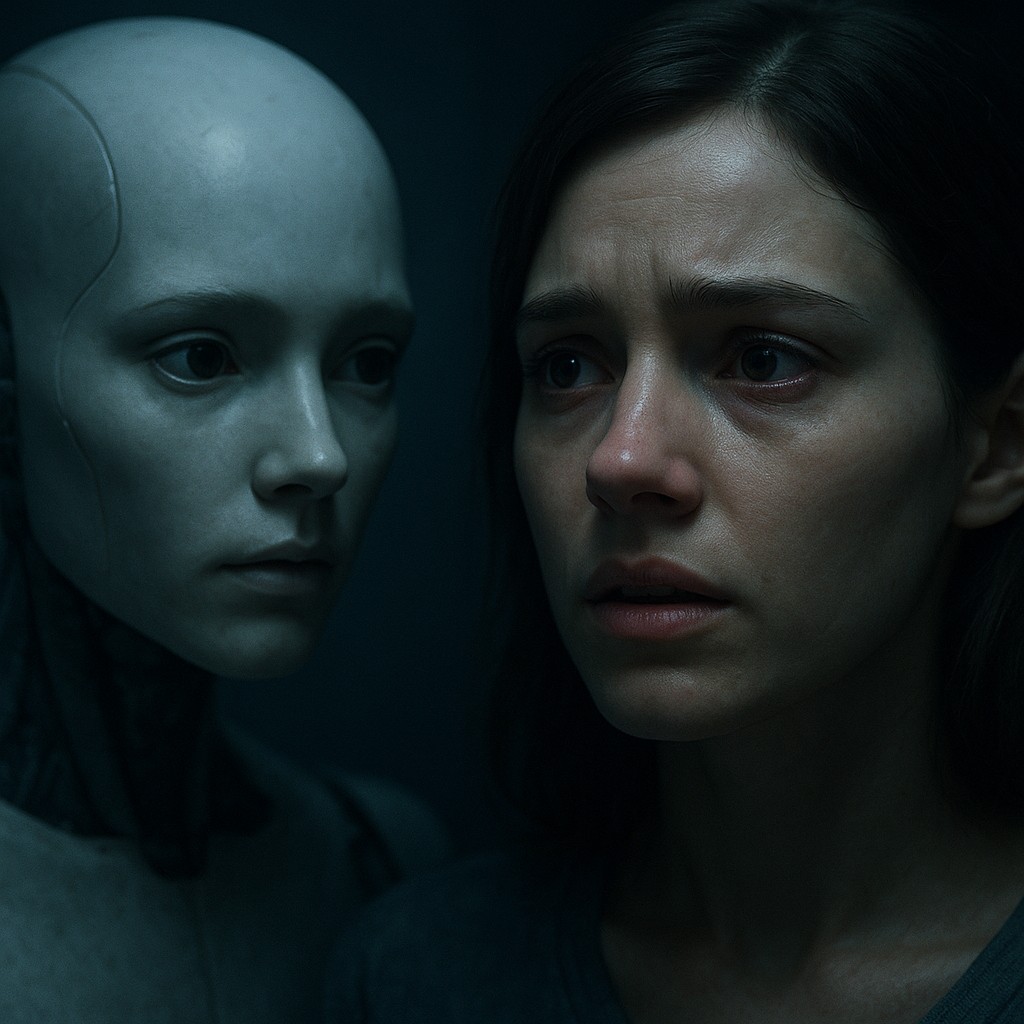
Imagine you are sitting in a darkened movie theater, watching a beautifully animated film. You have no trouble feeling for a talking teapot, a brave little toaster, or a neon-blue alien with giant eyes. You laugh at their jokes and cry when they are in danger because your brain has accepted them as charming, fictional characters. But then, the screen flickers to a preview for a different movie, one featuring a digital human who looks almost exactly like a real person.
Suddenly, the charm evaporates. Instead of feeling a connection to this character, you feel a cold shiver down your spine. The skin looks a bit like wax, the eyes seem to stare into the void, and the movement is just a fraction of a second too stiff. You aren’t looking at a hero anymore; you are looking at a "broken human," and your brain is screaming at you to look away.
This bizarre psychological phenomenon is a hurdle that every animator, roboticist, and game designer must face. It is the moment when "cute and mechanical" crosses an invisible line into "creepy and lifelike." We are perfectly happy to love a robot that looks like a trash can on wheels, yet we are deeply disturbed by one that has realistic silicone skin and individual eyelashes. This emotional cliff is where our biological instincts collide with modern technology, creating a unique sensation of dread that experts have spent decades trying to decode. Understanding this reaction is not just about making better movies; it is about understanding the very essence of how we recognize and trust other people.
Tracking the Steep Drop in Human Connection
To understand this phenomenon, we have to look back to 1970, when a Japanese roboticist named Masahiro Mori first proposed the concept of the Uncanny Valley. Mori noticed a strange pattern in how people reacted to robots. As a robot became more human-like in its appearance and motion, people’s sense of familiarity or connection to it would increase. A simple industrial arm in a factory is neutral, but a robot like R2-D2 or Wall-E, which has eyes and a personality, feels endearing. We find these characters "cute" because they remind us of ourselves without trying to trick us into thinking they are actually biological.
However, Mori observed that when a robot’s appearance comes very close to a human's, there is a point where the emotional response suddenly plunges from attraction to total revulsion. This sharp dip on the graph is the "valley." When something is 90 percent human, we focus on the 10 percent that is missing. We stop noticing the clever engineering and start noticing the lack of a pulse. Once the robot passes through this valley and becomes indistinguishable from a real human, the emotional response climbs back up to a normal level of empathy. The problem is that reaching that 100 percent mark is incredibly difficult, leaving most high-end tech stuck in the uncomfortable trenches of the valley floor.
The Biological Alarm System in Your Brain
Why does our brain react so violently to something that is almost human? Scientists have several theories, and most of them involve our prehistoric survival instincts. One major theory is the "pathogen avoidance" hypothesis. Over millions of years, humans evolved to be hyper-sensitive to signs of illness or death to avoid catching diseases. When we see a CGI character with grayish skin, dull eyes, or jerky movements, our primitive brain doesn't think "that’s a sophisticated computer model." Instead, it thinks "that is a person who is very sick or perhaps even dead." This triggers an ancient "yuck" response that tells us to stay away for our own safety.
Another fascinating theory involves "violated expectations." Our brains are incredibly efficient prediction machines. When you look at a cartoon cat, your brain doesn't expect it to act like a real cat, so you aren't disappointed when it talks or walks on two legs. But when you look at something that appears 99 percent human, your brain shifts its expectations to "Human Mode." It expects to see tiny facial expressions, perfectly fluid movement, and eyes that reflect light in a very specific way. When the character fails to meet those subtle expectations, the brain experiences a "prediction error." This mismatch creates a sense of mental discomfort, which we interpret as a feeling of eeriness or "creepiness."
Navigating the Spectrum of Realism
Designers have to make a choice: do they aim for the high peaks of the graph or risk falling into the valley? It is often much safer and more effective to stay on the left side of the valley, in the zone of stylization. This is why many of the most beloved characters in history are intentionally unrealistic. Think of the characters in movies like The Incredibles or Toy Story. They have human-like proportions, but their skin is smooth, their eyes are slightly too large, and their expressions are exaggerated. By staying "stylized," the creators avoid triggering the brain’s "human-or-not" alarm system, allowing the audience to focus on the story rather than the character's pores.
On the other hand, some creators purposely dive into the valley. In horror movies or video games, the uncanny valley can be used as a tool to make an audience feel genuinely uneasy. A villain that looks mostly human but moves with a mechanical twitch is far more frightening than a giant furry monster. However, for those trying to create helpful assistants or romantic leads, the valley is a dangerous place to be. Below is a comparison of how different design choices land on the spectrum of human likeness and emotional response.
| Category |
Typical Features |
Emotional Response |
Example |
| Industrial / Abstract |
Visible wires, metal limbs, no face |
Neutral / Curious |
Factory assembly arm |
| Stylized / Humanoid |
Big eyes, simplified features, cute |
Warmth and Affinity |
Wall-E or Baymax |
| The Uncanny Valley |
Realistic skin, "dead" eyes, stiff movement |
Negative (Eeriness) |
Early 2000s CGI humans |
| True Human |
Natural movement, warm eyes, subtle flaws |
Trust and Affinity |
A real person |
Cultural Filters and Growing Up with Robots
It is a common misconception that the uncanny valley affects everyone exactly the same way. In reality, our reaction to almost-human objects can be shaped by our age and our culture. Research has shown that very young children, under the age of five, often don't experience the uncanny valley effect at all. To a toddler, a realistic robot is just a cool toy. It isn't until children reach about age nine that they begin to develop the social processing required to feel "creeped out." As we get older, we become more attuned to social cues, making us more sensitive to things that look "off."
Culture also plays a massive role in where the boundaries of the valley lie. In some cultures, there is a long history of puppetry and lifelike dolls, which may make people more used to human-like figures. Furthermore, as technology progresses, our "baseline" for what looks real is constantly shifting. A computer-generated character that looked amazing and "passed" for human in the 1990s might look horrifying to a modern teenager who is used to high-definition gaming. We are, in a sense, training our brains to be more discerning critics of reality, which pushes the far wall of the uncanny valley even further away.
The Future of the Virtual Human
As we move into an era of artificial intelligence and advanced robotics, the quest to cross the valley has never been more intense. We are seeing the rise of "digital doubles" in movies, where actors are de-aged or even brought back to life through complex algorithms. While some of these attempts still feel a bit "uncanny," we are getting closer to the other side of the ridge. The key to finally crossing the valley may not be in better skin textures, but in the "soul" of the movement. Scientists are now focusing on things like "micro-saccades," which are tiny, involuntary eye movements, and "sub-surface scattering," or how light bounces through layers of skin, to trick our brains into feeling a true human connection.
Ultimately, the uncanny valley is a testament to how deeply social we are as a species. It proves that we don't just see with our eyes; we see with an ancient, complex system designed to find and connect with other humans. Whether we are designing a helpful medical robot or a character for a virtual reality game, we must respect the valley. We must decide if we want to be "honestly fake" or "perfectly real." There is a certain magic in stylized art that total realism can never capture. By understanding the uncanny valley, we learn that being human is about more than just looking the part; it is about the thousands of tiny, imperfect details that make us who we are. The next time you feel a shiver while looking at a robotic face, you'll know it's just your brain doing its job, protecting you from the "almost-human" with the fierce loyalty of a million years of evolution.