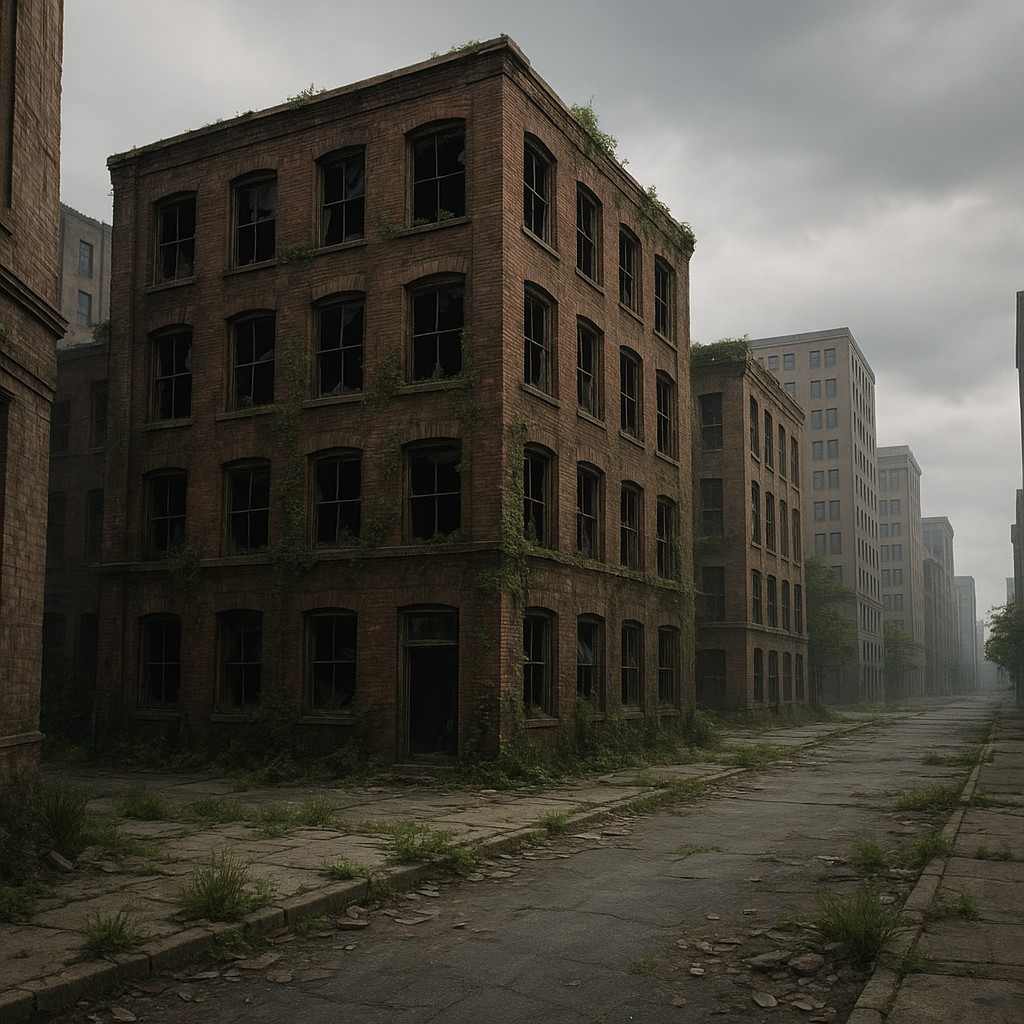
Imagine walking through a busy city center where prime real estate sits derelict, windows smashed and weeds pushing through the cracked pavement. You might assume the owners are simply lazy or waiting for the market to peak, but the reality is often more bureaucratic and bizarre. In many cases, no one is using the building because too many people own tiny, inseparable pieces of it.
While we are frequently warned about the "Tragedy of the Commons" - where everyone shares a resource and destroys it through overconsumption - there is a mirror image of this problem that is just as destructive. This is the "Tragedy of the Anticommons," a state of paralysis that happens when property is so fragmented that no one can get anything done.
When ownership is split into a thousand tiny shards, every single owner holds a "veto" over the entire project. If you want to turn that derelict block into a high-tech laboratory or a much-needed apartment complex, you do not just need a good architect; you need the unanimous consent of dozens, or even hundreds, of people. If even one person says no, or simply cannot be found, the entire project grinds to a halt. This isn't just a quirk of real estate; it is a fundamental flaw in how we organize rights that affects everything from the smartphones in our pockets to the life-saving vaccines in our clinics. By understanding how this gridlock works, we can see why some of our most ambitious human endeavors end up stuck in a permanent state of "no."
The Invisible Barricades of Fragmented Ownership
To understand how the anticommons works, we have to look at the concept of "exclusion rights." In a typical property arrangement, an owner has the right to use the resource and the right to keep others out. This is generally a good thing because it encourages the owner to invest in and maintain their property. However, the anticommons arises when the right to exclude is handed out to too many different parties for a single resource. Instead of one person holding the keys to the front door, imagine a door that requires twelve different keys held by twelve different people who all live in different time zones and do not particularly like each other.
This phenomenon was first famously observed in the post-Soviet transition of Moscow. While state-owned enterprises were being privatized, the rights to storefronts were often split among various local committees, federal agencies, and new private stakeholders. The result was a surreal landscape where the sidewalks were overflowing with temporary kiosks selling goods, while the actual permanent storefronts remained empty and decaying. The kiosks flourished because they only required one simple permit, whereas the stores remained "ghosts" because navigating the web of overlapping owners was an expensive nightmare. Each owner hoped to hold out for a massive payout, but since everyone held the same veto power, no individual could ever close the deal.
This isn't just an artifact of failing states or transitional economies. We see the same mechanism at play in modern urban zoning. Consider a city that wants to build a new subway line. If the project requires purchasing small strips of land from five hundred different homeowners, the "holdout problem" becomes inevitable. One or two owners might demand ten times the market value of their land, knowing they are the only thing standing between the city and its new infrastructure. When negotiation costs and the price of buying out "veto players" exceed the total value of the project, the plan is abandoned and the land remains underutilized.
Why Innovation Often Hits a Patent Thicket
While physical land is easy to visualize, the most high-stakes version of the anticommons currently plays out in the world of intellectual property. In the early days of industrialization, a patent was often granted for a whole machine, like a specific type of cotton gin. Today, a single product like a smartphone can involve thousands of individual patents held by hundreds of different companies. This creates what economists call a "patent thicket," a dense web of overlapping legal rights that a company must "hack" through before they can bring a new product to market.
If a pharmaceutical company wants to develop a complex new drug, they might find that the basic genetic sequences, the chemical delivery method, and the manufacturing process are all patented by different universities or rival firms. To move forward, the company has to negotiate licenses with every single one of those entities. If one patent holder demands an exorbitant fee, the entire drug development process might be shelved. This means that potentially life-saving treatments might never exist simply because the "toll booths" on the road to innovation were too numerous and expensive to pass.
The table below illustrates the stark differences between the more famous "Tragedy of the Commons" and the "Tragedy of the Anticommons" to help clarify how these two economic traps function.
| Feature |
Tragedy of the Commons |
Tragedy of the Anticommons |
| Core Problem |
Overuse and depletion |
Underuse and stagnation |
| Ownership Structure |
No one has the right to exclude |
Too many have the right to exclude |
| Common Example |
Overfishing in the ocean |
Empty storefronts or patent thickets |
| Individual Incentive |
Use it before someone else does |
Hold out for a bigger payout |
| Social Result |
Destruction of the resource |
Wasting of the resource |
| Solution |
Privatization or regulation |
Consolidation or eminent domain |
The High Cost of the Holdout Mentality
One of the most frustrating aspects of the anticommons is the "holdout problem," which is driven by a mix of rational economics and human psychology. In a negotiation where everyone is required to agree, the last person to sign the contract has an incredible amount of leverage. They know that without their signature, the previous ninety-nine signatures are worthless. This creates a logical but destructive incentive for everyone to wait and be the last person at the table. If everyone waits, the clock runs out, investors lose interest, and the "ghost town" effect takes hold.
This isn't always about greed, though greed certainly plays a role. Sometimes, it is a matter of "strategic ignorance" or simply the sheer cost of communication. If you are a developer trying to assemble a large plot of land that was subdivided a century ago, you might find that the owners are the three hundred descendants of a long-dead farmer. Many of them may not even know they own a 1/300th share of a muddy field. The legal fees required to track down every heir and secure their consent can easily dwarf the actual value of the land. In this scenario, the resource is effectively locked away from the world, not by a physical wall, but by a paper trail that has become too tangled to unravel.
The anticommons also thrives on "complementary" goods. In economics, things are complements if you need both of them to get any value, like a left shoe and a right shoe. If one person owns all the left shoes and another person owns all the right shoes, they both have a total monopoly over the final product. If they cannot agree on how to split the profit, they both end up with piles of useless footwear. When we apply this to high-tech fields like biotechnology or telecommunications, we see that the most advanced parts of our economy are actually the most vulnerable to this kind of fragmentation.
Clearing the Path Toward Collective Progress
Solving the tragedy of the anticommons requires a delicate balance. We value property rights because they protect individuals from being steamrolled by the government or large corporations. However, when those rights become a barrier to basic social functioning, we have to look for creative "unblocking" mechanisms. One of the most common, though controversial, tools is eminent domain, where a government can force the sale of property for public use. While this solves the holdout problem, it can also lead to abuses of power and the displacement of vulnerable communities.
A more market-friendly approach involves the creation of "patent pools" or "copyright collectives." In the music industry, for example, it would be impossible for a radio station to negotiate with every single songwriter and performer for every song they play. Instead, organizations like ASCAP or BMI act as clearinghouses. They collect fees and distribute them to the thousands of rights holders, allowing the music to flow without catching on the thorns of an anticommons thicket. Similarly, tech companies often enter "cross-licensing" agreements where they agree to let each other use their respective patents, effectively turning a fragmented forest back into a shared field.
Another solution is the implementation of "sunset clauses" or higher maintenance fees for property rights. In the world of patents, if you have to pay a significant fee every year to keep your patent active, you are less likely to hold onto "junk" patents that you aren't actually using. This encourages owners to either use the right, sell it to someone who will, or let it lapse into the public domain where it can be used by everyone. By making it slightly more expensive to be a "dog in the manger," we can encourage the flow of resources toward their most productive uses.
Embracing the Power of the Whole
The tragedy of the anticommons serves as a powerful reminder that more ownership is not always better. While the "ownership society" sounds like an ideal, the reality is that our world functions on a foundation of coordination. When we allow ourselves to become overly protective of our tiny slivers of the world, we risk losing the magnificent things that can only be built when we work together. A single brick is a piece of property, but it is only when many bricks are laid in a specific, coordinated order that we get a cathedral.
As we move deeper into an era defined by complex data, intricate biotechnology, and dense urban living, the challenge of the anticommons will only grow. We must be willing to rethink how we define and bundle our rights, ensuring that we do not accidentally build a world of "veto players" where nothing new can ever take root. True progress doesn't just come from the right to say "mine"; it comes from the ability to say "ours" and "let's build." By recognizing the invisible barricades of the anticommons, we can begin to tear them down, clearing the way for the next generation of breakthroughs, buildings, and bold ideas.