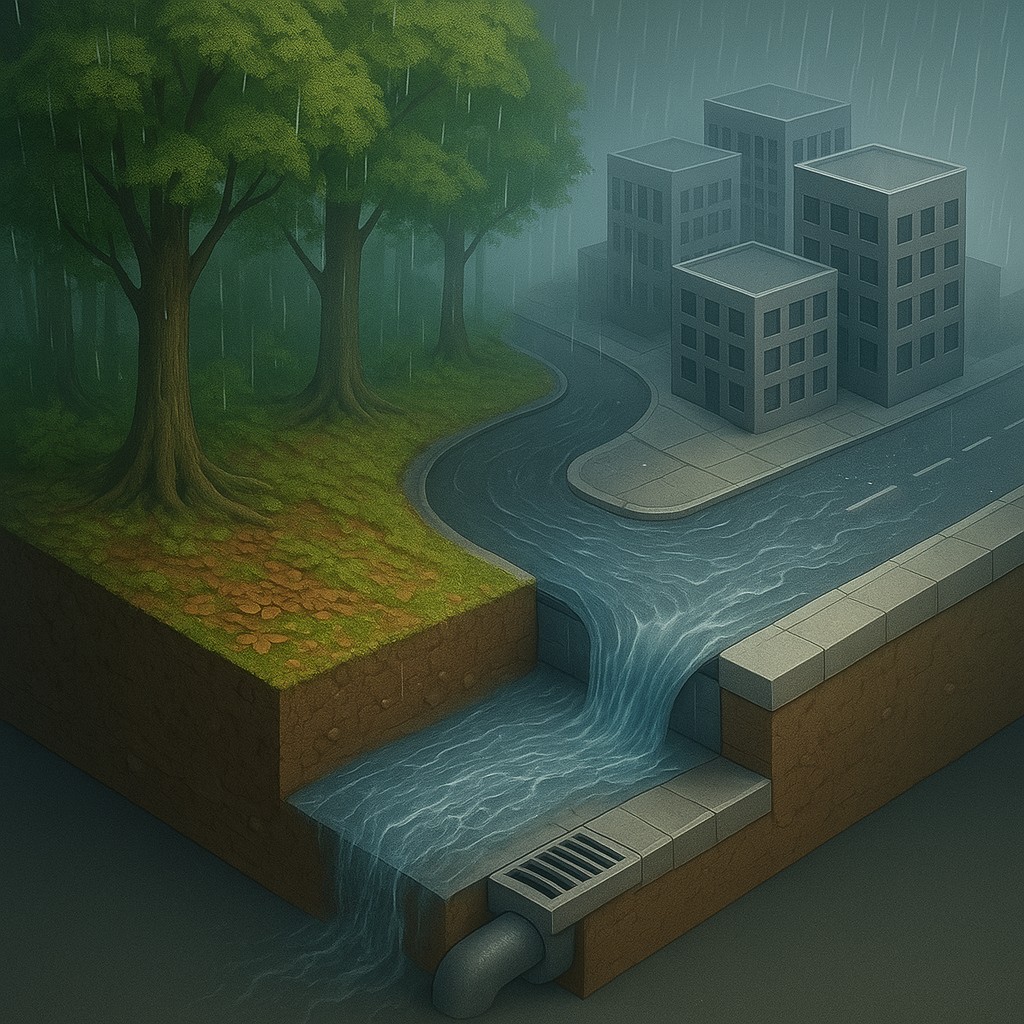
Imagine for a moment that you are standing in the middle of a thick, old-growth forest during a summer rainstorm. As the droplets fall, they begin a long, slow journey. They hit the leaves of the high canopy, drip onto the soft layer of rotting leaves on the forest floor, and finally sink deep into the porous soil. From there, the water might spend days or even weeks trickling through underground paths, slowly making its way toward the nearest river. In this natural landscape, the earth acts like a massive, patient sponge. It steadies the flow of water, ensuring the river downstream stays at a manageable level long after the clouds have cleared.
Now, look at a modern city like Berlin, London, or New York. The moment the rain hits the ground here, the rules seem to change. Instead of a soft forest floor, the water meets a landscape of solid armor: asphalt roads, concrete sidewalks, and ceramic roof tiles. There is nowhere for the water to sink, so it starts to run. It picks up speed on these smooth surfaces, diving into metal grates and rushing through a network of underground pipes. These pipes are designed for one thing: to get water away from buildings as fast as possible. This is the root of the Teltow effect. Named after an urban district in Germany where engineers first noticed the problem, it describes a startling reality. We have accidentally turned our cities into giant, high-speed funnels that have broken the natural rhythm of water.
The Mechanical Fury of the Urban Funnel
When people talk about city flooding, they usually blame the amount of rain. We look at a flooded street and think, "That was an incredible amount of water." However, the Teltow effect shows us that the speed of the water is often more dangerous than the volume. In a forest, perhaps only ten percent of rainfall turns into immediate runoff on the surface. In a paved city, that number can jump to over ninety percent. Because this water cannot soak into the ground, it all arrives at the river at the exact same time. This creates what water experts call a "flashy" hydrograph, which is a chart where the water level looks less like a gentle hill and more like a sharp, deadly needle.
This sudden surge of water turns a peaceful city stream into a high-pressure jet. When a river rises several feet in just a few minutes, the water moves with a mechanical force that natural habitats aren't built to handle. The sheer speed allows the water to pick up heavy sand, rocks, and debris, using them like sandpaper to scrub away the riverbanks. Instead of a winding stream where wildlife can live, the Teltow effect creates a deep, straight trench. This process, known as channel incision, cuts the river off from its surroundings. It leaves the water unable to support the plants and animals that once lived along its edge.
Rewriting the Physics of the Riverbed
To understand why this speed is so destructive, we have to look at how water depth and power work together. In a wide natural flood plain, a river spreads out when it overflows. By spreading out, it loses its concentrated energy. It drops rich soil onto the land and slows down as it brushes against grass and shrubs. In a city, we usually pin the river in with stone walls or steep banks to protect expensive property. When the Teltow effect hits and water levels spike, the river has nowhere to go but up and forward.
As water gets deeper in a narrow channel, the pressure at the bottom builds. This pressure acts as a driving force that can pluck giant boulders from the riverbed and toss them downstream like pebbles. Additionally, the rapid rise and fall of the water creates a suction effect on the banks. As the floodwater pulls back just as quickly as it arrived, the water that managed to soak into the banks tries to rush back out to the river. This often pulls the entire bank down with it. These collapses can threaten bridges, roads, and buildings, all because the water arrived in a frantic burst instead of a slow, steady sip.
Comparing Natural and Urban Water Cycles
| Feature |
Natural Landscape |
Urban Landscape (Teltow Effect) |
| Surface Reaction |
High absorption (soil and plants) |
High runoff (asphalt and concrete) |
| Water Speed |
Slow (days to weeks) |
Rapid (minutes to hours) |
| Peak Flow Height |
Low and steady |
High and instant |
| River Shape |
Wide, shallow, and winding |
Deep, narrow, and straight |
| Effect on Nature |
Feeds soil, life thrives |
Washes away banks and habitats |
| Main Cause of Floods |
Too much total rain |
Water moving too fast |
The Myth of the "More Rain" Problem
One of the most common mistakes in city planning is the idea that we just need bigger pipes to handle the "extra" rain. This mindset treats the city like a plumbing problem that can be fixed with more concrete. In reality, the rain is the same rain that has fallen for thousands of years; it is our delivery system that has changed. When we build larger storm drains to whisk water away from one neighborhood, we are often just firing that "bullet" of water faster toward the neighborhood downstream. We aren't stopping the flood; we are just moving it to someone else’s backyard.
The Teltow effect highlights a major system failure: the loss of storage. In a forest, every leaf and root acts like a tiny tank. In a city, we have removed those buffers. This leads to a strange situation where a city can have a devastating flash flood one afternoon and a drought a week later. Because the water was rushed out of the city and into the ocean so quickly, none of it stayed behind to refill the local groundwater or keep the plants hydrated. We have traded a stable, slow cycle for a dangerous, fast one.
Turning the City Back into a Sponge
The modern answer to the Teltow effect is a design style known as the "Sponge City." If the problem is that concrete acts like a funnel, the solution is to make the city "leaky" again. This involves a set of methods called Low Impact Development (LID). Instead of one giant concrete pipe, planners are now building rain gardens. These are basically attractive, engineered low spots in the ground filled with thirsty plants and sandy soil. These gardens catch water from sidewalks and hold it, letting it soak in at its own pace, just as it would in a meadow.
Another clever tool is permeable pavement. While traditional asphalt is a solid block, these special versions have gaps between the stones or pores that let water pass straight through the street into a stone storage area beneath. This turns every driveway, parking lot, and side street into a hidden sponge. By slowing down the water the moment it hits the ground, we can flatten the "spike" in water levels. This ensures the local river experiences a gentle rise rather than a violent surge.
Engineering the Future of City Waterways
The Teltow effect is a powerful reminder that our cities are never truly separate from nature; they are just a different version of it. Every time we pave a driveway or clear a lot for a new building, we are bumping up the "speed dial" of the local water system. While we cannot dig up every road or move every skyscraper, we can change how we handle falling rain. We can move away from the "collect and eject" model of the last century and move toward a "slow and soak" model for the future.
By understanding how water moves across our streets and through our pipes, we gain the power to protect both nature and our buildings. The goal is not to fight the river, but to copy the forest. When we replace a concrete alley with a green path, or swap a traditional roof for a "living green roof" covered in moss, we are doing more than just making things look better. We are restoring the natural pulse of the earth. Every gallon of water we can keep in the soil is a gallon that won't be tearing down a riverbank downstream. In the end, a strong city doesn't need more concrete and bigger pumps; it needs the quiet, humble power of the sponge.