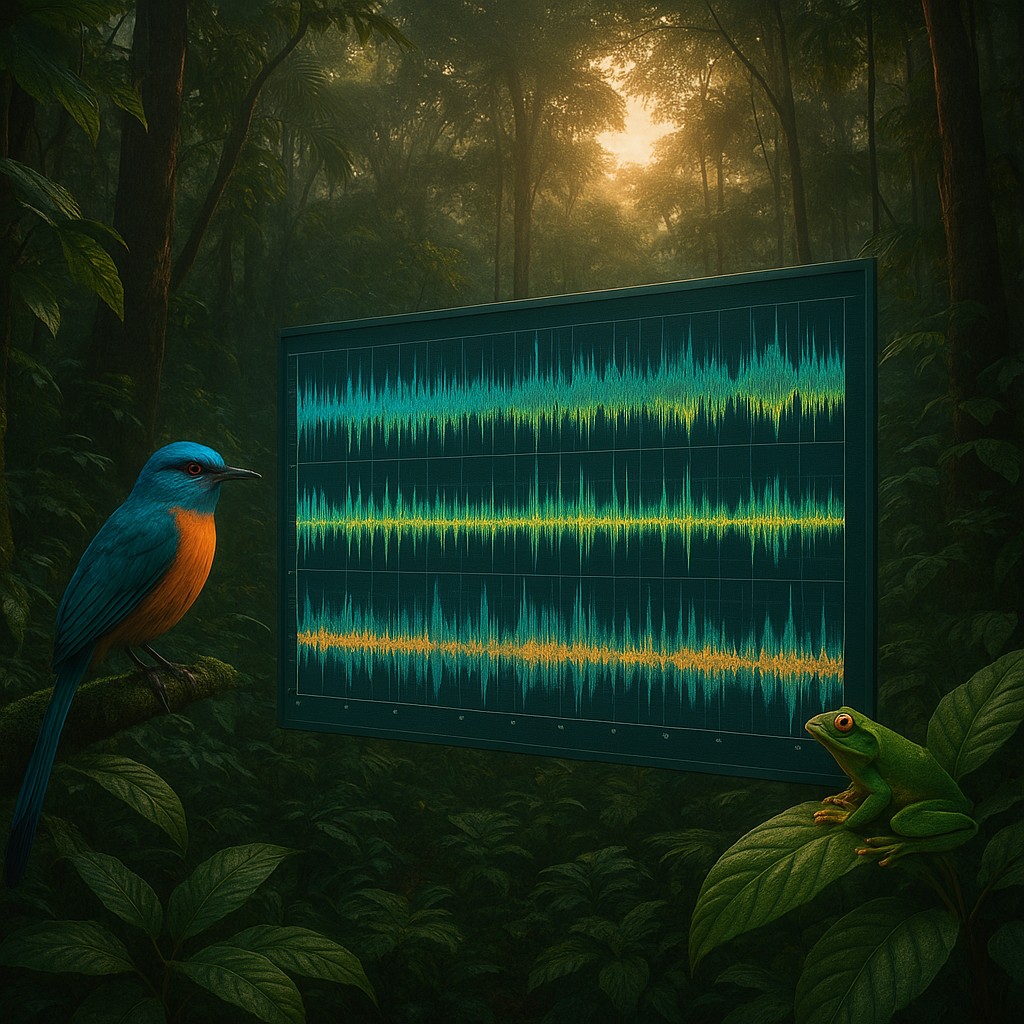
Imagine standing in the heart of a thick, tropical rainforest at sunrise. To someone who isn't used to it, the air feels like a chaotic wall of noise. It is a messy mix of shrieks, whistles, buzzes, and clicks that seems totally disorganized. We might assume every creature is just screaming over its neighbor in a desperate scramble to be heard. However, if you could slow that audio down and look at it on a screen, you would see something much more graceful. You would see a perfectly tuned symphony where every performer has a specific seat, their own sheet music, and a set frequency range they never leave.
This isn't just nature being polite; it is a matter of life and death. In the wild, if your mating call or warning cry sounds exactly like the buzz of a thousand cicadas, your message gets drowned out. If you can't be heard, your family line might end right there. This idea is called the "acoustic niche hypothesis." It suggests that animals have divided up the airwaves just like radio stations. One bird takes the high-pitched 8kHz band, a frog takes the low 1kHz rumble, and a cricket pulses at 5kHz. This orderly setup creates a unique "soundscape fingerprint" for a healthy environment. For the first time, we are using artificial intelligence to read those fingerprints to protect habitats we might never even visit.
The Invisible Architecture of the Soundscape
The idea of the acoustic niche is the foundation of modern nature-sound studies. Think of the available sound range as a massive apartment building. In a healthy forest, every room is full. The "tenants" are the different species. They have evolved to live on specific "floors" (frequencies) and use certain "time slots" (day or night) so they don't get in each other's way. When an ecosystem is thriving, the soundscape is thick and complex, filling almost every available frequency without much overlap. Researchers call this "high acoustic complexity," and it is the best sign of a strong, diverse environment.
When we use bioacoustic AI, we aren't just listening for one "celebrity" species, like a jaguar or a rare parrot. Instead, we look at the overall shape of the sound waves. Using computer programs, researchers can scan thousands of hours of audio to see how well these frequency bands are being used. A "full" soundscape suggests the entire food chain is healthy, from the bugs at the bottom to the predators at the top. If the soundscape looks "thin" or has big gaps in certain frequencies, it tells us that groups of animals have gone silent or vanished, even if the forest still looks green and healthy to the human eye.
Decoding the Language of Ecological Stress
Traditional conservation has always been a game of hide and seek. Biologists used to spend months hiking through mud and swatting mosquitoes, hoping to catch a five-second glimpse of a rare animal or flower. It is slow, expensive, and limited by how much a person can hike. Bioacoustic monitoring changes the game. By strapping tough, waterproof microphones to trees, we can listen to the heartbeat of the forest round the clock, all year long. These devices, called Autonomous Recording Units (ARUs), act as tireless guards that catch tiny changes in the environment that a person would likely miss.
The real breakthrough happens when the data from these microphones meets an AI trained to recognize patterns. The AI doesn't just hear "noise"; it spots changes in the "acoustic entropy," or the randomness of the sound. For example, if an invasive species moves in, it might start "shouting" over the locals. This causes a visible spike in one frequency band that silences other species. Similarly, illegal logging or mining often begins with the faint sound of distant engines or the loss of morning bird songs long before the first tree is actually cut down. This acts like a smoke detector for nature, allowing us to spot trouble before it becomes a disaster.
How Animals Share the Airwaves
To understand how AI judges the health of the land, we have to look at how different animals actually share the air. This isn't random; it is highly competitive. If two species use the exact same pitch to talk, they will eventually drive each other out. This is called "acoustic displacement." Over thousands of years, one will either change its pitch, move to a new area, or die out. This has created the organized bands we see today. Below is a simple look at how different animals divide the "radio dial" of a forest.
| Category |
Typical Frequency Range |
Role in the Soundscape |
| Large Mammals |
50 Hz - 1,000 Hz |
Low rumbles or roars that travel long distances through thick leaves. |
| Amphibians (Frogs) |
500 Hz - 4,000 Hz |
Mid-low range, often rhythmic pulses during rainy seasons. |
| Songbirds |
2,000 Hz - 8,000 Hz |
The melodic layer, using mid-to-high frequencies with quick changes. |
| Insects |
5,000 Hz - 15,000+ Hz |
High-pitched hiss or buzz that creates a constant background texture. |
| Bats (Ultrasonic) |
20,000 Hz - 100,000+ Hz |
Beyond human hearing; used for sonar and hunting in the dark. |
By checking these bands, the AI can calculate the Acoustic Complexity Index (ACI). A high score means a lively, diverse group of animals. A low score suggests a "quiet" forest, which is often a dying forest. Even more amazing is how AI can detect "niche packing," where species slightly shift their timing to avoid overlap. If a bird usually sings at 5:00 AM but a new rival arrives, the AI might track the original bird moving its "show" to 5:30 AM. These tiny shifts in behavior are the first signs that an ecosystem is changing.
Overcoming the Silence of the Hidden
While bioacoustic AI is a powerful tool, it is important to remember what it cannot hear. The technology is naturally biased toward the "noisy" members of the animal kingdom. Birds, frogs, monkeys, and insects are the stars because they are constantly shouting their location. However, many endangered species are "acoustic ghosts." Big cats hunt in total silence. Many reptiles have no vocal cords at all. Burrowing animals or sleeping insects are basically invisible to a microphone.
This can lead to a mistake: thinking a loud forest is healthy and a quiet one is dead. In reality, some stable environments are naturally quieter than others. A pine forest in winter will never be as loud as a tropical jungle, but that doesn't mean it is failing. Researchers must set a "baseline" for each specific home. We cannot compare the volume of the Amazon to a forest in Siberia; we have to compare the Amazon of today to how it sounded five years ago. This approach ensures we aren't chasing shadows or ignoring the silent creatures that keep the world running.
The Future of Global Sound Monitoring
The most exciting part of this technology is how wide we can spread it. Because the equipment is relatively cheap and the AI does the hard work of listening, we can monitor thousands of miles of remote wilderness at once. In places like the deep Amazon or the Congo Basin, where it is almost impossible to patrol on foot, these "digital ears" provide a steady stream of data. We are no longer looking at small snapshots; we are looking at the "big data" of the natural world.
Beyond just naming species, we are starting to use AI to understand the "mood" of the environment. New research is looking for signs that can tell the difference between the relaxed sounds of a stable group and the frantic, high-pitched distress calls of animals under pressure from predators or habitat loss. We are essentially learning to translate the "feeling" of the forest into hard facts that governments can use to spend their resources more wisely.
As we improve these systems, the line between technology and nature will blur even more. We are moving toward a world where the forest can literally "call for help." Imagine a system that hears the specific sound of an illegal chainsaw and instantly sends a drone to that spot, or an AI that notices a certain bee has gone missing and warns farmers that their crops might fail. By learning to listen to the beauty of sound waves, we are finding a new way to speak the language of the Earth and become better protectors of the symphony we all share.