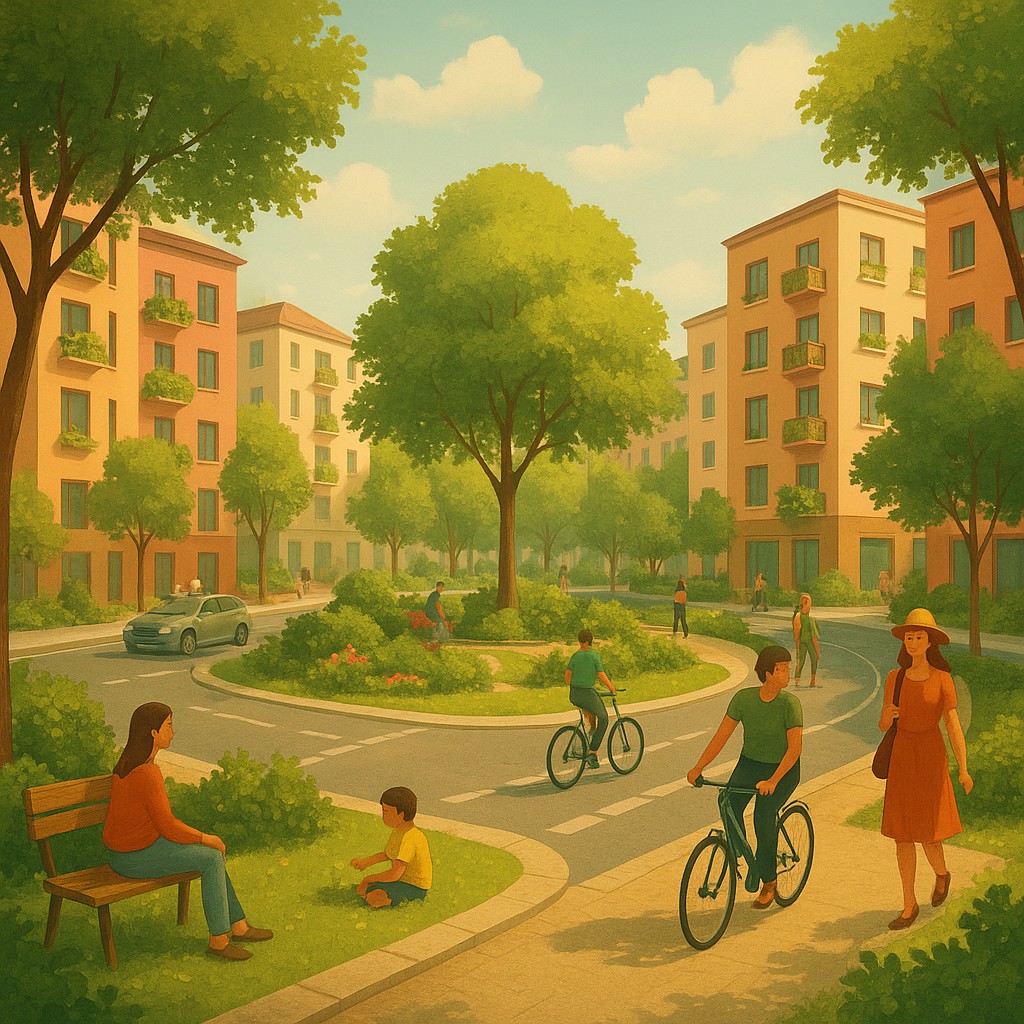
Imagine stepping out of your front door and, instead of the hectic roar of a delivery truck or the smell of exhaust, you are greeted by a neighbor’s laughter and the sight of a leafy garden. For the last century, cities have been designed with one main goal: moving metal boxes on wheels as quickly as possible. The street, once a stage for social life where children played and neighbors did business, was demoted to a simple traffic lane. We have lived with the hum of engines for so long that we often forget it is a choice we made, not a law of nature.
The tide is finally turning. Urban planners are realizing that squeezing more cars into narrow residential streets is a losing game that only leads to traffic jams, asthma, and lonelier lives. A revolutionary idea called the "superblock" is gaining ground. It offers a way to flip the script on city living without tearing down buildings or banning cars entirely. By rethinking how we group city blocks, we can "evict" through-traffic from our neighborhoods and reclaim the pavement for the people who actually live there. This is more than just a tweak to a map; it is a total shift in how we define the purpose of public space.
The Layout of a Living Neighborhood
To understand the superblock, we first have to look at the grid pattern that defines most modern cities. In a typical grid, every street is a potential shortcut. If a main road is backed up, drivers simply duck into a side street, turning quiet residential lanes into high-speed bypasses. This creates a "leaky" neighborhood where noise and danger are spread across every single block. The superblock changes this by grouping a square of nine existing blocks - a 3x3 grid - into one unit. Inside this boundary, the rules of the road change completely.
The genius of the design is in its perimeter. All heavy traffic, buses, and commuters are kept on the large streets that form the outer edge of the superblock. This leaves the inner streets for local use only. However, just saying "locals only" rarely stops a driver with a GPS, so planners use physical changes. Internal roads are often redesigned as loops or dead-ends, making it impossible to drive straight through the neighborhood to get somewhere else. While residents, emergency crews, and delivery vans can still enter, they must drive at a walking pace of about six miles per hour.
When you remove the 90 percent of traffic that was just passing through, the street transforms. Suddenly, the asphalt is no longer a danger zone. In cities like Barcelona, these reclaimed spaces are now filled with playgrounds, picnic tables, and running tracks. The street stops being a pipe for moving vehicles and starts being an outdoor living room. It turns the neighborhood into a "cell" within the city, protected on the outside but vibrant and open on the inside.
Breaking the Car’s Monopoly Without a Ban
A common myth about superblocks is that they are part of a "war on cars" meant to trap people in their homes. In reality, the superblock is a smart compromise. It recognizes that in a modern economy, we still need vehicles to deliver groceries, help the elderly, or respond to fires. The goal is not to get rid of the car, but to end its total control over every inch of our public space. It is about restoring a balance where people on foot are the priority in the urban environment.
Within a superblock, the street is often flattened, removing the curb that separates the "safe" sidewalk from the "dangerous" road. This visual cue tells drivers they are guests in a space for humans, not owners of a traffic lane. Because these roads are no longer useful shortcuts, the number of cars drops so much that the sense of danger vanishes. This allows for a "shared space" model where a toddler on a tricycle, a person in a wheelchair, and a slow-moving delivery van can all exist together without metal railings or constant stoplights.
This shift has a deep impact on the local economy and social life. When streets are pleasant to walk on, people spend more time outside. They stop to talk to neighbors, notice shop windows, and sit at outdoor cafes. Studies in cities like Vitoria-Gasteiz and Barcelona show that while some business owners fear losing traffic will hurt sales, the opposite is usually true. Foot traffic is the lifeblood of local business. People who are walking are much more likely to stop and spend money than someone swearing at a red light while driving past at forty miles per hour.
The Quiet Benefits of Peaceful Streets
The first thing a resident notices in a superblock is the silence. We have become used to a constant roar of about 70 decibels in most city centers. This noise is more than just annoying; it is a physical stressor that keeps our stress hormones high and ruins our sleep. By moving through-traffic to the edges, the inside of a superblock becomes quiet enough for normal conversations and even the sound of birds.
Lungs get a break, too. Nitrogen dioxide and tiny dust particles - the invisible killers of the city - are found mostly along busy car routes. When vehicles are pushed to the perimeter, the air quality in the center of the superblock improves almost instantly, creating "pockets of health" across the city. Interestingly, the total amount of traffic in the city often goes down, a trend called "evaporating traffic." When driving becomes slightly less convenient and walking becomes much more pleasant, many people simply choose to walk or bike for short trips.
| Feature |
Traditional City Grid |
Superblock Model |
| Main Goal |
Moving as many cars as possible |
Encouraging health and social life |
| Street Function |
A through-way for commuters |
A shared plaza and local access point |
| Noise Levels |
High and constant everywhere |
Quiet inside, concentrated on the edges |
| Air Quality |
Poor due to idling cars |
Much cleaner in the residential center |
| Local Economy |
Focused on quick commuter access |
Driven by steady foot traffic |
| Safety |
High risk for walkers and bikers |
Very safe; focused on human movement |
Solving the Border Problem
Critics often point to a potential "perimeter problem." If you push all the cars from the center to the edges, won't the boundary roads become clogged with smog and traffic jams? This is a fair concern. If planners move the cars without changing anything else, they are just shifting the problem to a different group of neighbors. This is why a superblock is never a solo project; it is always part of a bigger plan that includes better buses, trains, and bike lanes.
The goal is to reduce the total number of cars, not just move them around. In Vitoria-Gasteiz, Spain, superblocks were launched alongside a total redesign of the bus system to make sure people had a real alternative to driving. As these neighborhoods become more pleasant, the demand for local shops grows, leading to the "15-minute city" where everything you need is a short walk away. This reduces the need for long cross-city trips, eventually taking the pressure off those edge roads.
There is also the fear of rising costs. When a neighborhood becomes greener, quieter, and safer, property values usually go up. This can push out the very people the project was meant to help. To stop this, successful projects often use rent caps or include low-income housing. The street is a public utility, like water or power, and the benefit of clean air and a livable home should be a right for everyone, not a luxury for the wealthy.
Reclaiming the Common Ground
At its heart, the superblock is about changing our mindset. For decades, we have been trained to see the space between buildings as "the road," a place where humans don't belong unless they are moving. We rush across intersections and pull our children away from the curb. The superblock invites us to see that space as "the commons," or shared ground. When a street is paved with bricks instead of asphalt and filled with trees instead of parking meters, our behavior changes. We slow down. We stay a while.
This creates "social stickiness." On a traditional street, you see a lot of people, but they rarely talk. In a superblock, there are fewer people, but they stay longer. This leads to "accidental encounters," the small nods and short chats that build a strong community. You might not be best friends with the person three doors down, but because you both spend time in the same plaza, you recognize them. That recognition is the foundation of public safety and neighborhood spirit.
Making this work requires a new way to measure "success." For a long time, the only number that mattered was how many cars could pass through an intersection in a minute. The superblock asks us to measure things that are harder to count but more important to feel: the number of children playing outside, the age of the people sitting on benches, and how active the residents are. It turns the city from a machine for cars into a garden for people.
Redesigning Our Mental Map
As we look at the future of our planet, the way we design cities will be a major factor in our survival. Urban areas produce a huge amount of global carbon emissions, much of it from short, unnecessary car trips. The superblock provides a low-cost, repeatable plan to make our cities more sustainable and more joyful. It proves we don’t need flying cars to solve our problems; we just need to remember how to walk together.
The next time you walk down a noisy, crowded street, try to imagine it without the rows of parked cars and the constant traffic. Picture a row of trees where the center lane is now, and neighbors sharing a meal where an SUV is currently idling. The superblock isn't a fantasy; it is a proven strategy already saving lives and cooling down cities worldwide. By reclaiming our streets, we aren't just changing a map; we are reclaiming our right to a quiet, healthy, and connected life.
The change begins with a simple realization: the streets belong to us. We have the power to decide that our neighborhoods should be more than just gaps between destinations. When we prioritize human breath over horsepower and community over commuting, we create cities that don't just work, but flourish. Let superblocks remind us that even the most rigid concrete grid can be softened by a vision of a more human world. Reach out to your local leaders, talk to your neighbors, and start looking at your own street not as a road, but as a possibility.