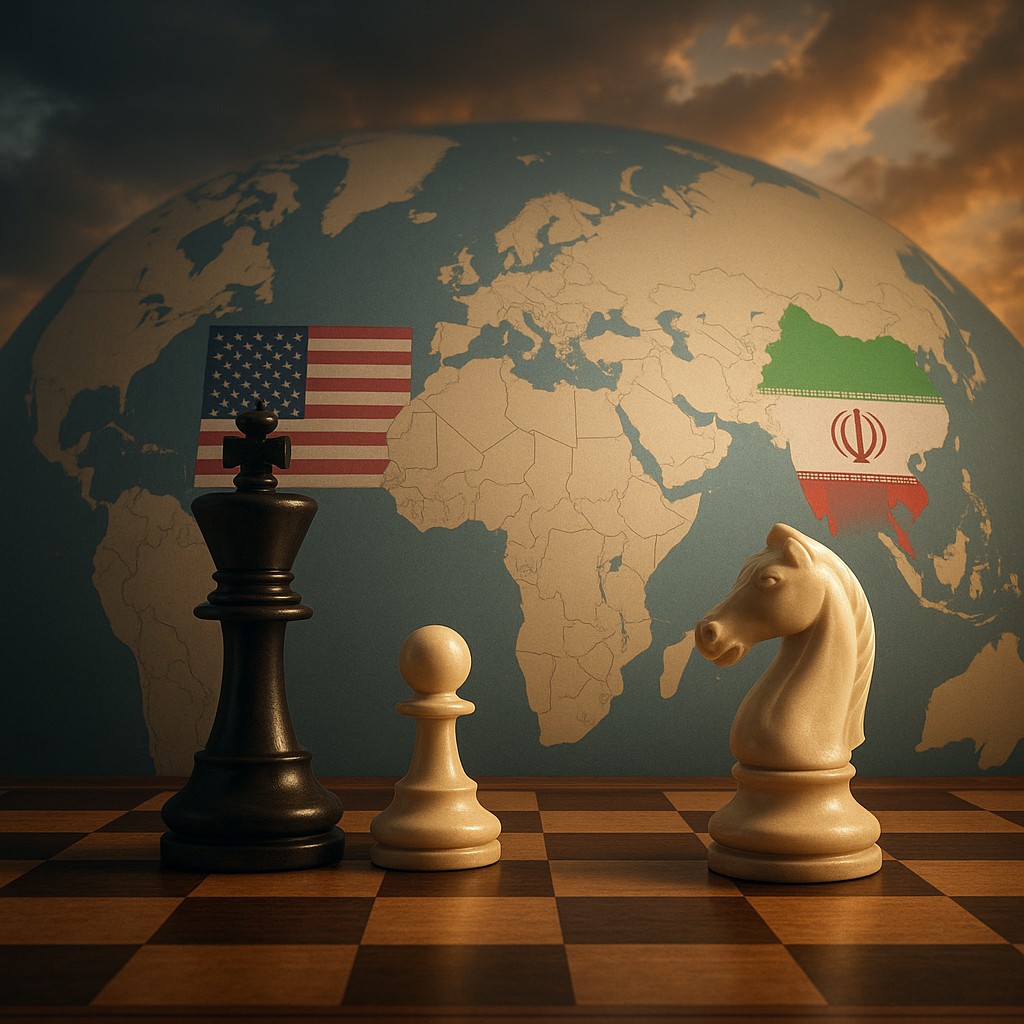
International geopolitics often feels like a giant, high-stakes chess match played with pieces that cost billions of dollars and carry global consequences. When news breaks of military action between the United States and Iran, it can feel overwhelming, confusing, and frankly, a little frightening. We are currently witnessing a major escalation in a relationship that has simmered for decades, moving from a "cold" shadow war of sanctions and cyberattacks into a very visible "hot" exchange of direct military force. Understanding this situation is about more than just reading headlines; it involves grasping the delicate balance of power in the Middle East and how a few hours of military activity can reshape the next decade of history.
To make sense of current events, we have to look past the smoke and dramatic press releases. The recent coordinated strikes by the United States and Israel against targets inside Iran represent a massive shift in how these nations interact. While technical details and casualty counts often trickle out slowly through intelligence briefings, the strategic picture is becoming clear. This is an attempt to fundamentally weaken Iran's ability to project power across its borders, targeting everything from missile silos to the command structures that direct regional influence. It is a story of technology, geography, and the grueling pursuit of security in a region that rarely sees a dull moment.
Deciphering the Strategy Behind the Precision Strikes
The military operation currently underway is not a random act of aggression but a highly synchronized campaign aimed at "degrading capabilities," the military term for destroying an enemy's tools and facilities. The primary focus of U.S. Central Command (CENTCOM) and its allies has been on neutralizing three specific areas: air defense systems, missile production facilities, and the command centers of the Islamic Revolutionary Guard Corps (IRGC). By taking out air defenses first, the U.S. and Israel ensure their aircraft can fly safely. This essentially "opens the door" to hit more sensitive targets without the same level of risk they would have faced just days earlier.
This approach is rooted in a concept called "Integrated Air and Missile Defense" (IAMD) in reverse. Instead of just trying to block incoming missiles, the strategy has shifted to "left of launch" tactics - a plan to destroy missiles while they are still on the ground or in the factory. By targeting the supply chains and manufacturing sites, the U.S. aims to shorten the reach of Iranian influence for months, if not years. It is a surgical approach designed to cripple the military while trying to avoid a total war that would draw the entire world into a ground conflict.
However, modern warfare is never a one-way street. Iran’s response typically involves "asymmetric" capabilities, which is a professional way of saying they use drones and missiles that are cheap to build but expensive and difficult to shoot down. We have seen Iranian retaliatory launches across the region, targeting bases and strategic locations to show they can still strike back despite the hits to their infrastructure. This back and forth is essentially a deadly conversation where each side tries to prove it has "escalation dominance" - the ability to have the final word in any fight.
The Technological Leap and the Drone Dilemma
One of the most fascinating, yet grim, aspects of this conflict is the role of unmanned systems. For decades, the U.S. relied on massive aircraft carriers and stealth bombers to project power. While those are still in play, the current landscape is dominated by drones. Iran has spent the last twenty years becoming a pioneer in low-cost drone technology, which they have exported to various groups throughout the Middle East. This has created a "saturation" problem for U.S. defenses, where dozens of cheap drones can be fired at once to overwhelm the sophisticated and expensive interceptor missiles used by the Navy and Air Force.
When the U.S. targets these sites, they aren't just looking for big hangars; they are looking for software labs and the specialized components that allow drones to navigate. The "precision" in "precision strikes" comes from satellite imagery and signals intelligence - methods of gathering electronic data - that can pinpoint a specific room in a building where drone guidance systems are programmed. It is a high-tech game of hide and seek where the U.S. uses its superior "eyes in the sky" to find targets that Iran tries to bury deep underground or hide in plain sight among civilian buildings.
| Combat Component |
U.S. Tactical Focus |
Iranian Tactical Focus |
| Primary Weaponry |
Stealth fighters, precision missiles |
Ballistic missiles, suicide drones |
| Defensive Strategy |
Layered Aegis and Patriot systems |
Deep underground bunkers, mobility |
| Goal of Strikes |
Crippling manufacturing and command |
Deterrence through regional retaliation |
| Technological Edge |
Satellite intelligence and cyber warfare |
Mass production of low-cost tech |
| Allied Integration |
High (Coordinated with Israel/UK) |
Proxy-based (Hezbollah, Houthis, etc.) |
A Century of Friction in a Few Decades
To understand why the U.S. is attacking now, we have to clear up some common misconceptions. It is easy to think this is a brand-new grudge, but tension has been building since at least the late 1970s. Many people believe the U.S. wants to "invade" Iran, similar to the Iraq war in 2003. However, current reality suggests something very different. Military analysts point out there is no appetite for a ground invasion. Instead, these strikes are part of a policy of "active containment." Rather than just putting up a fence and hoping Iran stays inside, the U.S. is occasionally reaching over that fence to break the tools Iran uses to reach out.
Another myth is that these attacks are purely about nuclear weapons. While the nuclear program is a major concern, the immediate trigger for recent U.S. actions is often the safety of global shipping lanes and the protection of U.S. personnel in neighboring countries like Iraq and Syria. Iran’s "Forward Defense" policy involves using regional allies to keep the fighting away from Iranian soil. By striking inside Iran directly, the U.S. and Israel are signaling that the "old rules," where Iran could act through third parties without facing consequences at home, have been rewritten.
The complexity also involves the global economy. A significant portion of the world's oil passes through the Strait of Hormuz, a narrow waterway bordering Iran. Any time the U.S. launches an attack, there is a risk Iran will try to close this strait. This is why the U.S. focuses so heavily on Iranian naval assets and coastal missile batteries. It isn't just about winning a fight; it is about keeping the "veins" of global commerce open so that a Middle Eastern conflict doesn't result in a gas price spike that crashes the world economy.
The Diplomatic Battlefield and the UN Theater
While the physical fighting happens with missiles and jets, a parallel war is fought in the halls of the United Nations. After recent strikes, emergency sessions of the Security Council became a theater for "lawfare," which is the use of international law as a weapon. The U.S. and Israel argue their strikes are preemptive self-defense, a legal concept that allows a country to strike first if they believe an attack is certain and unavoidable. Iran, conversely, views these as violations of national sovereignty and "acts of war" that justify their own retaliatory strikes under the UN Charter.
This diplomatic layer is crucial because it determines how other countries, like China and Russia, react. If the U.S. can convince the world its actions were necessary to prevent a larger regional war, it maintains its international standing. If it fails, it risks becoming isolated. The UN Chief and various leaders often find themselves in the middle, calling for de-escalation because they know one "miscalculation" - a stray missile hitting the wrong target or a ship being sunk in the wrong place - could trigger a spiral that diplomacy cannot stop.
It is also important to note the internal pressure within both the U.S. and Iran. Governments don't just act based on foreign policy; they act based on what their people want. In the U.S., there is a strong desire to avoid "Forever Wars," which is why these attacks are framed as "limited operations" rather than the start of a new campaign. In Iran, the leadership must balance its desire to look strong with the reality that its economy is struggling under heavy sanctions. Every missile fired is a calculated risk aimed at satisfying domestic audiences without accidentally starting a war they might not be able to finish.
Navigating the Fog of Information and Disinformation
In the modern age, the "fog of war" isn't just about smoke on the battlefield; it is about the flood of information on the internet. During these attacks, social media becomes a chaotic mess of old videos passed off as new, and "official" accounts from both sides claiming total victory. For example, after U.S. strikes, Iranian state media often shows footage of successful interceptions, while U.S. Central Command releases black-and-white satellite photos showing destroyed buildings. The truth usually lies somewhere in the middle, and it takes days for independent analysts to verify what actually happened.
One way to stay informed without being misled is to look for third-party evidence. If a missile site was truly destroyed, we will eventually see "burn scars" on civilian satellite imagery that anyone can buy. If a retaliatory strike caused casualties, we would see hospital reports or local funeral announcements. So far, reports indicate that while the physical damage to Iranian military infrastructure has been significant, the loss of life has been relatively contained compared to the scale of the weapons used. This suggests the U.S. is leaning heavily on intelligence to hit hardware while avoiding the "human cost" that would make peace impossible.
The "Information Operations" of both sides are just as important as the bombs themselves. The U.S. wants the Iranian leadership to feel vulnerable - to know their "secret" bases aren't secret at all. Iran wants the U.S. public to feel these strikes are a waste of money and a dangerous provocation. Understanding this helps us realize that every "leak" and every "official statement" is designed to influence how we feel or how leaders on the other side make decisions.
The Path Forward and the Power of Informed Perspectives
As we watch these events unfold, it is clear we are in an era of "precision volatility." The tools of war have become so accurate that a country can destroy a specific office inside a building half a world away, yet the political consequences remain as messy as they were a hundred years ago. The goal of current U.S. actions appears to be a "reset" of the balance of power, trying to ensure the cost of Iran’s regional activities becomes higher than the benefit they receive. Whether this leads to a more stable Middle East or a wider conflict depends on the restraint shown in the coming weeks.
Learning about these complex dynamics is the first step toward being a responsible global citizen. It allows you to look past the "breaking news" banners and see the underlying chess moves that define our world. When you understand the difference between a tactical strike and a strategic shift, you stop being a passive consumer of news and start being an informed observer of history. The world is undeniably complicated, but it is also deeply fascinating. By staying curious and critical, you gain a type of "intellectual armor" that keeps you steady even when the headlines are chaotic.
The future is never written in stone. While the sounds of conflict are loud right now, they are often the precursor to new diplomatic efforts. History shows that periods of intense tension often lead to a "realignment" where both sides, having tested each other's limits, find a new, if uncomfortable, way to coexist. By understanding the "why" and "how" of what is happening between the U.S. and Iran, you are better equipped to navigate the changes coming to the global stage. Stay sharp, stay curious, and remember that knowledge is the most effective tool we have for making sense of a world in motion.