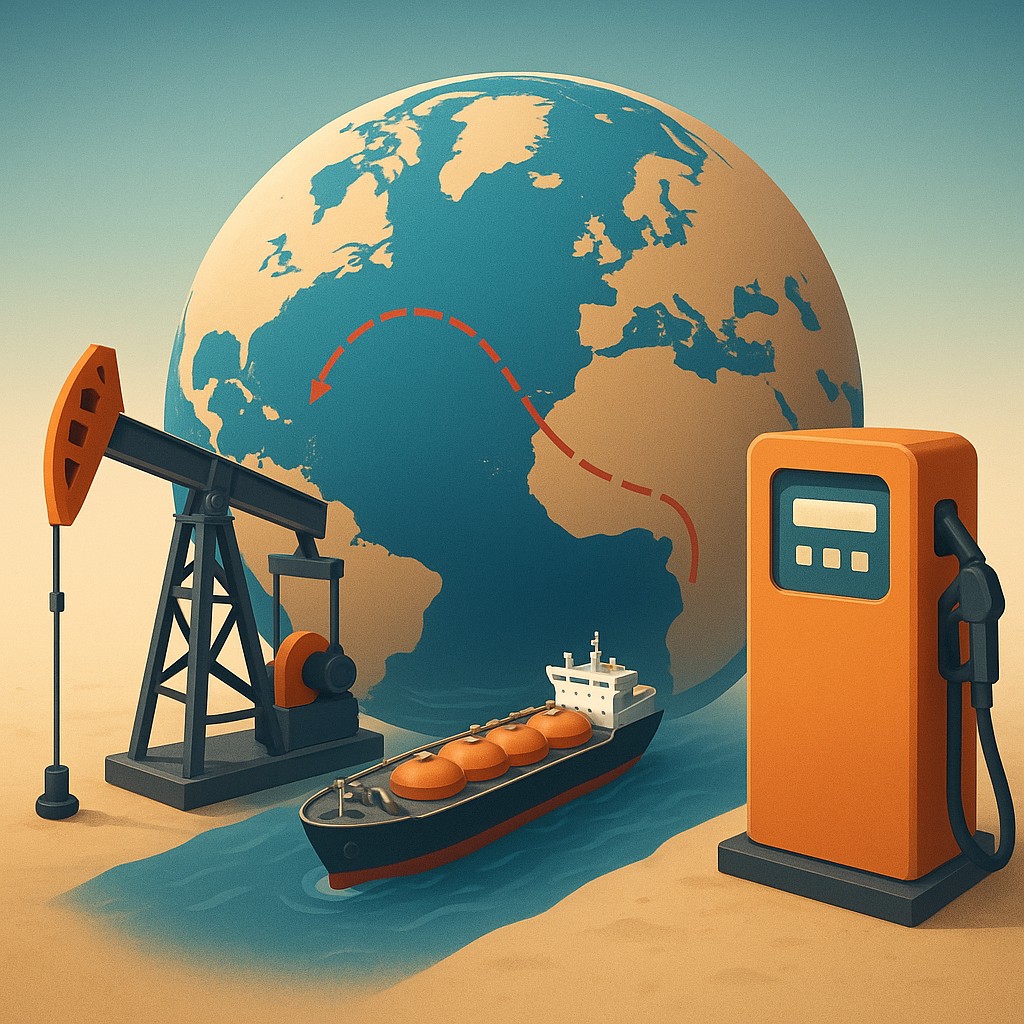
Think of your car's engine as a very picky eater. It has no interest in the thick, raw, sludge-filled crude oil pulled straight from the ground in Texas or Saudi Arabia. Instead, it demands a highly refined, chemically balanced liquid that has traveled through an invisible, global assembly line spanning thousands of miles. This vast network of pipes, ships, and refineries is perhaps the most complex machine humans have ever built. Most of the time, we hardly notice it. We pull up to a station, tap a card, and watch the numbers climb. But when a tiny strip of water on the other side of the planet gets blocked, that invisible machine starts to grind its gears, and we feel the friction in our bank accounts.
Current events have turned a spotlight on the Strait of Hormuz, a narrow waterway that acts like a main artery for the global energy market. When oil flow through this passage is restricted, it creates a ripple effect. It touches everything from the price of a gallon of gas in Ohio and the cost of a plastic toy made in Vietnam to the price of a truckload of tomatoes arriving at a grocery store in Berlin. To understand why a blockage in one corner of the Middle East makes life more expensive for everyone, we have to look behind the curtain at how oil is actually moved and how the world calculates its value in real time.
From Deep Underground to Your Local Pump
The journey of a drop of fuel begins as crude oil, a dark, thick mixture of energy-rich chemicals buried deep in the earth. This raw material is essentially useless until it reaches a refinery, but getting it there is half the battle. Because oil is often found far from where people actually live, it must travel across continents and oceans. Massive pipelines act like the body's arteries, pumping crude at high pressure toward coastal ports. From there, the oil is loaded onto "Ultra Large Crude Carriers," which are essentially floating skyscrapers capable of holding two million barrels of oil. These ships are the workhorses of global trade, navigating specific sea paths to reach refineries in the United States, Europe, and Asia.
Once the crude arrives at a refinery, the real transformation happens. Refiners use heat to separate the oil into different groups, or "fractions," based on their boiling points. This process, called fractional distillation, creates products like gasoline, diesel, jet fuel, and heating oil. After it is refined, the fuel is not just dumped into any old truck. It moves through a second network of smaller pipes and regional storage tanks. Finally, those shiny tanker trucks you see on the highway deliver the finished product to the underground tanks at your local gas station. Every step of this process costs money. Any delay or risk at the very beginning of the chain (the crude oil stage) increases the cost of every step that follows.
The Geography of a Global Chokepoint
If the world’s oil supply is like a life-support drip for the global economy, the Strait of Hormuz is the narrow tube that everything must pass through. Located between Oman and Iran, it connects the Persian Gulf with the Arabian Sea. At its narrowest point, the shipping lanes are only two miles wide in either direction. This is the only way for oil-producing giants like Saudi Arabia, Kuwait, the United Arab Emirates, Iraq, and Iran to get their product to the open ocean. Because so much of the world's daily oil (about 20% to 30%) passes through this single point, even a hint of trouble there makes the global market panic.
When we talk about a "blockage" in the Strait, we do not necessarily mean a physical wall. It could mean military tension, the threat of sea mines, or the seizing of ships. When shipping companies feel it is unsafe to send their billion-dollar vessels through the Strait, they have to make a choice: wait it out or take the long way around. Taking the long way usually means sailing around the entire continent of Africa, which adds weeks to the journey and millions of dollars in fuel and labor costs. Even if the ships keep moving, insurance companies will spike their rates because of the risk of damage. Those extra insurance costs are eventually passed down to shoppers at the pump.
The Mental Game of Global Pricing
A common mistake is thinking that gas prices only go up when there is a physical shortage of oil at the station. In reality, oil is traded on a "futures market." This is basically a giant room full of people betting on what the price of oil will be a few months from now. If traders see that the Strait of Hormuz is blocked or even threatened, they worry there will be a shortage later. To protect themselves, they start buying up oil contracts now, which drives the price up immediately. This is why you might see gas prices jump at your local station just hours after a news report about a conflict in the Middle East, even though the oil currently in the station's tanks was bought weeks ago.
This "fear factor" is a huge part of what you pay. The global economy hates uncertainty. When a major transit point like Hormuz is in danger, it tells every industry that the energy supply is no longer guaranteed. Factories that need massive amounts of power, airlines that need millions of gallons of jet fuel, and shipping companies that move goods across the sea all begin to prepare for higher costs. This collective reaction speeds up price hikes everywhere. The table below shows how different factors contribute to the final price you see at the gas station. You can see that "Crude Oil Costs," which are most affected by the Strait, are the biggest piece of the pie.
| Component of Price |
Percentage of Total (Approx.) |
Why it Changes |
| Crude Oil Cost |
50-60% |
Global supply, world politics, and shipping safety. |
| Refining Costs |
15-20% |
Seasonal maintenance, technology, and plant capacity. |
| Distribution & Marketing |
10-15% |
Trucking costs, local competition, and station overhead. |
| Taxes |
15-25% |
State and federal policies (mostly fixed). |
Why Alternatives Do Not Save Us Instantly
You might wonder why we do not just use "different" oil if the Middle Eastern supply is blocked. While the United States and other regions have increased their own production, the oil market is one giant global pool. If 20 million barrels of oil are stuck behind the Strait of Hormuz, the countries that were going to buy that oil (mostly in Asia) will start looking elsewhere, like the North Sea or West Africa. This creates a bidding war. Even if your local gas station gets its oil from a refinery in New Jersey using crude from Texas, the price is still tied to the "global benchmark," or the standard world price. If the global price goes up because of a shortage in Asia, your local Texas oil becomes more valuable, and the price rises for everyone regardless of where it came from.
Furthermore, changing the "plumbing" of the global oil trade is not as easy as flipping a switch. Pipelines have set capacities, and many are already running at full speed. Opening a new oil field or building a new pipeline to bypass a chokepoint takes years of planning and billions of dollars. This lack of flexibility is what makes the Strait of Hormuz so powerful. There simply isn't enough extra space in other routes to make up for the amount of oil that passes through that narrow strip of water. When that valve is tightened, the entire world feels the pressure.
Beyond the Pump and Into Your Pocket
The impact of a blocked shipping lane does not stop at your car's fuel tank. Because petroleum is a basic ingredient for modern life, high oil prices trigger "cost-push inflation," which is when the rising cost of production forces prices up. Think about a simple plastic water bottle. It is made from chemicals derived from oil, it is manufactured in a factory powered by energy often linked to oil prices, and it is shipped to you in a truck that runs on diesel. When the cost of the raw material (oil) goes up due to a bottleneck at sea, the price of the bottle, the transport, and the production all rise at the same time. This is why an energy crisis often feels like a general "everything is more expensive" crisis.
This connection explains why governments work so hard to keep shipping lanes open. It is not just about keeping the lights on; it is about keeping the entire engine of global trade from seizing up. When the Strait of Hormuz is blocked, it is as if a major highway intersection in a city was suddenly closed during rush hour. Traffic backed up in that one spot eventually causes delays in neighborhoods miles away. By understanding this system, you can see that price changes are not a conspiracy by your local gas station owner, but a reaction to a massive, delicate, and currently stressed global chain.
As you deal with changing prices and complex news, remember that you are a part of one of the most incredible logistical feats in history. Every time you fill your tank, you are tapping into a flow that involves thousands of people, brilliant engineering, and a complex dance of international politics. Knowledge is the best fuel for navigating uncertain times. By understanding how these hidden gears turn, you move from being a frustrated consumer to an informed observer of the world's most vital resource. Use this perspective to make smarter decisions, stay curious, and appreciate the immense effort it takes to keep our modern world moving.