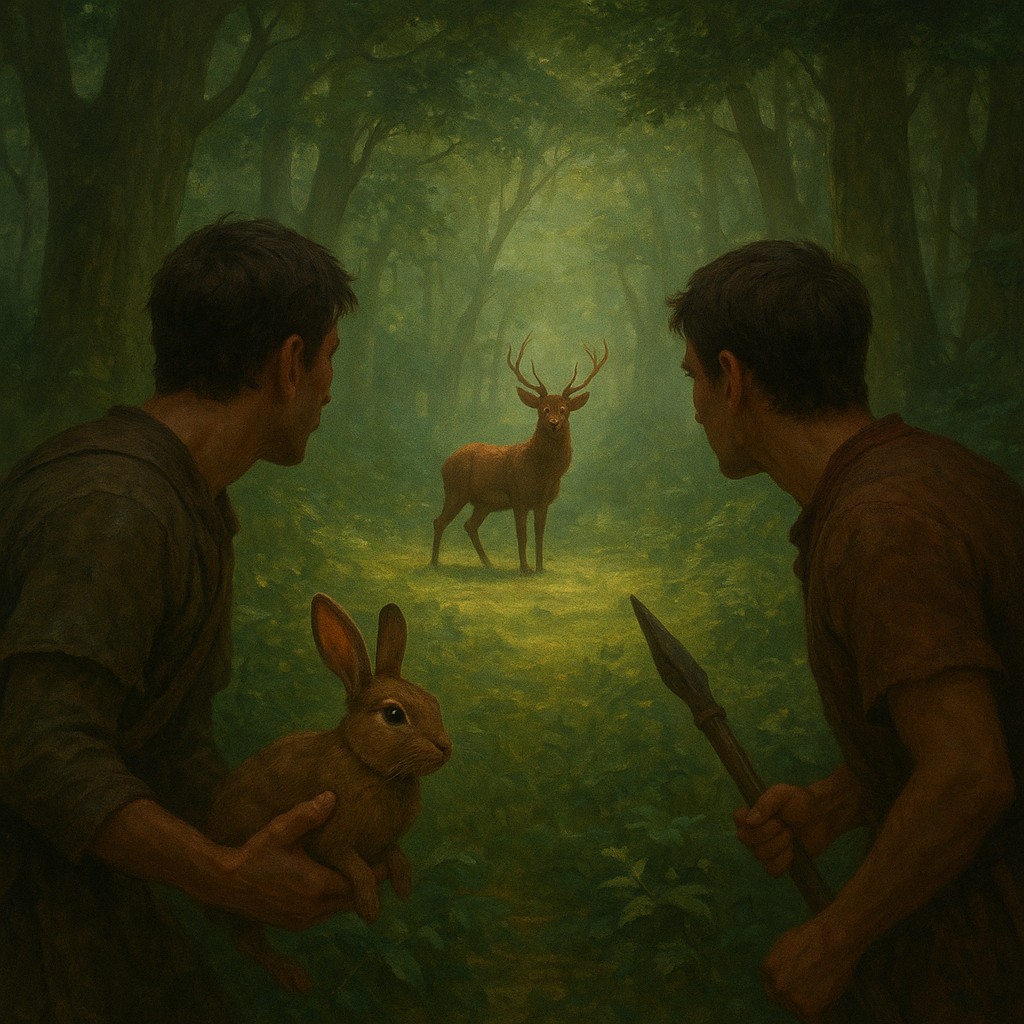
Imagine you and a trusted companion are standing at the edge of a dense, ancient forest. You haven't eaten in days, and your goal is clear: catch a stag. A stag is a massive prize, providing enough meat to feed both of your families for a week. However, a stag is also fast and powerful. It is impossible for one person to bring it down alone. You must work together, flanking the animal and coordinating your movements with perfect precision. If either of you moves too early or loses nerve, the stag bolts, and you both go hungry.
Just as the stag comes into view, a small, plump rabbit hops across your path, right within reach. If you lunge for the rabbit, you are guaranteed a meal for yourself today, but your sudden movement will surely scare away the stag. By grabbing the rabbit, you ensure your own survival while leaving your partner with nothing but a bitter story about the one that got away. This simple dilemma, first popularized by the philosopher Jean-Jacques Rousseau, is the heart of the "Stag Hunt." It is a game of trust, risk, and the agonizing tension between collective greatness and individual security.
The Mathematical Soul of Cooperation
In the world of game theory, the Stag Hunt is often described as a coordination game. Unlike the more famous Prisoner's Dilemma, where the "rational" choice is to betray your partner because it protects you regardless of what they do, the Stag Hunt is a bit more optimistic but significantly more social. In this model, there are two "equilibria," or stable outcomes. The first is the "Stag Equilibrium," where everyone cooperates and everyone wins big. The second is the "Rabbit Equilibrium," where everyone looks out for themselves, settles for less, and the big goals are abandoned.
The problem is not that people are inherently mean or selfish; it is that they are afraid of being the only ones trying to do the right thing. If I believe you are going for the stag, my best move is to help you. If I suspect you are going to get distracted by a rabbit, my best move is to grab my own rabbit first so I don't end up with an empty stomach. This creates a psychological feedback loop. Trust acts as the glue that holds high-level cooperation together. Without it, the "rational" choice cascades downward into mediocrity. This model is a perfect lens for looking at international relations, where countries must decide between long-term global stability and short-term national gains.
Chasing Rabbits on the Global Stage
When we move from the forest to the halls of the United Nations or the boardroom of a multinational corporation, the rabbits change shape, but the logic remains the same. Consider a global climate accord. Every nation on Earth would benefit from a stable climate, which represents the "Stag." However, achieving this requires every nation to make significant sacrifices now, such as limiting industrial output or investing heavily in unproven technologies. If one major country decides to ignore the accord to boost its own economy, that country is "catching a rabbit." They get a quick economic win while the rest of the world is left holding the bag of a failing climate strategy.
This dynamic explains why international agreements are so notoriously difficult to maintain. Even if every leader in the room genuinely wants the "Stag" (a healthy planet), they are constantly looking sideways at their neighbors. If a president or prime minister suspects that a rival is going to cheat to gain a competitive advantage, they feel pressured to cheat first to protect their own citizens. In diplomacy, this is often called the "security dilemma." The fear of being the only "sucker" who stayed loyal to the group goal while everyone else ate rabbits is one of the most powerful forces in human history. To visualize how these choices stack up, we can look at a simple payoff matrix.
| Participant A Choice |
Participant B Choice |
Outcome for A |
Outcome for B |
Result Name |
| Hunt Stag |
Hunt Stag |
Very High (5) |
Very High (5) |
Mutual Cooperation (The Dream) |
| Hunt Stag |
Catch Rabbit |
Zero (0) |
Medium (3) |
The Sucker's Regret |
| Catch Rabbit |
Hunt Stag |
Medium (3) |
Zero (0) |
The Defector's Lunch |
| Catch Rabbit |
Catch Rabbit |
Medium (3) |
Medium (3) |
Mutual Mediocrity (The Safe Bet) |
The Friction of Uncertainty and Rationality
One of the most fascinating aspects of the Stag Hunt is its reliance on the assumption of rationality. In a textbook, a rational player looks at the math and decides that 5 is better than 3. Therefore, if they can just be sure the other person will cooperate, they will always choose the stag. However, humans are not calculators. We are driven by pride, historical grudges, and internal politics. Sometimes a leader might choose to hunt a rabbit not because it is the most logical choice for their country, but because they need a quick win to satisfy voters before an election.
In the real world, the "Stag" is also often invisible or poorly defined. While two hunters in the woods can clearly see the deer, a "Stag" like global financial stability is an abstract concept. It is hard to stay motivated for a vague future benefit when a very real "Rabbit," like a cheap trade deal or a boost in domestic approval, is sitting right in front of you. This is why transparency is so vital in international relations. To keep everyone hunting the stag, you need "monitors." Whether it is weapons inspectors or carbon footprint auditors, these third parties act as the eyes of the group, ensuring that no one is sneaking off into the bushes to hunt small game.
Building Bridges across the Trust Gap
If the Stag Hunt tells us that cooperation is fragile, how do we ever get anything done? History is full of examples where the "Stag" was successfully caught. The development of the International Space Station, the eradication of smallpox, and the creation of the internet are all instances where groups decided the big prize was worth the risk. These successes usually share a common thread: they didn't start with the big hunt. Instead, they built up to it through a series of "mini-stags."
Trust is a muscle that grows with exercise. By starting with small, low-risk projects, nations and organizations prove to each other that they are reliable partners. If you and I successfully hunt ten rabbits together and share them fairly, I am much more likely to trust you when the stag finally appears. This is why diplomacy is often a slow, agonizing process of small steps. You aren't just negotiating a treaty; you are building a psychological foundation. Another strategy is to change the "payoffs." If the group creates a system where hunting a rabbit results in a heavy fine or social shunning, the rabbit suddenly looks much less appetizing. By increasing the cost of defecting, you make the stag the only sensible target.
Beyond the Model toward a Shared Future
The most poignant lesson of the Stag Hunt is that the "Rabbit Equilibrium" is a trap. It is a stable state where everyone is doing okay, but no one is doing great. It is easy to look at the world and see its flaws as the result of malice, but the Stag Hunt suggests something more tragic: many of our greatest failures are simply the result of a lack of confidence in one another. We settle for rabbits not because we hate the stag, but because we are afraid of the silence that follows a failed partnership. We choose the small win because it is better than the big emptiness.
However, recognizing this model gives us a roadmap for improvement. Once you understand that the primary obstacle to progress is often just the fear of being alone, you can focus your energy on communication and reliability rather than just competition. We live in an era where the "Stags" we are chasing, like curing diseases, colonizing Mars, or reversing environmental damage, are larger and more complex than ever before. These are prizes that no single person, company, or nation can capture in isolation. To win, we have to keep our eyes on the forest and our trust in our partners, even when the bushes are full of rabbits. The future belongs to those who are brave enough to stay in the hunt together, knowing that the greatest rewards are always found in the company of others.