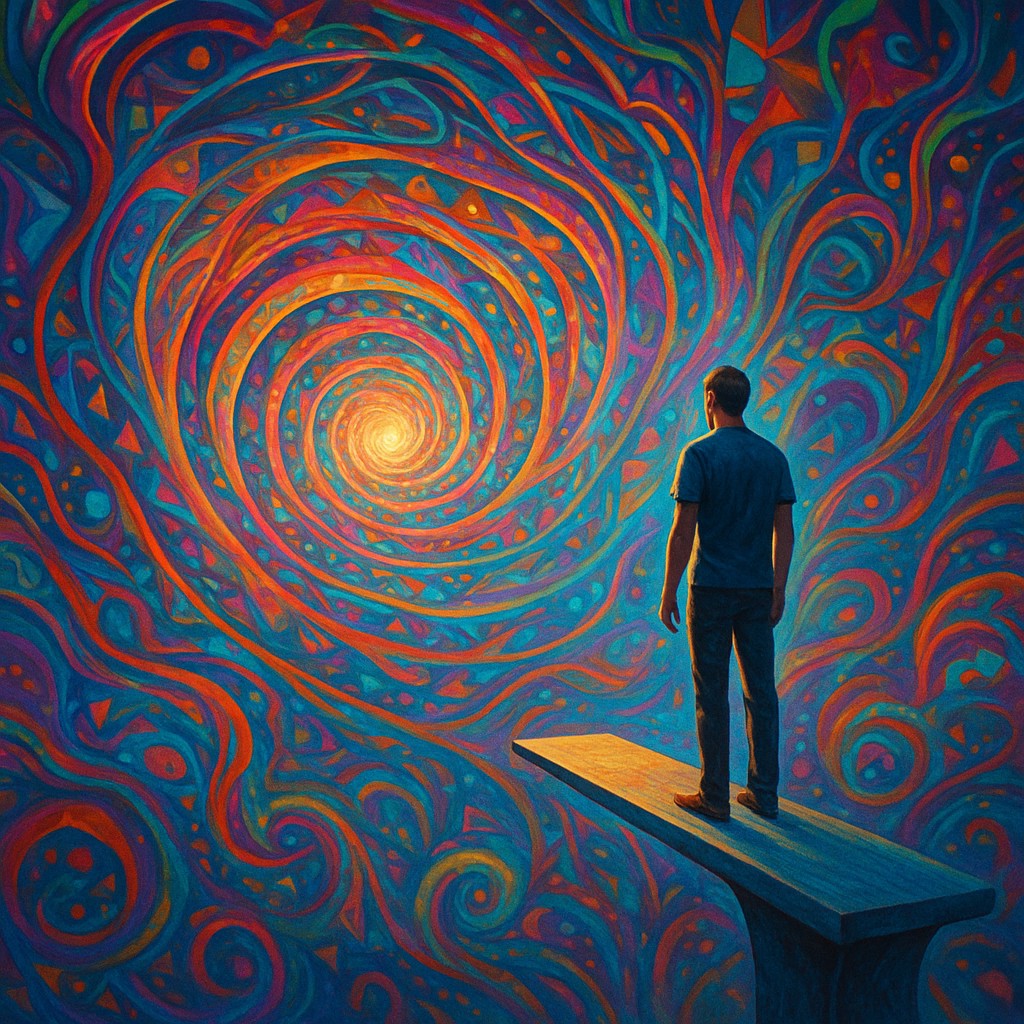
Imagine standing at the edge of a diving board. Instead of a swimming pool below, you see a swirling vortex of geometric patterns and impossible colors. You feel as if you are about to be launched from a cannon into the very center of the universe. In the worlds of pharmacology and neuroscience, few molecules are as mysterious or as potent as N,N-Dimethyltryptamine, or DMT. Often called the "Spirit Molecule," this tiny compound can completely rewrite a person’s perception of reality in seconds. It exists simultaneously in the bark of exotic trees, the grass in your backyard, and quite possibly, inside your own brain.
While other substances take their time to gently nudge the mind, DMT is famous for its "breakthrough" effect. This is a sudden, total immersion into a landscape that feels more real than the world we wake up in every morning. For decades, DMT was a well-kept secret of indigenous Amazonian cultures and niche academic circles. Today, it is at the heart of a major scientific revolution. Researchers no longer view it as a mere curiosity for those seeking mystical experiences. Instead, they see it as a key to unlocking how the brain constructs reality itself. To understand DMT is to take a deep dive into biology, chemistry, and the profound architecture of the human mind.
The Ubiquity of Nature’s Most Potent Secret
DMT is everywhere; that is a literal fact, not a metaphor. It is one of the most common alkaloids (natural nitrogen compounds) in the living world. It is found in hundreds of plant species and various mammals. From the roots of the Mimosa tenuiflora tree to the leaves of the Psychotria viridis shrub, nature seems obsessed with producing this specific arrangement of carbon, hydrogen, and nitrogen atoms. Because it is so widespread, some scientists jokingly call it "nature's currency." No one is quite sure why so many different organisms evolved the ability to create it. It is as if the universe hid a specific key in a thousand different pockets, waiting for someone to find the right door.
For humans, the historical gateway to this molecule was a thick, dark tea called Ayahuasca. Indigenous groups in the Amazon basin discovered that by combining the Psychotria viridis leaf (which contains DMT) with the Banisteriopsis caapi vine, they could create a long-lasting visionary experience. This was a stroke of chemical genius that predates Western science by centuries. On its own, if you eat or drink DMT, your stomach enzymes - specifically Monoamine Oxidase (MAO) - will dismantle the molecule before it ever reaches your bloodstream. The vine contains MAO inhibitors, which act like bodyguards. They allow the DMT to pass through the digestive system unharmed and travel to the brain.
In modern Western settings, DMT is more often found in its pure, crystalline form. This is usually extracted from plants using acid-base chemistry. While the laboratory version lacks the ceremonial history of the Amazonian brew, the core chemical structure is identical. Whether it comes from a clay pot in the jungle or a glass beaker in a high-tech lab, the molecule is a simple derivative of tryptophan. This is the same common amino acid found in turkey and chocolate. This simplicity is exactly what makes its profound effects so baffling to scientists.
Building the Spirit Molecule in the Lab and the Body
The creation of DMT, whether in a plant or a test tube, highlights the modular nature of organic chemistry. At its core, DMT is a tryptamine. This puts it in the same family as serotonin, the chemical that regulates mood, and melatonin, which helps us sleep. To make DMT, nature starts with the amino acid L-tryptophan. Through reactions driven by enzymes, a carboxyl group is removed and two methyl groups are added to the nitrogen atom. This "double methylation" is where the "Dimethyl" in its name comes from. This tiny structural change gives the molecule the incredible ability to cross the blood-brain barrier with ease.
In a lab, chemists mimic these natural paths using solvents and chemicals. Generally, plant material is soaked in an acidic solution to pull the DMT into the liquid. A base is then added to change the pH, making the DMT unable to dissolve in water. A non-polar solvent, such as naphtha, is used to "grab" the DMT molecules. When that solvent is frozen, the DMT drops out of the liquid, forming beautiful white-to-orange crystals. This process is a standard part of organic chemistry. It shows how we can isolate powerful compounds from seemingly ordinary organic matter.
One of the most debated topics in neuroscience is whether the human body produces its own DMT. We know the human brain has the necessary enzymes - specifically indoleethylamine N-methyltransferase (INMT) - to create it. Small amounts of DMT have been found in the pineal glands of rats, and traces have been detected in human urine and blood. Some theorists, led by Dr. Rick Strassman, suggest the brain releases a flood of DMT during birth, death, and intense dreaming. While these theories are still unproven and considered speculative by mainstream academics, they offer a reason why DMT experiences often feel deeply familiar and profound to those who have them.
The Brain Under the Influence of a Chemical Tsunami
When DMT enters the brain, it acts like a master key for doors that are usually bolted shut. Its primary target is the 5-HT2A receptor. This is a specific type of serotonin receptor found mostly in the "higher" parts of the brain, such as the prefrontal cortex. This area handles complex thinking, self-awareness, and how we interpret the world. Normally, these receptors filter the massive amount of sensory data we receive every second, ensuring we only focus on what is necessary for survival. DMT essentially turns that filter off. It allows the brain’s processing power to run at 200 percent capacity without the usual limits of logic or physics.
Recent brain imaging studies have shown that DMT significantly reduces the activity of the "Default Mode Network" (DMN). The DMN is the brain's conductor; it maintains our sense of self and keeps our thoughts organized and predictable. When the DMN is sidelined, different regions of the brain that do not usually talk to each other start shouting across the aisles. The visual cortex communicates directly with emotional centers, and auditory regions might link up with spatial reasoning centers. This explains "synesthesia," where people report "seeing music" or "tasting colors." The brain becomes a hyper-connected web of information, free from the ego’s rigid control.
Additionally, DMT interacts with sigma-1 receptors, which help with cell survival and protein folding. This suggests that DMT’s effects go beyond "trippy visuals." It may actually help protect and regrow brain cells, a process called neuroplasticity. By stimulating these receptors, DMT might encourage the brain to form new neural connections, essentially "re-wiring" itself. This is why researchers are currently testing DMT as a treatment for deep depression and PTSD. It is not just about the ten-minute journey into another dimension; it is about the lasting structural changes the brain undergoes while trying to make sense of the trip afterward.
Contrasting the DMT Experience with Other States
To understand what DMT does, it helps to compare it to better-known substances. While it is related to LSD and Psilocybin (magic mushrooms), DMT is a different beast entirely regarding its intensity and duration. Understanding these differences clarifies why DMT is treated with such unique reverence by both scientists and seekers.
| Feature |
DMT (Vaporized) |
Psilocybin |
LSD |
| Duration |
5 to 15 minutes |
4 to 6 hours |
8 to 12 hours |
| Onset |
Instant (seconds) |
30 to 60 minutes |
45 to 90 minutes |
| Visuals |
Intricate, 3D, independent |
Flowing, organic, "breathing" |
Geometric, sharp, trailing |
| Sense of Self |
Total "Ego Death" is common |
Softening of self-boundaries |
Analytical, reflective state |
| Location |
Feeling like you are "elsewhere" |
Deeply grounded in nature |
Heightened version of reality |
As the table shows, the defining trait of DMT is its speed and power. Because the body processes it so quickly, the user is rocketed into a peak state almost instantly and returns to normal within twenty minutes. This "flash" is so fast that it skips the reflective, thinking stage of other psychedelics. There is no time to ponder your childhood; there is only the overwhelming presence of the experience itself. This makes it a powerful tool for studying "peak experiences" in a controlled medical environment.
The Mystery of the Autonomous Entities
One of the most baffling parts of the DMT experience is the consistent report of "entities." Unlike the blurry hallucinations of a fever dream, DMT users often report meeting intelligent, independent beings. These are described as elves, spirits, or "mechanical teachers." While a skeptic would say these are just the brain turning its own internal patterns into characters, the consistency of these reports across different cultures has left scientists puzzled.
From a neurological view, this could be the result of the brain's "agent detection" system being over-activated. Humans are social creatures; our brains are wired to look for faces and intent in our environment to help us survive. When DMT floods the visual and social centers of the brain, the mind might project a sense of "personality" onto the chaotic patterns it sees. Essentially, the brain tries so hard to make sense of the noise that it creates a person to talk to. Whether these entities are "real" in a spiritual sense is a question for philosophers, but their presence in the mind shows how we are built to find meaning and companionship, even in a chemical storm.
This phenomenon also highlights a radical shift in how we perceive space. Users do not just see patterns on a wall; they feel as though they have been moved to a three-dimensional room or city. This suggests that DMT affects the parietal lobe, the part of the brain that handles our sense of location. By scrambling these coordinates, the molecule allows the mind to build an entirely new internal map. It creates a simulated reality that feels just as solid as the room you are sitting in right now.
Debunking the Myths of the Brain’s Secret Weapon
With a substance as powerful as DMT, myths grow like weeds. One common myth is that DMT is highly addictive. In reality, DMT is not "rewarding" in the way dopamine-heavy drugs like cocaine are. Most people find a DMT experience so profound and physically taxing that they have no desire to do it again immediately. It lacks the chemical hook that leads to physical dependency. Most medical studies classify it as having a "low abuse potential" because the experience is often described as "hard work" rather than a casual escape.
Another myth is that DMT is highly toxic to the body. While a DMT trip looks intense, the molecule itself does not damage the organs. Its main physical effects are a temporary increase in heart rate and blood pressure, similar to a hard workout or a scary movie. Because the body already knows how to handle DMT-like compounds, it has an efficient system for breaking it down. The danger is not the chemistry of the molecule, but the psychological shock of the experience and the risk of taking it in an unsafe place.
Finally, there is a common legend that DMT stays in your spinal fluid forever or can keep you "high" indefinitely. This is biologically impossible. DMT is one of the fastest-processed substances known to science. Your body clears it so quickly that by the time you feel normal twenty minutes later, the molecule is almost entirely gone. "Flashbacks" are usually just vivid memories of an intense event, not a chemical re-activation. Clearing up these facts lets us look at the molecule for what it is: a short-acting tool for exploring the mind.
Exploring the Frontiers of Human Potential
The study of DMT is more than an exploration of a strange substance; it is a journey into the heart of consciousness. As we map how this molecule interacts with our brain, we gain a front-row seat to the masterpiece of human biology. We are learning that our reality is more flexible than we thought. The brain has hidden gears that, when moved, can reveal entirely new landscapes of thought. This research is not just about medicine; it is about the fundamental human drive to understand the "why" behind our lives.
As you step away from this look into the mystery of DMT, carry a sense of wonder for the complexity inside your own head. Your brain is capable of building entire universes using the same chemical building blocks found in trees and stars. Whether DMT is a biological quirk or a key to the subconscious, it reminds us that the world is much bigger than it appears. Stay curious, stay informed, and never lose your fascination for the machinery that allows you to experience this beautiful reality every day.