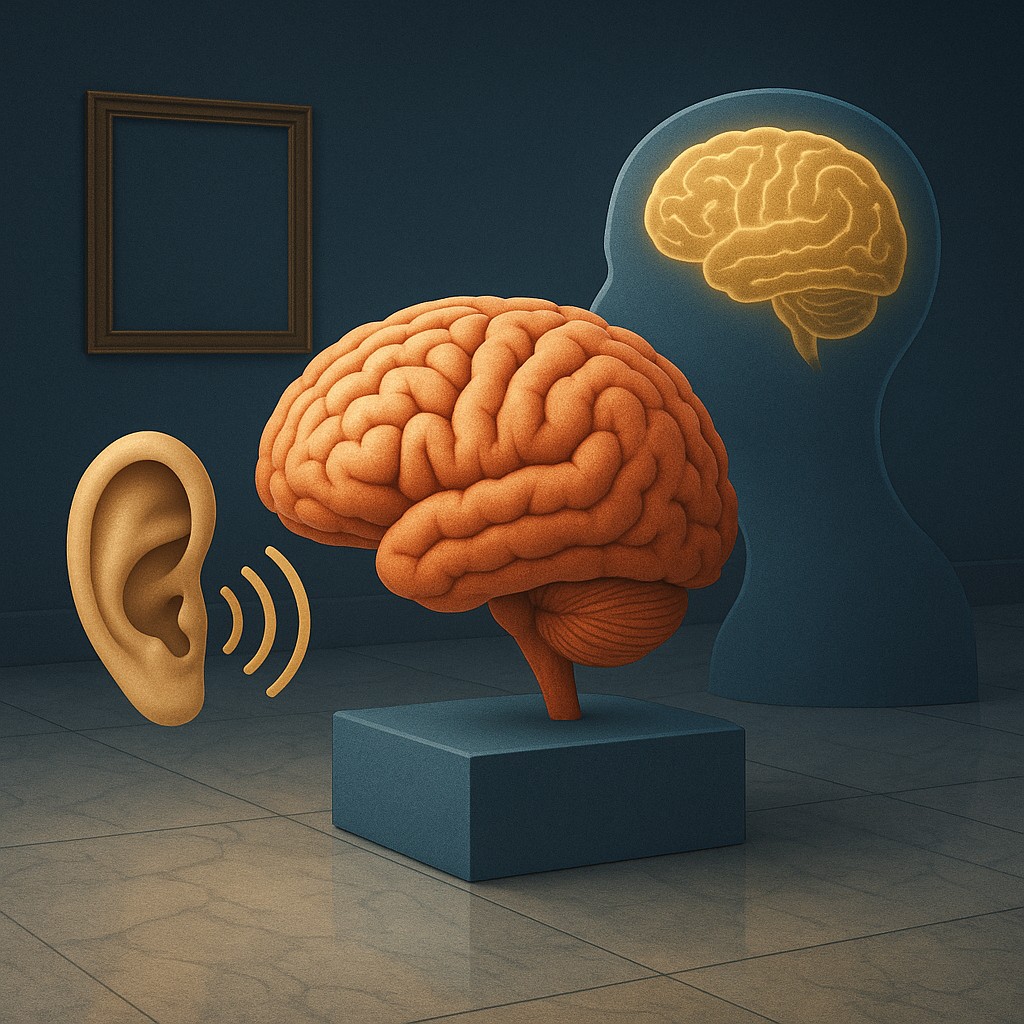
Imagine for a moment that you are walking through a quiet museum with polished marble floors. As you move from one exhibit to the next, the laws of physics suggest your heavy boots should be creating a thunderous series of echoes bouncing off the walls. Yet, unless you specifically listen for the rhythm of your feet, you barely hear a thing. Your mind is elsewhere, perhaps admiring a painting or overhearing a conversation three galleries away. This is not because your ears have stopped working, or because the museum has invisible carpet; it is because your brain is actively silencing these sounds for your own benefit.
This phenomenon is a masterclass in biological efficiency. If your brain treated every sound you produced as "new" information, you would be constantly startled by your own existence. The sound of your breathing would be a distracting roar, the rustle of your clothes would sound like a forest fire, and the steady thrum of your heartbeat would keep you awake at night like a persistent drum. To prevent this sensory overload, your nervous system uses a strategy called predictive coding. Instead of just reacting to the world, the brain anticipates it. It subtracts expected noises from your awareness, ensuring that the only things that grab your attention are the things you did not see coming.
The Inner Command and the Ghostly Copy
At the heart of this silence is a hand-off between two very different parts of your brain: the motor cortex, which plans your movements, and the sensory systems, which interpret the world. When you decide to take a step, your motor cortex sends a signal down your spinal cord to tell your leg muscles to move. However, at that exact millisecond, it also does something quite clever. It sends a duplicate of that instruction, known as an "efference copy," to your hearing and touch centers. This copy acts as an internal memo that says, "Attention team, we are about to make a loud thud with the left heel. Please ignore it."
This internal memo allows your brain to calculate a "forward model." Because the brain knows exactly how much force you are using and what surface you expect to step on, it can precisely predict the acoustic fingerprint of that footstep. When the actual sound waves travel from the floor into your ear, the brain’s sensory processors are already waiting with a match. Like noise-canceling headphones that generate an opposing sound wave to silence a humming airplane engine, your brain "subtracts" the predicted sound from the incoming data. The result is sensory attenuation, a technical term for turning down the volume of your own life so you can hear the world happening around you.
This mechanism is so precise that it can tell the difference between sounds you make on purpose and sounds you make by accident. If you tap a pen on a desk to a specific rhythm, the sound is muted because your brain is the conductor of that rhythmic orchestra. But if you accidentally knock that same pen off the table, the resulting clatter feels much louder and more jarring. In the first case, the internal memo was prepared and filed; in the second, the sound arrived without a reservation, triggering a full-scale neurological response that demands your immediate attention.
Prediction Errors as a Survival Compass
If our brains were perfectly successful at silencing our own sounds, we might actually be in trouble. We need to know when our expectations do not match reality, such as when we think we are stepping on solid ground but find ourselves on a patch of black ice or a pile of dry leaves. This is where the "prediction error" becomes the star of the show. When the brain’s predicted sound (a muffled thud) does not match the actual incoming data (a sharp crunch), the silencing system fails instantly. The subtraction does not work because the numbers do not add up, leaving a large, un-canceled signal that screams for notice.
This prediction error is effectively a biological alarm bell. It snaps your focus away from your thoughts and back to your surroundings. In terms of evolution, this was the difference between life and death. A prehistoric human walking through the woods needed to ignore the repetitive, predictable sound of their own footsteps to hear the snapping of a twig from a stalking predator. However, if the human's own foot made an unexpected sound, it might mean they were stepping into a hole or onto unstable ground. The brain keeps the expected quiet to keep the unexpected loud.
We can see this system in action by looking at why you cannot tickle yourself. When you try to tickle your own ribs, your brain predicts the exact location, pressure, and timing of your fingers. It cancels out the sensation before it even happens. But if a friend does the exact same thing, your brain has no copy of the movement command and no way to predict the path of the fingers. The result is a chaotic flurry of sensory signals that leads to uncontrollable laughter or squirming.
Framing the Filter: Intention versus Perception
To better understand how these predictions are prioritized, we can categorize different types of sounds and how the brain handles them. Not all self-generated sounds are treated equally, and the level of silencing often depends on how much control the brain has over the action.
| Type of Sound |
Source of Instruction |
Brain's Response |
Level of Awareness |
| Heartbeat |
Automatic Nervous System |
Constant prediction and heavy filtering |
Almost zero (unless stressed) |
| Walking (Steady) |
Motor Cortex (Routine) |
Internal copy enables high silencing |
Very Low |
| Walking (Uneven) |
Motor Cortex (Adjusting) |
Incomplete prediction leads to "error" |
Moderate to High |
| Falling Object |
External Physics |
No prediction available |
High (Immediate alert) |
| Speech (Your own) |
Motor Cortex (Language) |
Precise prediction of your own voice |
Low (to hear others) |
This hierarchy shows that the brain is a ruthless editor. It is constantly deciding what is "boring" (your own heartbeat) and what is "news" (a stranger's voice). Even when you speak, your brain dampens your own voice in your ears. This is why many people are shocked or even annoyed when they hear a recording of themselves. When you speak live, you are hearing a filtered, quieted version of yourself. When you hear a recording, you are hearing your voice as an external sound for the first time, stripping away the neurological "vanity filter" your brain usually applies.
The Malfunctioning Filter and Neural Noise
While this system is a marvel of engineering, what happens when the filter breaks? Scientists have found that disruptions in predictive coding might be at the root of several conditions. For example, some researchers believe that auditory hallucinations in people with schizophrenia may result from a failure of this silencing process. If the brain fails to send an internal memo when the person speaks or thinks, the brain might interpret its own internal voice as an external one. To the person, it does not feel like a thought; it feels like a sound coming from the outside world because the brain did not subtract it.
Similarly, conditions like tinnitus, the phantom ringing in the ears, can sometimes be thought of as the brain over-amplifying internal noise that it should be ignoring. When the brain stops receiving clear external sounds, perhaps due to hearing loss, it might turn up the volume on its internal sensors. This causes it to pay attention to the tiny electrical signals of the hearing nerve that were always there but were previously filtered out. It is as if the brain is so desperate for input that it begins to treat its own background static as a breaking news report.
Interestingly, we can also see the predictive system adjust in real-time. If you spend enough time walking on a certain type of gravel, the initial crunch that caught your attention will eventually fade into the background. Your brain updates its model. It learns that on this path, a step equals a crunch, and it begins to generate a new internal memo that includes that sound. This flexibility allows us to move through many different environments without being overwhelmed by the changing sounds of our own movement.
Bridging the Gap Between Action and Awareness
The beauty of predictive coding is that it turns the brain from a passive receiver into an active participant. We do not just hear the world; we write the world by predicting what should be there and only noticing the differences. This reveals a clear truth about human perception: we are largely oblivious to the things we do ourselves. We are shielded from the noise of our own bodies so that we can remain open to the details of our surroundings.
This mechanism also helps explain why we are often bad at judging our own impact. Whether it is the volume of our voice in a crowded room or the force with which we slam a door, our brains are literally muting our own actions. We underestimate our own noise because our biology is designed to erase it. Learning about this system gives us a bit of "metacognition," or the ability to think about our own thinking. We can realize that while we might think we are being quiet and subtle, the rest of the world, whose brains are not muting us, might have a very different perspective.
As you finish reading and move back into your day, take a second to try and catch your brain in the act. Listen for your own footsteps. Feel the fabric of your shirt against your skin. Notice the rhythm of your own breath. You will find that as soon as you focus on these things, they bloom into your consciousness. You are overriding the filter, forcing your brain to stop the subtraction and show you the raw data. It is a brief glimpse into the incredible amount of work your mind does every second just to keep the world feeling coherent and quiet. Inspired by this hidden labor, you can move through the world with a new appreciation for the silent, predictive partner that walks every step with you.