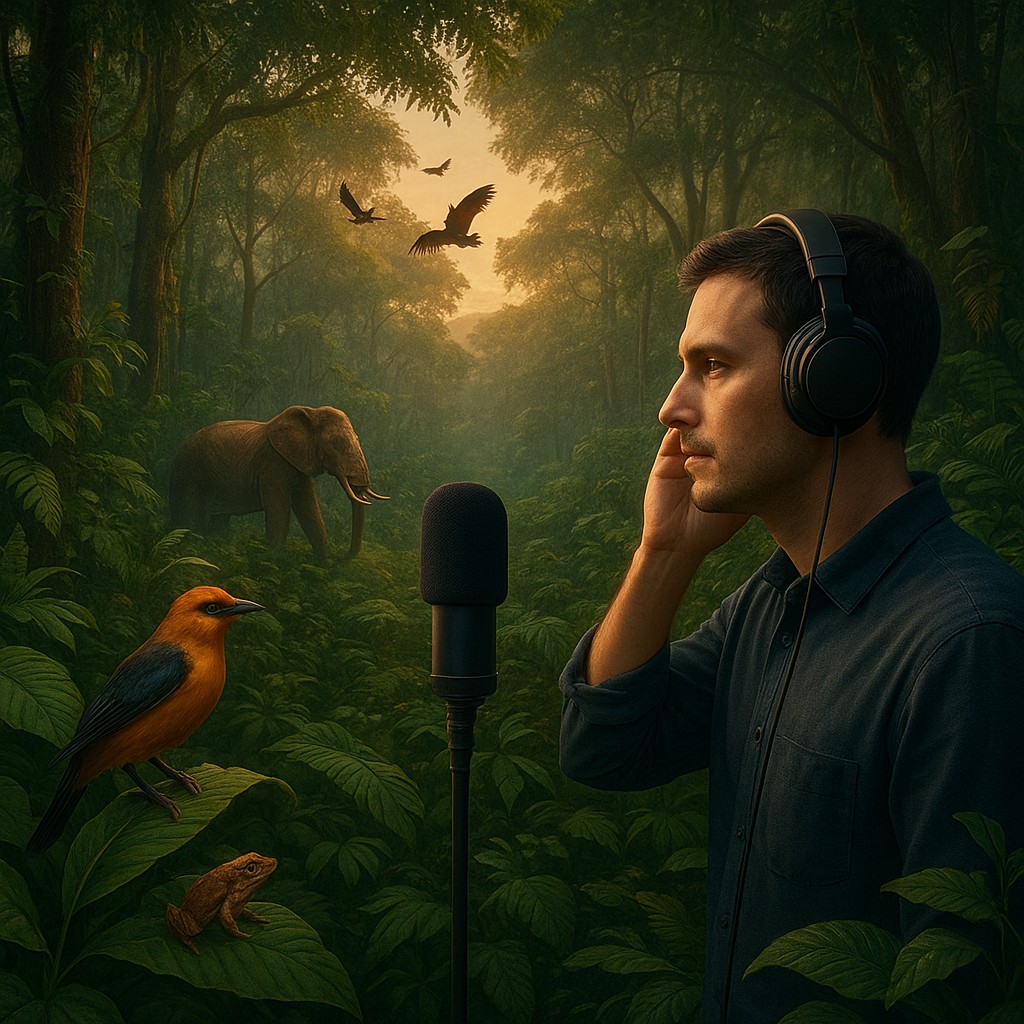
Imagine walking into a dense tropical rainforest at dawn. To the untrained eye, or to a satellite orbiting hundreds of miles above, the success of a reforestation project might look like nothing more than a green smudge on a map. We can see the canopy closing, the leaves thickening, and the shadows deepening. But for the ecologists and investors trying to figure out if that forest is actually "working," a satellite photo is about as useful as looking at a silent picture of a party to tell if the music is any good. To truly understand if an ecosystem is recovering, you have to stop looking and start listening.
The emerging world of biodiversity credits, where investors fund nature restoration, is currently facing a massive hurdle: how do we prove that a "restored" forest isn't just a collection of quiet, lonely trees? This is where the science of bioacoustics comes in. By using sensitive microphones that stay active while humans are asleep, researchers are capturing the "auditory fingerprints" of the wild. This data is transforming how we value nature, moving us away from vague promises of "planting a billion trees" and toward verifiable proof of biological life. It turns out that a healthy forest is an incredibly noisy place, and that noise is exactly what the market needs to hear.
The Symphony of Biological Health
When we talk about bioacoustics, we are essentially discussing the "soundscape" of a landscape. Every living creature that makes a sound, from the low-frequency rumble of an elephant to the ultrasonic click of a bat or the rhythmic sawing of a cicada, contributes to a collective orchestra. Ecologists split these sounds into three layers. First is the geophony, which includes non-living sounds like wind, rain, and thunder. Second is the anthrophony, the persistent hum of human activity like chainsaws or distant highways. The third, and most important for our purposes, is the biophony: the total sum of all sounds produced by living organisms.
In a struggling or damaged forest, the biophony is thin and repetitive. You might hear one or two species of hardy birds, but the "acoustic space" is mostly empty. However, as a forest heals and different layers of plants grow back, new homes are created for wildlife. More insects arrive, which brings more birds, which in turn attract predators. Each of these residents claims a specific "frequency band" to communicate, much like radio stations claim different spots on the FM dial to avoid overlapping with one another. A dense, diverse sound signature is a direct indicator of a complex, healthy food web. If the air is thick with a wide range of frequencies at all hours of the day, you know the ecosystem is thriving.
Teaching Machines to Hear the Hidden
Collecting thousands of hours of audio is the easy part. The challenge is making sense of it. A single recorder can generate terabytes of data in just a few months. No researcher, regardless of how much coffee they drink, can sit and listen to it all. This is where machine learning and artificial intelligence become the ultimate field assistants. Modern bioacoustic platforms use convolutional neural networks (CNNs), the same type of AI used for facial recognition, to "see" sound. They convert audio files into visual graphs called spectrograms, which show frequency over time.
To the AI, a bird’s song looks like a specific glowing pattern on a graph. By training these models on huge libraries of known animal calls, like those at the Cornell Lab of Ornithology, researchers can automatically detect specific "indicator species." These are the VIPs of the forest, animals whose presence proves the habitat is in top shape. If the AI detects a specific primate that only lives in mature, fruit-bearing trees, we have objective evidence that the forest is truly maturing. This automated identification allows for a level of transparency that was once impossible, providing a digital paper trail for every "biodiversity unit" sold to an investor.
From Acoustic Data to Market Value
The rise of biodiversity credits represents a fundamental shift in how we fund conservation. In the past, most environmental funding was based on "inputs," such as how many acres were fenced off or how many saplings were planted. But the market is moving toward an outcome-based model. Investors want to buy results, not just effort. Bioacoustics provides the "Measurement, Reporting, and Verification" (MRV) framework required to make these credits credible - essentially, the professional audit of the environment. By comparing the soundscape of a project site against its original state and against a nearby untouched old-growth forest (the "gold standard"), we can track exactly how well a forest is recovering.
| Metric |
Traditional Monitoring |
Bioacoustic Monitoring |
| Consistency |
Occasional (seasonal field visits) |
Continuous (24/7 recording) |
| Cost Efficiency |
High (expensive expert labor) |
Low (scalable hardware and AI) |
| Objectivity |
Subjective (human bias and errors) |
Objective (raw digital evidence) |
| Scope |
Visible species only |
Full spectrum (birds, bugs, bats) |
| Verification |
Difficult to check later |
Raw audio is a permanent record |
This table shows why bioacoustics is such a game-changer for the financial side of nature. It moves the needle from "we think it's working" to "here is the audio proof of seventeen threatened species returning to this valley." Because the data is digital and timestamped, it can be audited by third parties anywhere in the world, reducing the risk of "greenwashing" or exaggerated claims of success.
The Pitfalls of Practical Deployment
While the technology feels like magic, we must acknowledge its limits to avoid getting carried away by the hype. The first major hurdle is that silence does not always mean an animal is missing. Many species are "cryptic," meaning they are naturally quiet or only make noise during mating seasons. A forest might be teeming with life, but if you record during a dry month when insects are dormant and birds are hunkered down, your data might look deceptively bleak. Furthermore, some of the most critical members of an ecosystem, like fungi or certain reptiles, do not make any noise at all.
There is also the challenge of "acoustic masking." Heavy tropical rain or a nearby rushing stream can create so much "white noise" on a recording that it drowns out the subtle chirps and clicks of the forest residents. Furthermore, the sheer volume of data requires massive computing power and storage, which can be expensive and logistically difficult in remote areas without internet. To solve this, some researchers are developing "edge processing" devices - small computers built into the microphone box that only save the "interesting" bits of audio, drastically reducing the amount of data that needs to be moved.
Debunking the Myths of the Digital Forest
A common misconception is that bioacoustics will eventually replace human ecologists. This couldn't be further from the truth. While AI is great at counting known calls, it still needs humans to provide context. An AI might tell you there are ten times more bird calls than last year, but it takes an ecologist to realize those calls are all from an invasive species that is actually driving out the local wildlife. We must also be careful not to value "loudness" as the only metric for health. Some of the most biodiverse environments, like high-altitude mossy forests, are naturally quieter than a lowland jungle.
Another myth is that this technology is only for "pristine" wilderness. In reality, some of the most exciting trials are happening in "working landscapes" like coffee plantations or sustainable timber forests. In these areas, the goal isn't total silence or total wildness, but a balance where farming can coexist with a vibrant natural choir. The microphones allow us to see how different farming or logging techniques affect the local wildlife in real time, turning the forest into a living laboratory where we can adjust our behavior based on the feedback of the inhabitants.
The Future of Living Assets
As we refine these tools, we are moving toward a future where "Nature as an Asset" isn't just a metaphor. Imagine a world where a reforestation project in Indonesia or a rewilding effort in the Scottish Highlands can "stream" its health data directly to a dashboard for investors in London or Tokyo. This creates a powerful feedback loop. When a project performs well and the soundscape grows richer, the value of those biodiversity credits could increase, providing more funding to the local communities who are doing the hard work of protecting the land.
The ultimate power of bioacoustics lies in its ability to reconnect us with the pulse of the planet through a medium we instinctively understand. Sound is emotional; there is a profound difference between reading a spreadsheet about carbon storage and hearing the chaotic, joyful roar of a forest coming back to life. By bridging the gap between high-tech machine learning and the ancient rhythms of the wild, we are finally developing a language that allows us to listen to what the Earth is saying about its own recovery. If we listen closely enough, the forest might just tell us how to save it.