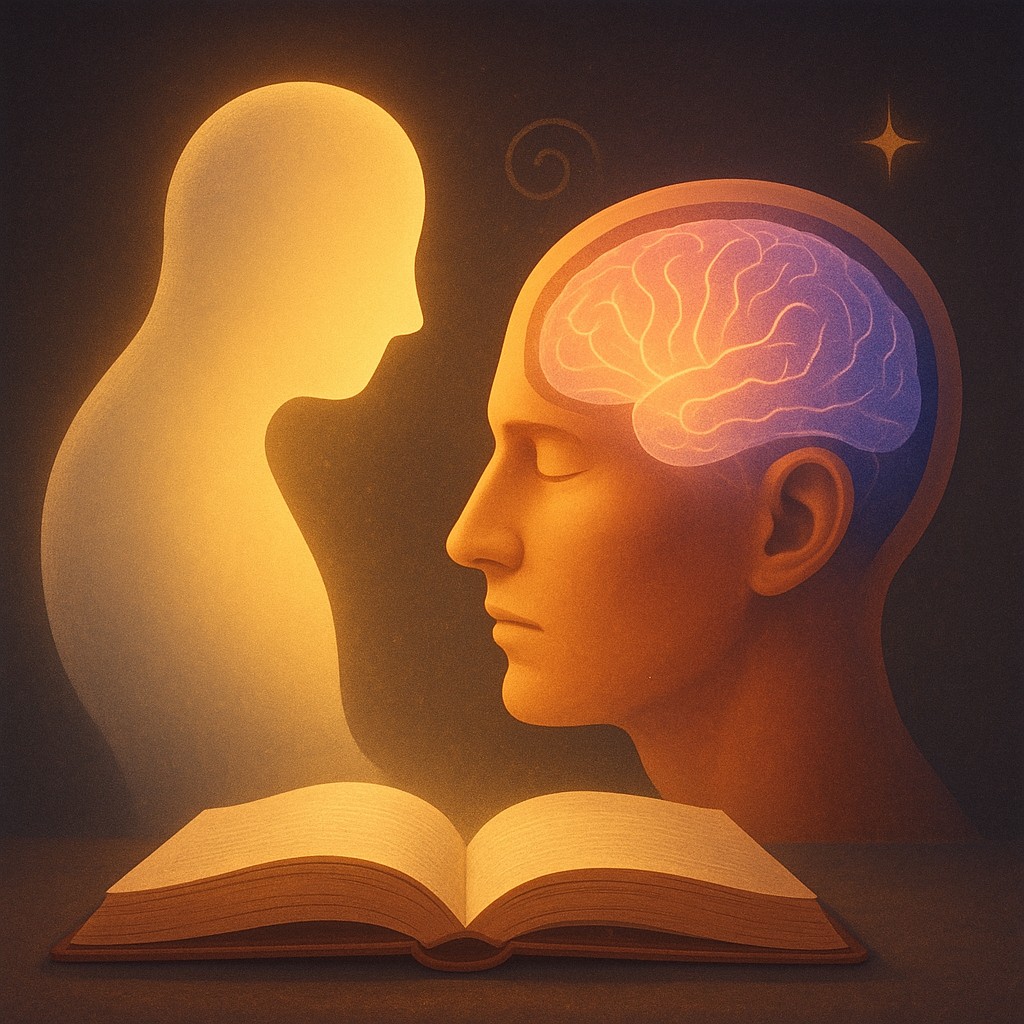
Most of us encounter the idea of a soul long before we can define it. It appears in bedtime stories, funerals, love songs, and that sudden late-night thought that you are more than a walking list of errands and opinions. The soul is the part of you that people say survives change, survives death, and somehow remains “you” even if your hair, habits, and playlists change radically.
At the same time, we live in an era where brain scans can reveal patterns of activity when you recall your childhood or choose between chocolate and vanilla. Science has become unnervingly good at linking mental life to physical tissue. So a reasonable modern question is: if thoughts and feelings map onto the brain, how much room is left for a soul?
This is not just an academic quarrel for philosophers with elbow patches. Your answer affects how you treat others, how you face death, how you think about responsibility, and what kind of meaning you believe a human life can hold. Let us look at what “soul” has meant, what evidence people point to, what science actually says, and what claims you can responsibly make without pretending certainty where none exists.
What people usually mean when they say “soul”
The word “soul” functions like a multipurpose tool, which is handy but also confusing. In many religious traditions, the soul is an immaterial essence given by a divine source, the true self that can exist without the body. In everyday speech, “soul” can mean personality (“she’s an old soul”), emotional depth (“that movie has soul”), or moral core (“he sold his soul”), which are poetic uses rather than metaphysical claims.
A useful way to stay clear is to separate three common senses. First, the soul as life-force - the thing that makes a body alive rather than a corpse. Second, the soul as mind or consciousness - the inner movie of experience: sights, sounds, feelings, and the sense of being you. Third, the soul as identity and value - the “real me” that matters morally and perhaps lasts forever.
These meanings overlap, but they are not identical. You can accept that consciousness is real without thinking it floats free of biology. You can affirm that people have deep value without committing to an immortal essence. Many arguments about the soul collapse because people switch definitions mid-argument, which is like playing chess while one side quietly replaces bishops with helicopters.
A quick tour of soul ideas across history and cultures
Humans have imagined soul-like things for a long time, partly because death is strange and partly because consciousness is stranger. In ancient Egypt, the person was sometimes described as a bundle of parts (ka and ba), some of which could travel after death if properly cared for. Ancient Greek thinkers debated the soul intensely: Plato leaned toward an immortal soul that existed before birth, while Aristotle conceived the soul more as the form and functions of a living being, not a separable ghost-pilot.
In many Hindu and Buddhist contexts, you find sophisticated accounts of rebirth, karma, and mind, but not always in the “unchanging personal soul” sense. Buddhism, for example, often emphasizes non-self (anatta): what you call “me” is a dynamic process, not a permanent nugget. Meanwhile, Abrahamic religions (Judaism, Christianity, Islam) typically affirm a personal self that persists, with variations in how body and soul relate and what “resurrection” or afterlife means.
Across Indigenous and animist traditions, soul concepts are often woven into nature, ancestors, and community. The common thread is this: nearly every culture tries to explain three puzzles - life, consciousness, and death - and the soul is one of the oldest explanatory tools in the kit.
What science can say about the “soul,” and what it cannot
Science excels at studying things that produce measurable effects. If a soul exists and interacts with the body in a consistent way, that interaction should, in principle, leave evidence: changes in energy, information, brain activity, behavior, or some detectable signature. Neuroscience, psychology, and medicine have been systematically mapping mental functions to brain processes, and the results are hard to ignore.
When particular brain regions are damaged, specific mental capacities can change. Injury to areas involved in speech can disrupt language. Damage to the hippocampus can impair the formation of new memories. Neurodegenerative diseases can alter personality, impulse control, empathy, and judgment. Anesthesia can switch consciousness off and on with chemical precision that would impress any light-switch engineer.
This does not logically disprove a soul, but it constrains what a soul could plausibly be. If your ability to remember your partner depends on brain tissue, then the soul (if it exists) is not handling memory independently of biology. At minimum, mind and brain are deeply linked. Many scientists take this as evidence that mental life is an emergent product of the brain - like music arising from instruments and players - not something imported from outside.
Science also has limits. It can correlate brain states with experience, but it cannot directly measure first-person experience itself. It can tell you which networks light up when you feel pain, but it cannot step inside your pain and taste it. This explanatory gap is one reason the “soul” conversation continues even in highly technological societies.
Consciousness: the mystery that keeps the soul debate alive
The strongest reason people take the soul seriously is consciousness. You do not just process information, you experience it. There is something it is like to be you, even when you are doing something tedious like watching a download bar crawl to 97 percent.
Philosophers sometimes call this the “hard problem” of consciousness: why should physical processes produce subjective experience at all? We can describe neurons firing and networks synchronizing, but the leap from electrical activity to the feeling of redness or nostalgia still feels conceptually slippery. Some conclude that consciousness must be non-physical, perhaps soul-like. Others argue that our intuitions mislead us, and that once we fully understand the brain, the “hardness” of the problem will shrink.
It helps to avoid two extremes. One extreme is claiming consciousness is an illusion, which is odd because illusions are themselves experiences. The other extreme is treating mystery as automatic proof of an immortal soul. Mystery is a promissory note, not a final proof. It signals that more work remains.
The best-known arguments for the soul, and the best pushbacks
People who believe in a real soul often point to several kinds of evidence or reasoning. Some are philosophical arguments, some are personal experiences, and some are cultural intuitions that feel nearly universal. Here are a few major ones, with thoughtful challenges.
Near-death experiences and “leaving the body”
Many report vivid episodes during cardiac arrest or trauma: tunnels of light, encounters with deceased relatives, life reviews, a sense of floating above the body. These experiences can be deeply meaningful and sometimes life-changing. The key question is whether they show the mind operating independently of the brain.
Skeptics point to plausible brain-based explanations: oxygen deprivation, neurotransmitter surges, temporal lobe activity, and the brain’s skill at creating narratives under stress. Attempts to test out-of-body claims with hidden targets in clinical settings have not produced robust, repeatable evidence. A respectful middle position is this: near-death experiences are psychologically real and important, but they are not yet a scientific slam dunk for a separable soul.
“I feel like more than matter”
Many people sense that love, meaning, and morality cannot be reduced to chemistry. The rebuttal is that “reduced to” does too much rhetorical work. Explaining how something works does not make it less real. A rainbow is “just” light refracting, yet it still makes people stop their cars to take photos and rethink their priorities.
A physical account of love does not cancel love. It describes the machinery that makes love possible. The disagreement is not over whether love exists, but over whether it requires an extra metaphysical ingredient beyond biology and experience.
Personal identity: the sense of a stable “me”
You probably feel like the same person you were years ago, even though your cells have turned over and your opinions have changed. This sense of continuity makes the idea of an enduring soul feel natural. But psychology shows that the self is partly the story we tell: memory, habits, social roles, and values woven into a narrative.
The brain appears to maintain “self-models,” and those models can shift. People with certain neurological conditions can feel alienated from their bodies, lose autobiographical continuity, or undergo dramatic personality changes. That suggests the feeling of a stable, soul-like self may be a cognitive construction, not proof of an immortal core.
Moral accountability and human dignity
Some argue that without a soul, humans lose intrinsic worth, and morality becomes arbitrary. But worth need not depend on an immortal substance. Many secular ethical systems ground dignity in consciousness, the capacity to suffer, relationships, autonomy, or the simple fact that we are fellow beings with inner lives.
In practice, societies that reject souls can still build strong moral systems, and societies that affirm souls can still behave badly - history, unfortunately, is not short on examples. The soul is not a guaranteed generator of morality. Ethics is a distinct project that can draw on religion, philosophy, empathy, and social agreements.
Common misconceptions that cloud the conversation
A lot of debate about the soul gets stuck because of a few persistent myths. Clearing them up makes the topic easier to think about.
One misconception is that science has “proved there is no soul.” It has not. Science has provided strong evidence that mental functions depend on the brain, but “no soul” is a broader metaphysical claim than the data alone can definitively settle.
Another misconception is that if something is physical, it is meaningless. That is a non sequitur in a tuxedo. Meaning is something minds create, and minds appear to be what brains make. If anything, the fact that meaning arises in a finite universe can make it more precious, not less.
A third misconception is that the soul must be a tiny person inside you, steering the body like a driver in a car. This “ghost in the machine” picture is intuitive but problematic: how does the ghost interact with matter without producing measurable traces? Where exactly does it plug in? Many modern spiritual views, even those friendly to the idea of a soul, avoid this cartoon image and speak instead of a deeper dimension of mind or being.
A practical comparison of major views (and what each predicts)
The main positions can be summarized without turning this into a cage match. Each view makes different claims about what a soul is, how it relates to the brain, and what evidence would matter.
| View |
Core idea |
What it tends to predict |
Main challenge |
| Physicalism (materialism) |
Mind is what the brain does |
Changing the brain changes the mind, no survival after death |
Explaining subjective experience in a satisfying way |
| Dualism |
Mind or soul is non-physical and can exist separately |
Consciousness not fully explainable by brain activity, possible survival |
How does a non-physical thing interact with a physical brain? |
| Idealism |
Mind is fundamental, matter is secondary |
Reality is ultimately mental, brain is a pattern in mind |
Hard to test, can become unfalsifiable |
| Panpsychism |
Consciousness is a basic feature of matter |
Even simple systems have tiny “proto-experiences” |
Combining tiny consciousness into a unified human mind is tricky |
| Religious soul (varied) |
Soul is created by God and persists |
Moral and spiritual reality, afterlife, divine purpose |
Depends on theological claims, evidence often interpretive |
Notice this: several views take consciousness seriously without automatically endorsing an immortal personal soul. The menu is larger than “science says no” versus “religion says yes.”
So, is the soul real? What we can responsibly say
If by “soul” you mean an immortal, non-physical entity that can think and remember independently of the brain, we do not currently have strong scientific evidence for that. The best empirical evidence ties memory, personality, and consciousness to brain function. That makes the traditional separable-soul model harder to support empirically, though not logically impossible.
If by “soul” you mean the reality of inner experience, the depth of personhood, and the fact that there is something it is like to be you, then yes, something real is absolutely there. Consciousness and subjectivity are among the most certain facts you have, even if their ultimate explanation is still under construction. The debate is less about whether inner life exists and more about what kind of thing it is.
If by “soul” you mean moral worth, then the soul is not the only foundation available. You can defend dignity on religious grounds or on secular ones, but in either case the lived ethical challenge is the same: treat conscious beings as if their inner worlds matter, because they do.
A reasonable, intellectually honest stance for many people is “open but careful.” Stay open to possibilities, but demand clarity about definitions and evidence. You can keep wonder without outsourcing your critical thinking.
Living with the question without needing a final answer
The soul question persists because it sits at the intersection of fear, hope, love, and curiosity. It is about death, yes, but it is also about life: why you feel like someone on the inside, why other people are not just background characters, and why certain moments seem to glow with significance.
You do not need a perfect metaphysical conclusion to live well. You can treat consciousness as profound, respect the tight link between mind and brain, and remain humble about what we do not yet understand. You can also choose practices that deepen your sense of inner life - reflection, prayer, meditation, journaling, art, or simply paying attention instead of multitasking through existence.
If there is a soul in the strongest, immortal sense, careful inquiry and compassion will not offend it. If there is not, careful inquiry and compassion are still among the best uses of a finite human life. Either way, the question nudges you toward a mature kind of awe: one that does not panic at uncertainty and that keeps asking better questions.