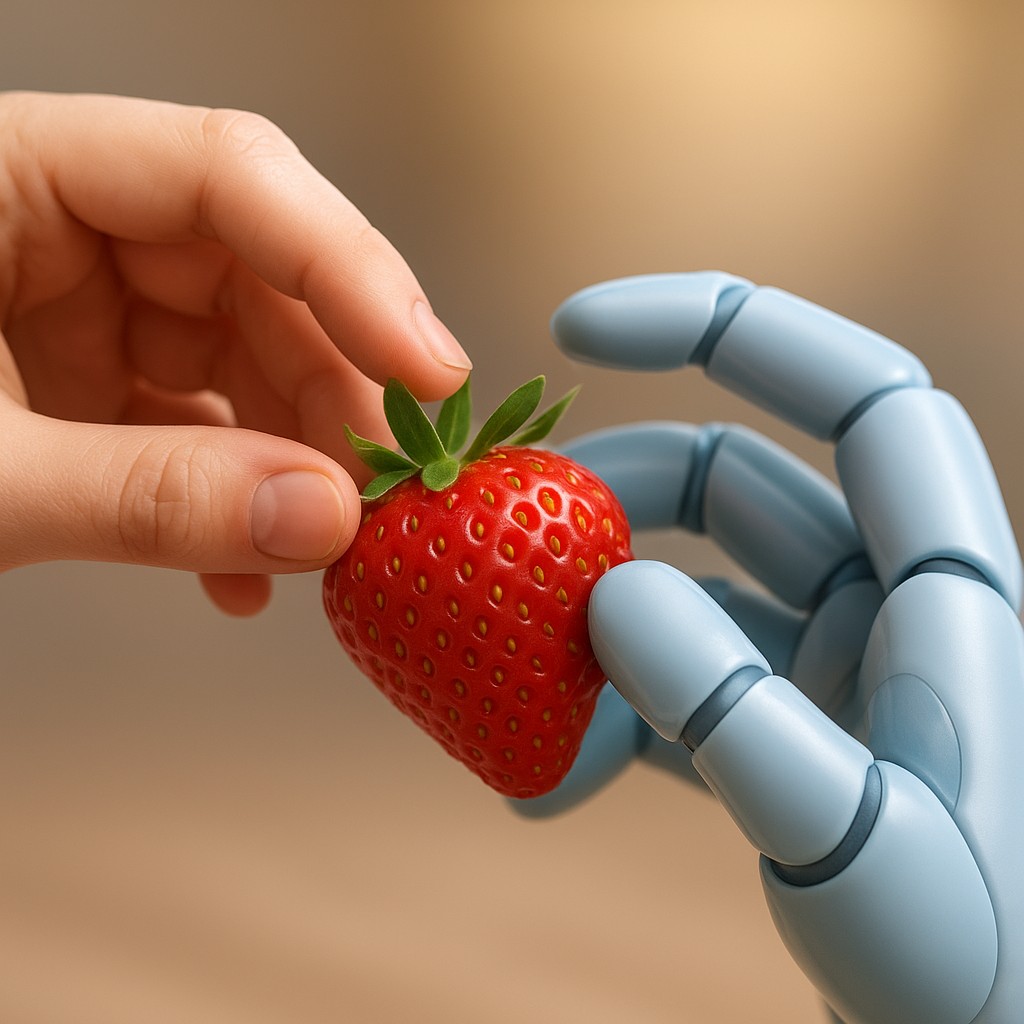
Imagine you are standing in your kitchen, reaching for a ripe strawberry warmed by the sun. You don’t need to do complex math to figure out how hard to squeeze. You don’t consult a database of fruit densities or run a computer simulation of the berry’s strength. Your fingers simply "know" what to do. This knowledge isn't just in your brain; it is built into the physical makeup of your body. Your skin presses down, your tendons stretch, and your soft tissues shape themselves to the berry’s uneven surface, creating a perfect, gentle grip. This is the magic of "embodied intelligence," where the physical design of an object handles the hard work so the brain doesn't have to.
For decades, the robotics world tried to copy this feat using the exact opposite approach. We built hands out of stiff steel, powered them with heavy electric motors, and connected them to complex gearboxes. To stop these metal claws from crushing a strawberry, we wrote millions of lines of code. We added expensive pressure sensors and ultra-fast processors to calculate the exact tiny amount of force needed to hold the fruit without turning it into jam. This "rigid-first" philosophy is precise and powerful, but it is also very fragile. If the computer makes a tiny error, or if the strawberry is a bit softer than expected, you end up with a sticky mess. Today, however, a quiet revolution is happening in soft robotics labs, where engineers are trading gears for "liquid" tendons and metal for flexible pouches.
The Flaw in the Machine Heart
To understand where we are going, we have to look at why traditional robot hands struggle in our messy, organic world. Consider a typical industrial arm used to build cars. It is a masterpiece of precision, able to weld a seam with perfect accuracy thousands of times a day. But that precision depends on being stiff. Every joint is locked into place by a motor and a set of gears. If that robot arm accidentally bumps into a person or a stray cardboard box, it does not "give." Instead, it stays on its path with all the momentum of its heavy metal frame, usually resulting in a broken box or a safety alarm. This happens because traditional robots have high mechanical resistance - they fight against outside forces rather than absorbing them.
This stiffness creates a massive "computational tax." Because the robot’s body is a "dumb" stick of metal, the computer must be "smart" enough to plan for every possible interaction. If the robot wants to pick up an egg, the software must constantly check sensors to make sure the hard fingers don't squeeze too hard. The moment the sensor feels contact, the computer must process that signal, decide to stop the motor, and send a new command. In the world of high-speed electronics, this happens fast, but it is still a reactive process. There is always a lag, no matter how small, between the physical touch and the digital response. During that split second, a fragile object can easily be crushed.
The move toward soft robotics is a shift away from this reactive model toward a proactive, physical one. By using materials that naturally change shape, we are moving the "intelligence" of the task from the software into the hardware itself. Imagine a robot hand made of soft, fluid-filled chambers. When it closes on a strawberry, it doesn't need a sensor to tell it to stop at a specific millimeter. The hand simply wraps around the berry until the pressure of the fluid inside balances the resistance of the fruit. The material does the "thinking" by fitting itself to the shape of the object. This is a fundamental change in how we define a robot, moving from a machine that follows orders to one that responds to the world.
Actuators that Breathe and Flow
The secret to this new generation of robots is the "electro-ribbon" actuator and the use of special oils. In a standard motor, electricity creates a magnetic field that spins a shaft. These are loud, heavy, and hot. In a soft actuator - the part that creates movement - we use the rules of static electricity. Imagine two thin, flexible ribbons placed close together with a small amount of non-conductive oil between them. When electricity is applied, the ribbons are pulled toward each other. This movement "zips" the ribbons together, pushing the liquid into a different part of the structure. This is known as a Peano-HASEL actuator, and it works a lot like a human muscle fiber.
These parts allow a robot finger to shrink and grow with a smoothness that no gear can match. Because the system is full of liquid, it is "compliant," meaning it yields under pressure. If you push against a liquid-filled pouch, it pushes back, but it also reshapes itself to fit your finger. This provides immediate, physical feedback. The "tendons" of these robots are often pouches of fluid that act as both the muscle and the sensor. When the hand hits an obstacle, the fluid moves, and the change in pressure can be measured instantly. More importantly, even if the computer is turned off, the hand stays soft. It cannot crush things by accident because it physically lacks the stiffness to do so.
This "liquid" approach also solves the problem of grip. A metal finger is smooth and hard, so it only touches a tiny part of the object it is holding. To get a good grip, it has to squeeze harder. A soft robotic finger, however, flattens out against the surface, much like your own fingerprint does. This allows the robot to lift heavy or slippery items with much less force. Instead of a "pinch," it is a "hug." This is why these systems are currently doing well in jobs like picking apples or sorting warehouse items, where things are oddly shaped, delicate, and unpredictable.
Comparing the Old Guard and the New Wave
To see why this shift is so important, it helps to look at the trade-offs between the two styles. We aren't necessarily getting rid of stiff robots, but we are finding they are the wrong tool for "human-centered" places like kitchens or hospitals.
| Feature |
Traditional Rigid Robotics |
Modern Soft/Liquid Robotics |
| Main Material |
Steel, Aluminum, Hard Plastics |
Silicone, Fabric, Special Oils |
| Power Source |
Electric Motors & Gears |
Flexible Ribbons & Fluid Pouches |
| Primary Safety |
Controlled by Software (Sensors) |
Built into Hardware (Natural Softness) |
| Adaptability |
High (Requires complex coding) |
Automatic (Physically fits shapes) |
| Weight |
Heavy (Dense metal parts) |
Light (Thin membranes and fluids) |
| Precision |
Measured in hair-thin units |
Organic, "Good enough" accuracy |
| Failure Mode |
Snaps or crushes under stress |
Changes shape or leaks, easy to fix |
As the table shows, the "soft" approach trades perfect mathematical precision for a more organic, flexible kind of intelligence. While you wouldn’t use a soft robot to build a microchip where every atom counts, you would definitely want one to help an elderly patient stand up or to pack a crate of delicate tomatoes. The soft robot's "brain" is spread throughout its entire body, allowing it to handle "messy" data - like an object being slightly out of place - without the computer crashing.
The Architecture of Giving Way
One of the deepest shifts in this field is how the internal frame is designed. In the past, if a robot had a "soft" part, it was usually just a rubber glove pulled over a metal skeleton. This was a superficial fix. True soft robotics involves designing the entire internal structure to "give way." This is often inspired by nature, like an elephant's trunk or an octopus's arm. These limbs have no bones, yet they can pull with great force and perform delicate tasks. They do this through "hydrostatic skeletons," where pressurized fluid provides the internal structure.
By changing the pressure of the liquid inside the robot’s tendons, engineers can change how stiff the robot is on the fly. This is called "variable stiffness." Imagine a robot arm as soft as a pillow while it moves through a room so it doesn't hurt anyone it might bump into. But the moment it needs to turn a heavy doorknob, it "stiffens" its internal fluid, turning the pillow into a solid pillar of support. This ability to switch between states - from liquid flexibility to solid strength - is something rigid gears simply cannot do. It allows the robot to tune its physics to the task at hand, rather than relying on its computer to make up for a stiff body.
This move toward "embodied intelligence" is also making robots much cheaper and more energy-efficient. Because the materials handle the balance and grip, the robot doesn't need to run high-speed software loops that drain the battery. It also doesn't need the most expensive processors. A soft hand can grab a peach using a simple air pump or a small battery, while a stiff hand would need high-tech laser sensors just to avoid squashing the fruit. By letting the materials handle the complexity, we are making robotics more affordable and power-conscious.
Beyond the Factory Floor
The impact of this change goes far beyond the warehouse. Think about search and rescue. Currently, if a robot is sent into a collapsed building, it often gets stuck. Its stiff limbs get wedged between pieces of rubble, and if it tries to force its way out, it breaks. A soft robot, inspired by a vine or a worm, can squeeze through gaps smaller than its own body. It can wrap itself around a jagged piece of metal and "flow" past it. The liquid nature of its movement allows it to survive in environments that are naturally hard on precision machinery.
We are also seeing a massive leap in prosthetic technology. Traditional prosthetic hands are often heavy and hard to control, requiring the user to think hard about every finger movement. Soft prosthetic hands, powered by fluid pouches, feel more natural. They fit the shape of a coffee mug or a loved one's hand automatically. They are lighter to wear and require less mental effort because the hand itself handles the logic of the grip. This makes the tool feel less like a machine and more like a part of the body.
The shift from gears to tendons represents a maturing of the robotics field. We are moving away from the "Cold War" era of machines - tools designed to work alone, performing repetitive tasks with brute force. We are entering the era of "Co-bots," or collaborative robots, designed to live alongside us. These machines are built with the understanding that the world is soft, wet, and unpredictable. By embracing "liquid" movement, we aren’t just making robots better at picking up strawberries; we are making them safe enough to share our homes, our jobs, and our lives.
The next time you watch a robot move, don’t just look at its programming; look at what it’s made of. The switch from rigid metal to soft, fluid-filled systems is a reminder that sometimes, the best way to solve a hard problem isn’t to think harder, but to be softer. As we move the complexity of life from lines of code into the "flesh" of our machines, the line between mechanical and biological is blurring. This journey into soft robotics is more than a technical upgrade; it is a step toward technology that finally feels as natural as the world it was built to inhabit. Expect a future where the most advanced machines aren't the hardest, but the ones that know exactly when to give.