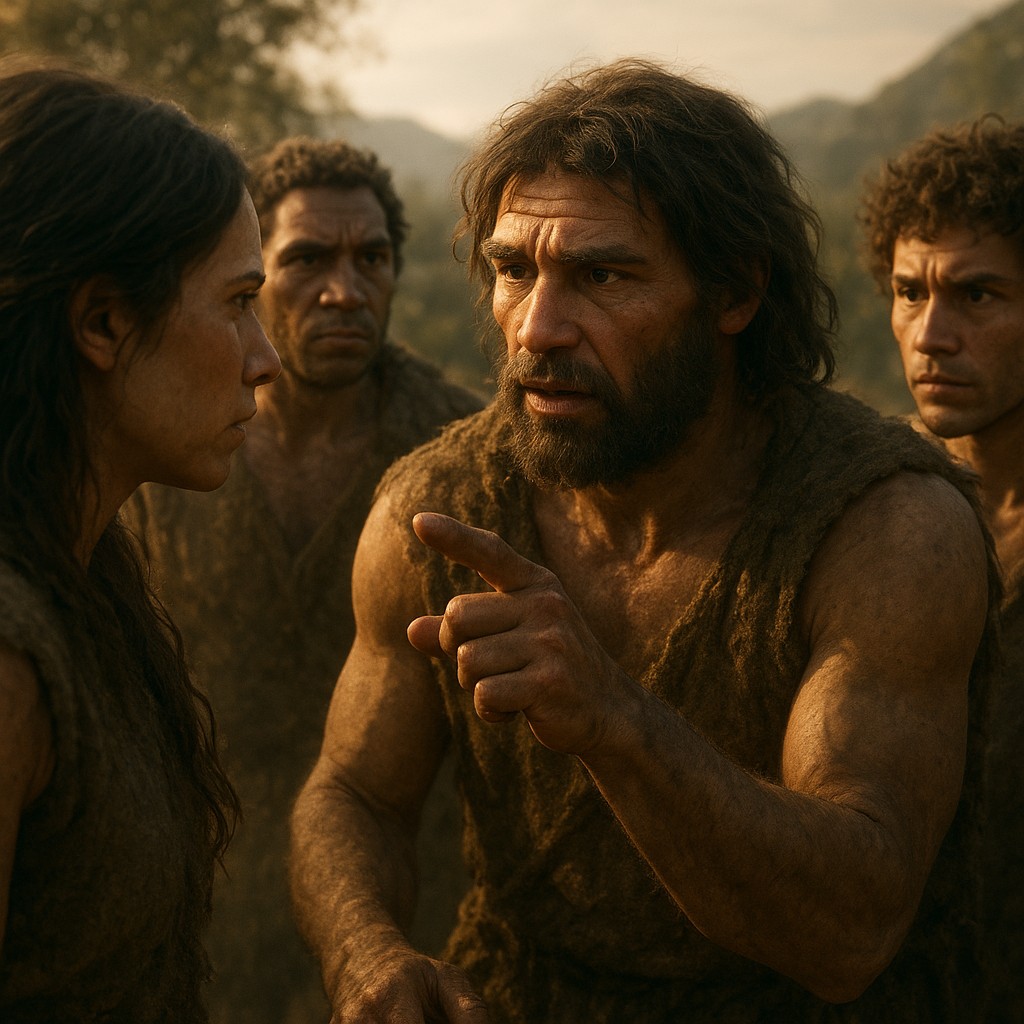
Imagine for a moment that you are a time traveler dropped into the middle of the Stone Age. You might expect your biggest problem to be a hungry saber-toothed cat or the daunting task of starting a fire without a lighter. While those are definitely urgent concerns, the reality of prehistoric life was much more personal. Your greatest challenge was actually the person standing next to you. Who can you trust to share their food? Who is secretly plotting to take your spot by the fire? Who is annoyed because you forgot to help them sharpen their spear yesterday? These questions might sound like petty drama, but they are the exact reason you have such a massive, energy-hungry organ sitting inside your skull.
We often tell ourselves a flattering story about our intelligence. We like to think we grew big brains to master the elements, invent the wheel, or solve complex math problems. However, many anthropologists now believe that our cognitive "superpower" didn't evolve for physics or botany, but for gossip, politics, and the endless dance of social life. This idea, known as the social brain hypothesis, suggests that the human neocortex grew to its current, impressive size primarily so we could keep track of who is who in our ever-expanding social circles. By the end of this exploration, you will see how your brain is less like a calculator and more like a high-speed social switchboard, constantly buzzing with the complexities of human interaction.
The Mental Tax of Knowing Your Neighbors
When we look at the animal kingdom, researchers see a fascinating pattern. If you measure the size of a primate's neocortex - the brain's outer layer involved in complex tasks like processing senses and spatial reasoning - you can actually predict how many friends that primate has. This isn't just a coincidence. It turns out that living in a group is mentally expensive. As a group grows, the number of individual relationships within it doesn't just increase; it explodes. In a group of five people, you only have ten possible pairs of relationships to track. In a group of twenty, that number jumps to 190.
Processing these relationships requires massive "computing power." You aren't just remembering a face; you are remembering a history. You need to know if Bob is a reliable ally, if Sarah is Bob’s sister, and if Sarah is currently mad at Bob. This multi-layered web of social data is what pushed our ancestors’ brains to expand. While finding a fruit tree is a straightforward puzzle, figuring out how to outmaneuver a rival who is also trying to figure you out is an "evolutionary arms race." It requires a level of mental flexibility that simple survival tasks just don’t demand.
The neocortex serves as the headquarters for this operation. While the "older" parts of our brain handle breathing, heart rate, and basic instincts, the neocortex is the part that allows us to pause and think. It gives us the ability to control our immediate urges, like punching a teammate who stole our snack, in favor of long-term cooperation. This capacity for restraint and strategic thinking is the hallmark of the social brain. It is the reason we can live in bustling cities with millions of strangers without constantly descending into chaos.
Decoding the Legend of Dunbar’s Number
One of the most famous ideas linked to the social brain hypothesis is Dunbar’s Number. Named after British anthropologist Robin Dunbar, this theory suggests there is a hard limit to the number of people with whom we can maintain stable social relationships. Based on the size of the human neocortex, Dunbar calculated that this limit is roughly 150 people. This doesn't mean you can’t recognize more than 150 people; it means you likely can't track the complex social dynamics and "who owes what to whom" for more than that many individuals at once.
This number appears with startling frequency throughout history and modern society. Traditional hunter-gatherer societies often lived in tribes of about 150. Modern military units, specifically companies, often stay around this same size because it is the largest group that can be managed through personal loyalty and social pressure rather than rigid, cold bureaucracy. Even in the digital age, research suggests that the average person's most active social network on platforms like Facebook or X (formerly Twitter) tends to settle around this magic number.
To understand why this limit exists, we have to look at the different "circles" of intimacy that make up our social world. Our brains seem to categorize people into folders based on how much mental energy we invest in them. The table below shows how these layers normally break down in a standard human social structure.
| Relationship Layer |
Approximate Size |
Level of Investment |
| Inner Core (Support Group) |
5 people |
Daily contact, deep emotional bond |
| Sympathy Group |
15 people |
Close friends, regular interaction |
| Social Network |
50 people |
Frequent acquaintances, shared activities |
| The Dunbar Limit |
150 people |
Stable social ties, mutual obligations |
| Meaningful Faces |
500 - 1,500 people |
Recognition without personal connection |
The Art of Spotting a Social Cheater
If the goal of a big brain was simply to live in a group, we might have stopped evolving a long time ago. The real driver for intelligence was the "cheater problem." Cooperation is incredibly helpful, but it only works if everyone plays by the rules. If I help you hunt a mammoth with the promise that you will share the meat, but then you run off with the best cuts for yourself, I have lost energy and time. Evolutionarily speaking, I’m the loser. This created serious pressure for humans to become world-class lie detectors and "social accountants."
To survive, we had to develop what psychologists call Theory of Mind. This is the ability to understand that other people have thoughts, desires, and intentions different from our own. It allows us to ask, "Why did he offer me that piece of fruit? Is he being nice, or is he trying to distract me?" This level of social deduction is incredibly complex. It requires us to simulate multiple versions of reality in our heads. We have to keep track of what we know, what the other person knows, and what the other person thinks we know.
This complexity is why "gossip" is actually a vital survival tool. While we often think of gossip as shallow or negative, it serves as a massive shortcut for social info. Instead of having to be cheated by every person in the tribe to know who is untrustworthy, I can simply listen to your story about being cheated. This flow of information allows the group to police itself and keep the "cheaters" in check. Our brains are essentially wired to find social information more interesting than almost any other data because, historically, knowing who was sleeping with whom or who broke a promise was a matter of life and death.
Beyond the Group: The Role of the Environment
While the social brain hypothesis is a powerful explanation for our intelligence, it is important to recognize its limits. Some critics argue that focusing only on group size ignores the harsh realities of the physical world. After all, a big brain is useless if you starve to death. This has led to the "Ecological Intelligence Hypothesis," which suggests our brains also grew to handle the challenges of finding food in unpredictable environments.
Finding high-energy food, like calorie-rich tubers or fast-moving game animals, requires sophisticated mental mapping and the ability to plan for the future. You have to remember where the water holes are during a drought and which plants are poisonous. Modern research increasingly suggests that it wasn't just social life or just the environment that shaped us, but the interaction between the two. We needed big brains to find food, and we needed even bigger brains to figure out how to share that food without fighting.
For instance, consider the challenge of "extractive foraging," which involves getting food out of hard-to-reach places, like cracking nuts or pulling termites out of a mound. This requires tool use and fine motor skills, which the neocortex also handles. However, the best way to learn these difficult skills is by watching others. Social life and the physical environment are two sides of the same coin. We became smart to survive the world, but we became "brilliant" to survive each other. The pressure to navigate the physical world provided the foundation, while the pressure of social life provided the rocket fuel for our mental growth.
Moving Past the Myth of the Lone Genius
One of the most persistent myths in our culture is that of the "lone genius" who sits in a room and dreams up revolutionary ideas through sheer individual brainpower. The social brain hypothesis turns this idea on its head. It tells us that our intelligence is, at its core, a collective effort. Our brains are designed to be "plugged in" to a larger network. We are not just individual processors; we are nodes in a massive, shared human computer.
This realization explains why social isolation is so incredibly damaging to human health. When we are cut off from our "tribe," our brains perceive it as a fundamental threat to our survival, just like a lack of food or water. It also explains why we find such deep satisfaction in teamwork and shared goals. We are built for the "we," not just the "me." When you feel that spark of excitement during a great conversation or the warmth of a shared laugh, that is your neocortex firing the way it was meticulously designed to over millions of years of evolution.
As you go through your day, take a moment to appreciate the sheer amount of work your brain is doing behind the scenes. Every time you read a subtle facial expression, catch a hint of sarcasm, or decide which friend to call for advice, you are using the most complex social machinery in the known universe. You aren't just a person trying to get through the day; you are the pinnacle of a long line of ancestors who were smart enough to stick together, kind enough to cooperate, and just clever enough to keep an eye on the guy who tried to steal the fire. Your intelligence is a testament to the power of human connection - a gift from a history where the hardest puzzle we ever solved was the mystery of one another.