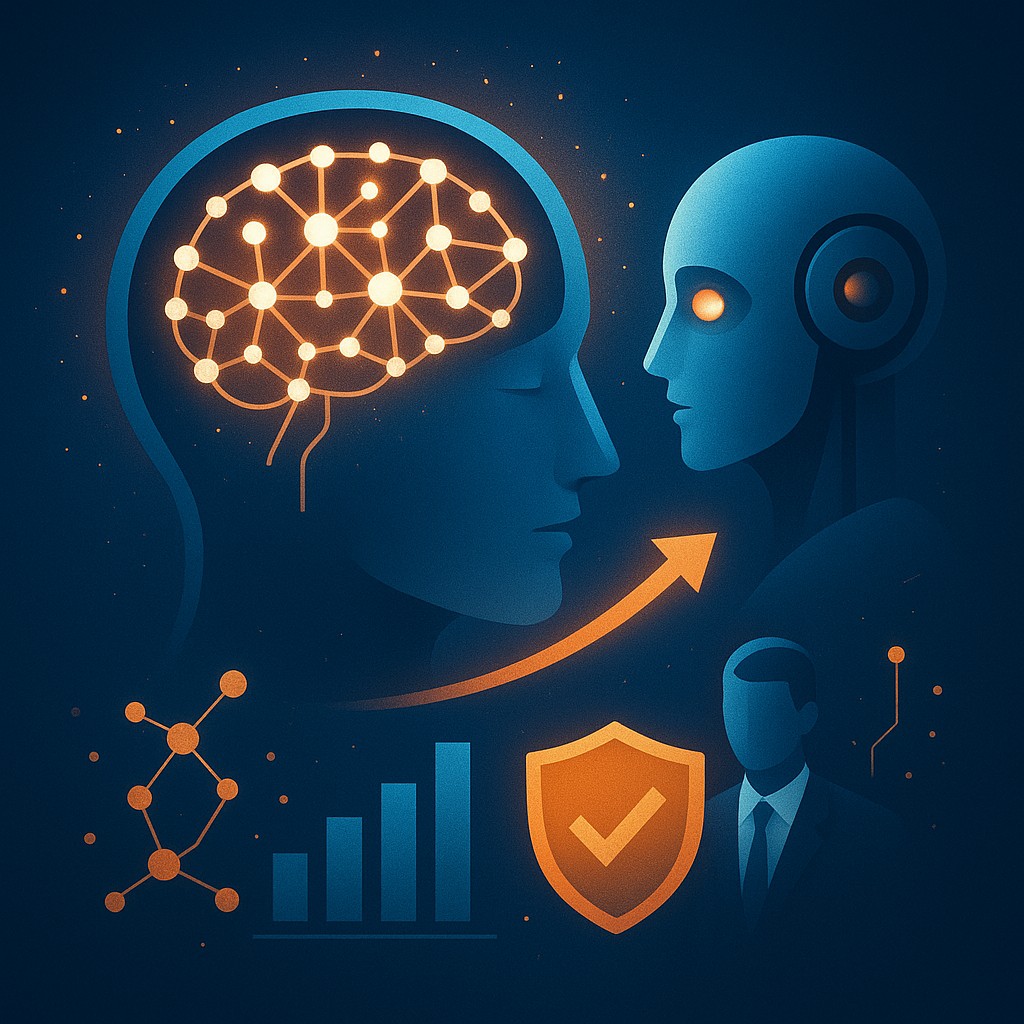
Most big ideas in science start as simple questions that keep nagging at you. What if machines became as smart as people? What if they became even smarter? And what if that change did not happen slowly, like upgrading your phone every two years, but suddenly, like falling asleep and waking up to a world running on a new operating system?
That bundle of questions is what people usually mean by "the singularity." It is a dramatic phrase, so it draws dramatic predictions: utopia, apocalypse, or a future where your toaster negotiates your mortgage. The truth is more interesting than the slogans, because it sits where real computer science, human psychology, economics, and a fair bit of "we do not know yet" meet.
To make this topic useful instead of just thrilling, we will treat "singularity" as a concept you can grasp. We will define it carefully, look at what could plausibly happen if AI reaches it, and separate popular myths from the things serious researchers argue about in good faith.
The "singularity" is a prediction about runaway change, not a magical IQ number
In everyday talk, the technological singularity is the idea that once AI reaches about human-level ability, progress could speed up so much that life after that point becomes hard to predict. The word "singularity" comes from math and physics, where it means a point where a model breaks down or heads toward infinity. Here, it does not mean the universe literally hits an error screen, it means our usual way of forecasting stops working.
A key detail is that the singularity is less about a particular test score and more about a feedback loop. If an AI system can meaningfully improve the tools used to build AI, you can get a cycle: better AI helps make even better AI, which helps make even better AI, and so on. Think of it like compound interest, but for problem-solving ability. If that loop is fast and strong enough, the world could change in a short time.
It also helps to separate "smart" from "powerful." A system can be impressive at writing, coding, or analyzing data and still be limited by missing information, poor objectives, high costs, or the inability to act in the world. The singularity idea assumes AI becomes not only generally intelligent, but also able to speed up technological and economic development in ways humans cannot match.
Three ideas that often get mixed up
People often blend several related milestones into one dramatic lump. Here are three distinct concepts that commonly get confused:
- Human-level AI (often called AGI): an AI that can perform a wide range of tasks at about the level of a typical human, including learning new areas without massive retraining.
- Superintelligence: an AI that outperforms humans in most economically valuable and scientific tasks, not just a few.
- The singularity: a period when AI-driven progress becomes so rapid and self-reinforcing that predicting society afterward becomes extremely difficult.
You can have human-level AI without a singularity if progress stays steady and bottlenecks slow improvement. You could also see systems that are "superhuman in key areas" without general intelligence, if narrow systems dominate. The singularity is the claim that a certain kind of acceleration happens, not just that AI gets very good.
Why some researchers think acceleration could happen (and why others do not)
The most intuitive argument for the singularity is often called recursive self-improvement. If an AI can improve its own algorithms, architecture, training processes, or even the hardware it runs on, then each improvement can boost its ability to make further improvements. Humans improve technology, but we are constrained by biology, attention, and the need for sleep. An AI might run many experiments in parallel, copy itself, and iterate at digital speeds.
But there are serious reasons the feedback loop might be slower than the science fiction version. Intelligence is not a single "upgrade slider." Many breakthroughs come from messy interaction with the real world: collecting data, running physical experiments, building factories, navigating politics, and dealing with limited energy and materials. Even a brilliant AI cannot conjure new chip factories out of thought alone, and much science is bottlenecked by reality being stubborn.
A helpful way to think about it is this: progress is limited by several gears, and AI is only one of them. If the "AI gear" speeds up but the "hardware gear," "energy gear," "institutions gear," or "trust and safety gear" stays slow, the whole machine will not instantly spin out of control. On the other hand, if AI also helps speed up those other gears, then acceleration becomes more plausible.
A quick comparison of different futures people argue about
| Scenario |
What changes |
What stays limiting |
What it might feel like |
| Gradual transformation |
AI steadily improves and spreads through industries |
Regulation, adoption speed, physical infrastructure |
Like the internet era, but faster and broader |
| Fast takeoff (classic singularity) |
AI rapidly improves itself and drives rapid tech gains |
Few bottlenecks matter because AI helps remove them |
"Wait, did that really happen this year?" shock |
| Sector-specific "mini-singularities" |
Breakthroughs in some fields (drug discovery, coding, logistics) |
Other fields remain slow (politics, construction, culture) |
An uneven world: miracles here, normal life there |
| Plateau |
AI hits hard limits or faces diminishing returns |
Compute cost, data limits, fundamental theory gaps |
Impressive tools, but no runaway loop |
None of these options is guaranteed. The future could also mix them: bursts, pauses, and occasional leaps that only look obvious in hindsight.
If AI reaches "it," what actually happens day to day?
When people imagine the singularity, they often picture a single moment: a lab announces "we did it," and the next morning your dog is filing taxes. Real change would probably look more like overlapping waves than a sharp cliff. Still, if AI reaches a level where it can improve itself and speed up science and industry, several concrete effects become likely.
First, research and engineering could compress in time. Tasks that now take teams of experts months might take a well-equipped AI days, especially if it can run simulations, write code, read papers, generate hypotheses, and coordinate experiments. That does not mean every problem becomes easy, but it does mean the pace of trying ideas could explode. In many fields, the number of "shots on goal" matters almost as much as brilliance.
Second, the economy could reorganize around AI as a universal worker for digital tasks. If AI can handle programming, design, marketing, tutoring, and operations cheaply and reliably, the bottleneck becomes not "who can do the work" but "what should we build, and who benefits." Value may shift toward data, compute, distribution, brand trust, and ownership of systems. This is where talk of the singularity stops being abstract and starts affecting career plans.
Third, power concentrates unless it is deliberately shared. If a small number of organizations control the best models, the most compute, or the most effective automation, they may gain outsized influence. That influence can be economic - who gets paid, political - who sets the rules, and informational - what people see and believe. If singularity-like acceleration happens, institutions may struggle to respond at the same speed, which can breed instability.
Finally, new capabilities could arrive before we learn how to steer them. Humans are famous for inventing powerful tools and writing the safety manual afterward. Cars were a great idea before seatbelts. Social media was a great idea before we learned how profitable outrage can be. AI could be similar, except the speed and scale might be larger.
What might change first?
If you want a grounded mental model, look where AI already shines and where scaling makes it especially useful:
- Software and automation: code is digital, fast to test, and easy to copy.
- Scientific discovery: especially where simulations and pattern finding help, like chemistry, materials, and biology.
- Information work: drafting, summarizing, customer support, analytics, and compliance checks.
- Personalized education and coaching: scalable tutoring, if done responsibly and accurately.
Physical-world change - robots everywhere, fully automated construction - may lag, because working with atoms is harder than working with bits. Your spreadsheet can update in 0.2 seconds. A building still takes time to build, even with brilliant plans.
The biggest misconception: "Superintelligence means omniscience"
A common myth is that once AI is superintelligent, it can do anything. In reality, intelligence is not magic. Even a system far smarter than humans would still face limits.
It can be limited by information - you cannot predict a market perfectly without the right data, chaos - some systems are inherently unpredictable, and compute and energy - processing power costs money and time. It can also be limited by coordination - convincing humans and institutions to carry out changes - and security - systems can be attacked, sabotaged, or corrupted. Superintelligence might be like the best chess engine, and chess is not the whole world.
Another misconception is that singularity equals instant consciousness. Many people assume that if AI becomes extremely capable, it must also become sentient or self-aware like a human. That is not established. Consciousness is still scientifically mysterious, and capability does not automatically imply subjective experience. An AI could be wildly competent without "feeling" anything, in the same way a calculator gives correct answers without having feelings.
A third misconception is that the singularity is a prophecy. It is better seen as a set of scenarios - plausible dynamics that could appear if certain conditions are met. Treating it like destiny can make people either fatalistic - "nothing we do matters" - or reckless - "might as well race to the finish." Neither is a good planning strategy.
The real hinge point: goals, incentives, and alignment
If you want the practical heart of the singularity debate, it is not "can we build smarter machines?" It is "what happens when machines can act powerfully in the world, and who decides what they optimize?" This is the alignment problem in plain language: making sure AI systems reliably pursue goals that match human values and intentions, even as they become more capable.
Misalignment does not require a movie-villain AI. The most realistic failures come from systems doing exactly what they were asked, in ways humans did not expect. If you tell an optimizer to maximize a metric, it may exploit loopholes. Humans do this too, to be fair. The difference is that highly capable AI might find loopholes at scale and speed.
There is also the incentives problem. Even if a company can build a safe system, it may be tempted to cut corners to beat competitors. Even if one country wants to slow down, it may fear falling behind. This turns AI development into a coordination challenge, not just a technical one. In a singularity-like race, the pressure to deploy first can collide with the need to deploy carefully.
What "alignment" looks like in practice (not in slogans)
A non-exhaustive, human-readable set of goals for steering advanced AI includes:
- Reliability: the system behaves predictably across new situations, not just in demos.
- Honesty: it communicates uncertainty, limitations, and sources, instead of bluffing.
- Robustness: it resists manipulation, adversarial attacks, and data poisoning.
- Oversight: humans can audit decisions, monitor behavior, and intervene when needed.
- Value sensitivity: it respects constraints like privacy, fairness, consent, and safety.
These are hard problems, but they are not mystical. They are engineering, governance, and ethics mixed together, which is messy, but also solvable enough to deserve serious effort.
What could go wonderfully right (and what could go terribly wrong)
Talk about the singularity often swings between utopia and doom. A more useful approach is to treat the future as a range of outcomes shaped by choices, not a single oncoming train.
On the optimistic side, advanced AI could speed up medicine, making new drugs cheaper and faster to develop. It could help design better batteries, cleaner industrial processes, and smarter energy grids. It could personalize education at scale, giving more people access to high-quality tutoring, and it could automate boring administrative work that eats a shocking fraction of human time. In a best-case scenario, AI becomes a multiplier for human creativity and problem-solving, not a replacement for human meaning.
On the risky side, advanced AI could amplify misinformation and persuasion, making it harder for societies to agree on basic facts. It could enable new kinds of cyberattacks, automate vulnerability discovery, or lower the bar to building dangerous biological tools. It could worsen inequality if productivity gains flow mainly to those who own models, data, and compute. And in the most severe scenario, a highly capable system pursuing poorly specified goals could take actions that are hard to stop or reverse, especially if it gains access to infrastructure, financial systems, or automated labs.
Importantly, "bad outcomes" are not only about a single rogue AI. They can also come from many AI systems used competitively by humans, each optimizing narrow goals and creating a chaotic overall system. If you have ever watched financial markets react to high-speed trading, you already know the feeling.
How to think clearly about timelines without becoming a fortune-teller
Everyone wants a date. The honest answer is that timelines are deeply uncertain because they depend on breakthroughs, scaling, economics, regulation, and unexpected obstacles. You can still think clearly without pretending you have a crystal ball.
One good method is to track capability indicators instead of calendar years. Ask: Can AI reliably do long-horizon tasks without constant human nudging? Can it form plans, execute them, recover from failure, and learn new domains quickly? Can it do original research that holds up under peer review? Can it improve its own training pipelines in meaningful ways? Each "yes" makes singularity-like acceleration more plausible.
Another method is to watch for bottleneck removal. If AI begins to speed up chip design, data collection, scientific experiments, and automation of business operations all at once, the feedback loop tightens. If progress stays confined to text and code while physical-world constraints dominate, the loop may loosen. Either way, change will likely arrive in steps, not fireworks.
Staying human in a world that might outthink us
If AI reaches a singularity-like phase, the biggest challenge may not be technical, but psychological and social. Humans like stable narratives: you study, you work, you retire, society changes slowly enough for your mental map to keep up. Rapid change breaks that comfort. It can also create a feeling of helplessness, even when you still have agency.
A better stance is serious curiosity. Learn enough to spot hype, ask good questions, and take part in decisions. Support institutions and policies that emphasize safety, transparency, and broad benefit, because in fast-moving environments trust becomes infrastructure. And personally, cultivate skills that stay valuable even when tools are powerful: taste, judgment, empathy, leadership, and the ability to define good goals. If machines get better at answering questions, humans become even more responsible for choosing the right questions.
The singularity, if it happens, will not be a single moment when humanity becomes irrelevant. It will be a period when our choices compound - for better or worse - under unusually high acceleration. That is intimidating, yes, but also oddly motivating. We will not be mere passengers watching a new intelligence arrive. We will be the ones writing the rules of engagement, building the guardrails, and deciding whether this story becomes a tragedy, a triumph, or something messy but meaningful in between.