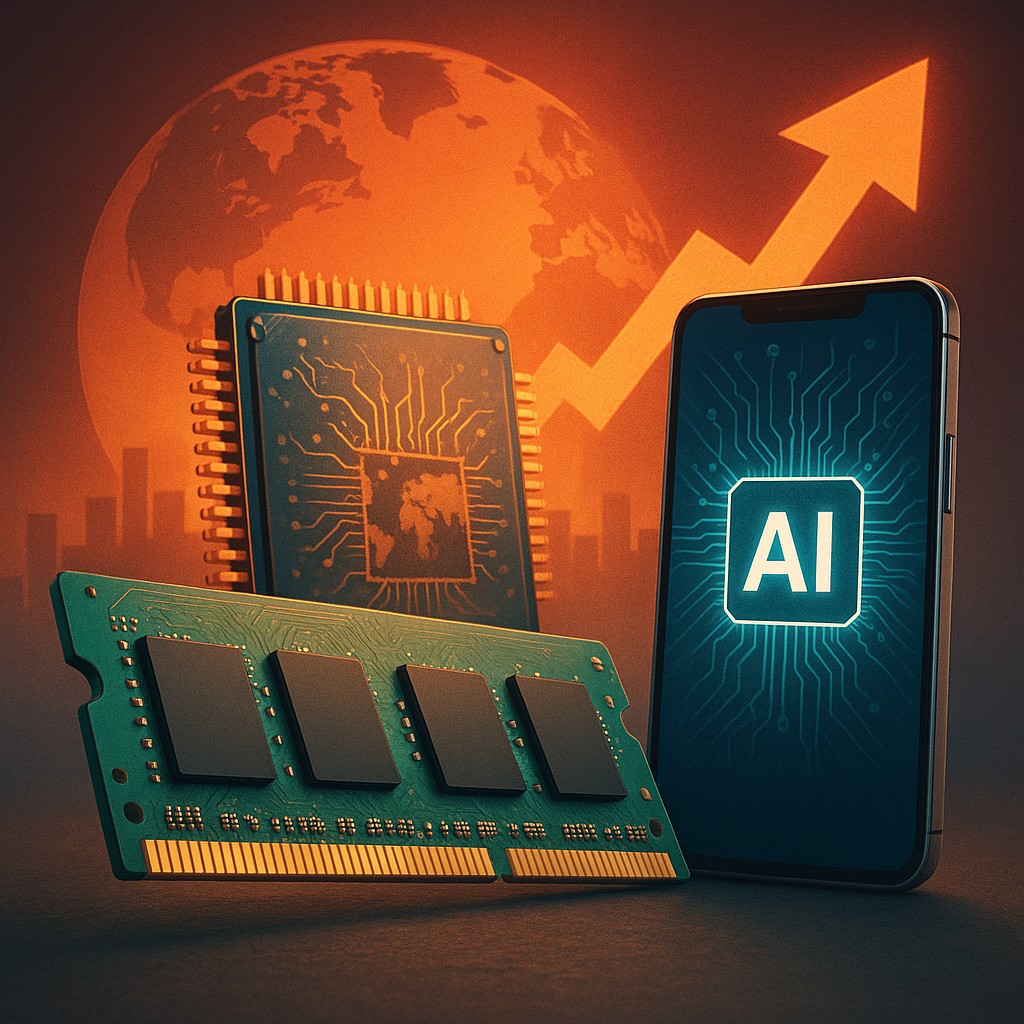
If you have recently tried to upgrade your gaming PC or wondered why a high-end smartphone now costs as much as a ten-year-old used car, you are not alone in your sticker shock. The digital world is currently weathering a perfect storm in the semiconductor market that has sent memory prices soaring.
As we move through the first quarter of 2026, we are witnessing something not seen in decades: the cost of essential silicon chips - the parts that store our data and run our apps - has nearly doubled. We usually expect technology to get cheaper as it gets older, but the "invisible hand" of the market has taken a sharp turn this year. This shift is forcing everyone, from casual tech fans to massive corporations, to reach deep into their pockets.
To understand why a stick of RAM or a solid-state drive (SSD) now feels like a luxury item, we have to look past the local computer shop and into the heart of global infrastructure. This isn't just a temporary hiccup; it is a fundamental change in how silicon is made and who gets first dibs on the limited supply. We are in a "capacity crunch," where the world’s hunger for data, driven largely by Artificial Intelligence, has moved faster than factories can produce chips. This is a global competition for a resource that has become more valuable than oil.
The Engine Driving the AI Gold Rush
The main reason for the 80 to 90 percent price jump in standard memory is a specialized piece of hardware you might not even have in your home: High Bandwidth Memory, or HBM. As AI moved from a trendy buzzword to a global requirement, tech giants began a frantic race to build massive data centers. These centers need tens of thousands of specialized AI processors, and those processors have a very specific "diet."
They cannot run without HBM, which is much faster and more "dense" - meaning it stores more data in less space - than the standard RAM used in laptops. However, making this high-performance memory is a slow, delicate process. Compared to older versions, it results in fewer working chips per silicon wafer (the large discs used to print circuits).
Manufacturers like Samsung, SK Hynix, and Micron only have so much factory space. When the demand for AI-grade memory exploded, these companies faced a choice: keep making the standard memory used in home PCs or switch their lines to produce the much more profitable HBM chips for tech giants. They chose the latter. This has left a massive shortage of "legacy" or standard memory. Because factories are busy serving the AI elite, there are fewer machines left to make the memory for your next laptop, car's navigation system, or smart fridge.
Think of a bakery that can make 1,000 loaves of bread or 100 elaborate wedding cakes. If the demand for wedding cakes triples, the baker will focus entirely on the cakes. The price of a simple loaf of bread will skyrocket because suddenly only ten loaves are available for the whole neighborhood. In the memory market, we are the hungry neighbors looking for bread, while the silicon bakers are busy decorating AI wedding cakes.
The Struggle of Physics and Factory Yields
To make matters worse, making modern memory has become much harder. As we try to cram more data into smaller spaces, the laws of physics are pushing back. Manufacturers are moving toward "advanced nodes," where circuits are so small they are measured in atoms. When they switch to these new methods, the "yield" - the percentage of chips on a wafer that actually work - is often very low at first. This means for every hour of factory time, companies are getting fewer usable products than they did two years ago.
Additionally, the industry is transitioning from the older DDR4 standard to the faster DDR5. DDR5 is more complex, so it takes longer to test and verify. When you combine the low success rate of new tech with factories being reconfigured for AI, you get a global bottleneck. It isn't just that things are expensive; the physical amount of "simple" memory being produced has actually shrunk. This forces buyers to outbid each other, driving contract prices up by record percentages in just a few months.
Breaking Down the Price Hikes
To see where the price increases are hitting hardest, look at the different types of storage and memory. While the 90 percent headline figure applies to standard DRAM, the impact varies.
| Memory Category |
Expected Q1 2026 Increase |
Main Cause |
Impact Level |
| Standard DRAM |
90 - 95% |
Servers & PC Upgrades |
Critical |
| NAND Flash (SSD) |
55 - 60% |
Cloud Storage & Data Centers |
High |
| HBM (AI-Specific) |
100%+ |
Generative AI Training |
Extreme |
| Legacy/Mobile Memory |
40 - 50% |
Phones & Smart Devices |
Moderate |
The trend is clear: the closer a chip is to the "brain" of an AI processor, the more the price has ballooned. While SSD storage hasn't risen as sharply as RAM, a 60 percent jump in a few months still disrupts entire supply chains. This "cascading inflation" means that even if you aren't building an AI server, you are paying an "AI tax" because your device uses the same silicon foundations.
Is This Just Corporate Greed?
When prices jump this fast, it is easy to blame "price gouging." While memory makers are seeing record profits now, they are coming off several years of massive losses. Leading up to 2024, there was an "oversupply" of chips. Prices were so low that companies were losing money on every chip they sold. To survive, they slashed budgets for new factories and slowed down production.
This is part of the "Silicon Cycle." It takes years and billions of dollars to build a new semiconductor factory (often called a "fab"), so supply cannot react quickly to sudden spikes in demand. When the AI boom hit, the industry was already running in a "lean" state with very little extra capacity. You cannot simply flip a switch to double production; you have to build a specialized "cleanroom" the size of two football fields and fill it with machines that take 18 months to ship. Current prices are a painful correction as the market tries to balance an explosion in demand against a supply chain that was intentionally scaled back.
This also isn't a temporary "bubble" like the cryptocurrency craze. That was driven by speculation, but this demand is driven by physical infrastructure. Big Tech is spending hundreds of billions because they are changing how the internet works. This is a structural shift in the global economy. When the biggest companies on Earth decide they need every chip available to win the AI race, the individual consumer gets crowded out.
The Ripple Effect
The impact of this surge goes far beyond the price of a single part. Device manufacturers now have to choose: raise their prices or cut corners. In 2026, we are seeing "shrinkflation" in tech. You might notice that "base model" laptops cost the same as last year, but they ship with less RAM, or they use slower, older memory to keep costs down.
In the business world, these prices are wrecking budgets. Companies planning to refresh office computers or upgrade internal servers find their money only goes half as far as it used to. This slows down the whole economy. Even the car industry, which uses chips for safety and navigation, is feeling the squeeze, leading to longer wait times and higher sticker prices for new vehicles.
Finally, there is the "psychology of scarcity." When distributors see prices rising 10 percent every week, they begin to hoard inventory. They worry that if they sell today, they won't be able to afford to restock tomorrow. This hoarding makes the shortage worse, creating a loop that pushes prices even higher.
Navigating the Silicon Storm
As we look toward the middle of 2026, everyone wants to know when this will end. While new factories are being built in the U.S., Japan, and Europe, they won't be ready for quite some time. For most people, the best strategy is "patience." If you don't absolutely need an upgrade right now, waiting for production to catch up is the smartest move. Historically, these bottlenecks eventually clear, but the AI era has changed many of the old rules.
Your expensive smartphone isn't just the result of a brand name; it reflects a global struggle for silicon. Knowing the "why" behind the numbers helps you decide when to buy and when to wait. The world of tech moves fast, but sometimes we have to look under the hood to understand why the ride has suddenly become so expensive. Stay curious, watch the supply trends, and remember that even with high prices, the innovation driving this demand will shape the next decade of our lives.