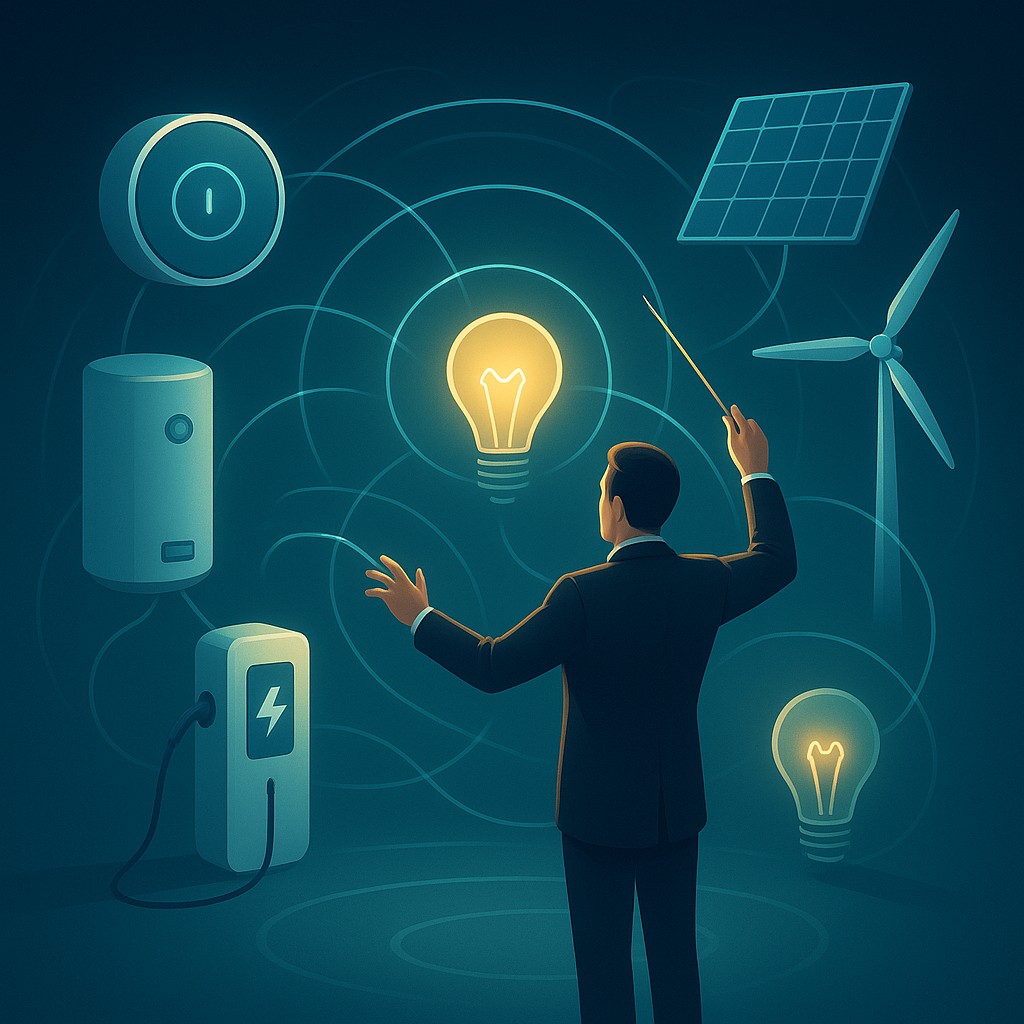
Imagine for a moment that you are a conductor standing before a massive, invisible orchestra. Instead of violins and cellos, your performers are millions of water heaters, electric car chargers, and smart thermostats scattered across thousands of miles. This orchestra faces a very specific challenge: the audience (the power grid) is incredibly demanding. If the music gets even a tiny bit too fast or too slow, the entire concert hall could go dark.
In the past, whenever the rhythm faltered, we simply hired an expensive group of backup drummers known as coal or gas power plants to bang their drums harder. Today, we are finding a much more elegant solution. We are teaching the tiny instruments already in the room to hum a little softer or louder in perfect harmony.
This shift marks the birth of the Virtual Power Plant, or VPP. This concept flips the traditional relationship between you and your utility company on its head. For over a century, you were a passive consumer; you flipped a switch, and the grid scrambled to meet your demand. Now, your home is becoming an active, intelligent part of a living network. By linking together the everyday appliances we already own, engineers are creating a "cloud-based" power plant that doesn't burn a single lump of coal or release a single puff of smoke. It is a masterpiece of digital coordination that solves one of the hardest puzzles of the green energy transition: how to keep the lights on when the wind stops blowing and the sun goes down.
The High-Wire Act of Grid Frequency
To understand why we need a virtual power plant, we first have to appreciate the incredibly precise physics of the electrical grid. Electricity isn't a liquid that sits in the wires waiting for you; it is a live flow that must be produced at the exact millisecond it is used. In North America, this flow pulses back and forth 60 times per second (60 Hertz), while in much of the rest of the world, it is 50 Hertz. If demand for power suddenly spikes because everyone turns on their air conditioners at once, this frequency drops. If it falls too far, the physical machinery of the grid can actually start to shake apart, leading to emergency shutdowns and city-wide blackouts.
In the old days of "Baseload Power," this was managed by massive spinning turbines in coal or nuclear plants. These turbines had a lot of physical momentum, known as inertia, which acted like a heavy flywheel to keep the frequency steady. However, as we swap these heavy spinning giants for solar panels and wind turbines, we lose that physical stability. Solar panels don't spin; they just sit there. When a cloud passes over a massive solar farm, the power output can drop instantly. Without a massive flywheel to provide momentum, the grid’s frequency can jitter like a nervous hummingbird.
A Virtual Power Plant fills this gap by providing "synthetic inertia." Instead of relying on a giant spinning piece of metal, a VPP uses software to talk to thousands of smaller devices. If the grid frequency starts to dip, the VPP doesn't try to make more electricity. Instead, it instantly tells five thousand water heaters to pause their heating cycle for just thirty seconds. To the grid, reducing demand by ten megawatts looks exactly the same as increasing supply by ten megawatts. It is the mathematical equivalent of a power plant, but instead of being built of steel, it is built of code and diverted energy.
From Dumb Appliances to Digital Soldiers
What actually makes up a Virtual Power Plant? It isn't just one type of technology, but a diverse ecosystem of "Distributed Energy Resources" (DERs). These are small-scale power assets located at the "edge" of the grid, right where people live and work. When these assets are isolated, they are just convenient gadgets. When they are bundled together, they become a powerhouse. By coordinating these devices, a VPP operator can participate in the energy market just like a traditional power plant owner, offering to "sell" a reduction in electricity use during peak times.
The brilliance of this system is that it targets devices with "thermal inertia" - the ability to hold onto heat or cold over time. For example, your water heater is essentially a giant battery that stores heat. If the power shuts off for ten minutes, the water inside stays hot, and you likely won't even notice. Similarly, a modern home has enough insulation that if the AC turns off for five minutes during a peak demand spike, the temperature might only rise by half a degree. By linking thousands of these "unnoticeable" delays together, the VPP creates a massive buffer of flexibility.
| Component Type |
Role in the VPP |
User Impact |
| Smart Thermostats |
Adjusts AC/Heating by 1-2 degrees during peaks |
Minimal; house stays comfortable |
| Electric Vehicle (EV) Chargers |
Pauses or slows charging speed during high demand |
Low; car is still full by morning |
| Residential Batteries |
Pumps stored solar power back into the house or grid |
High; reduces total grid strain |
| Smart Water Heaters |
Shifts heating cycles to off-peak hours |
Zero; water remains hot for use |
| Industrial Fridge Units |
Briefly turns off compressors during frequency drops |
Zero; food stays at safe temperatures |
The Software Brain Behind the Curtain
The most complex part of a Virtual Power Plant isn't the hardware; it’s the "Distributed Energy Resource Management System," or DERMS. This is the sophisticated software brain that manages millions of moving parts. Think of it as a high-tech air traffic controller. It has to predict how much power each home will need based on weather forecasts, historical usage, and even the day of the week. It also has to ensure it never inconveniences the customer. A VPP that leaves people with cold showers or dead EV batteries is a VPP that people will quickly uninstall.
This software uses machine learning to create a "flexibility profile" for every participating home. It knows that House A stays cool for a long time because it has great insulation, while House B needs the AC to kick back on sooner. It then rotates the "off" signals across its network like a game of musical chairs. While some houses are taking a five-minute break, others are turning back on. This creates a smooth, continuous block of energy reduction that looks perfectly steady to the utility company, even though it is made of thousands of shifting parts.
Furthermore, this system handles the billing and "negawatt" accounting. A negawatt is a unit of power saved rather than produced. In many regions, the VPP operator receives payments from the grid for being available to help during emergencies. These payments are then shared with the homeowners. Essentially, your water heater could earn you five or ten dollars a month just for being part of the team. It is a rare "everybody wins" scenario: the homeowner gets a lower bill, the utility avoids a blackout, and the planet sees fewer carbon emissions.
Debunking the Big Brother Myth
Whenever we talk about a central system controlling household appliances, people naturally get a bit uneasy about privacy and control. There is a common misconception that a Virtual Power Plant means a faceless bureaucrat in a dark room is deciding exactly when you can wash your dishes. In reality, modern VPPs are built on a foundation of "opt-in" consent and strict boundaries. The homeowner always remains the ultimate authority over their own environment.
Most VPP programs work on a "set it and forget it" principle with a manual override. If you are having a dinner party and absolutely need the house at exactly 68 degrees, you can simply tap your thermostat and opt out of that day's event. The VPP software is smart enough to find that extra energy from another participant who isn't home that afternoon. The goal isn't control; it's coordination. By bringing so many participants together, the system becomes resilient to individual choices.
Another myth is that VPPs are only for people with expensive solar panels and home batteries. While batteries are excellent additions because they can push power back into the wires, they aren't the only players. The most effective VPPs are often built from the simplest tech: smart thermostats and water heaters. These "demand-side" participants act as virtual batteries. They don't store electricity, but they store the work that electricity does. By shifting when that work happens, they provide the exact same service as a giant battery at a fraction of the cost.
The Invisible Infrastructure of Tomorrow
As we move toward a future powered by variable sources like wind and solar, the Virtual Power Plant is likely to become the most important piece of infrastructure you’ll never see. It represents a shift from a "top-down" world where a few massive plants dictate the flow, to a "bottom-up" world where every home is a tiny pillar of stability for its neighbors. This democratization of the energy grid is more than just a technical fix; it’s a social evolution. It turns the act of living in a modern home into an act of community service.
The next time you hear your air conditioner hum to a stop on a blistering Tuesday afternoon, don't think of it as a minor inconvenience. Think of it as your home whispering to the grid, "I've got this." You are part of a massive, invisible network that is making the transition to clean energy possible, one degree and one gallon at a time. The power plant of the future won't be a smokestack on the edge of town; it will be the quiet intelligence inside the walls of your own living room, proving that when we coordinate our smallest actions, we can solve our biggest problems.