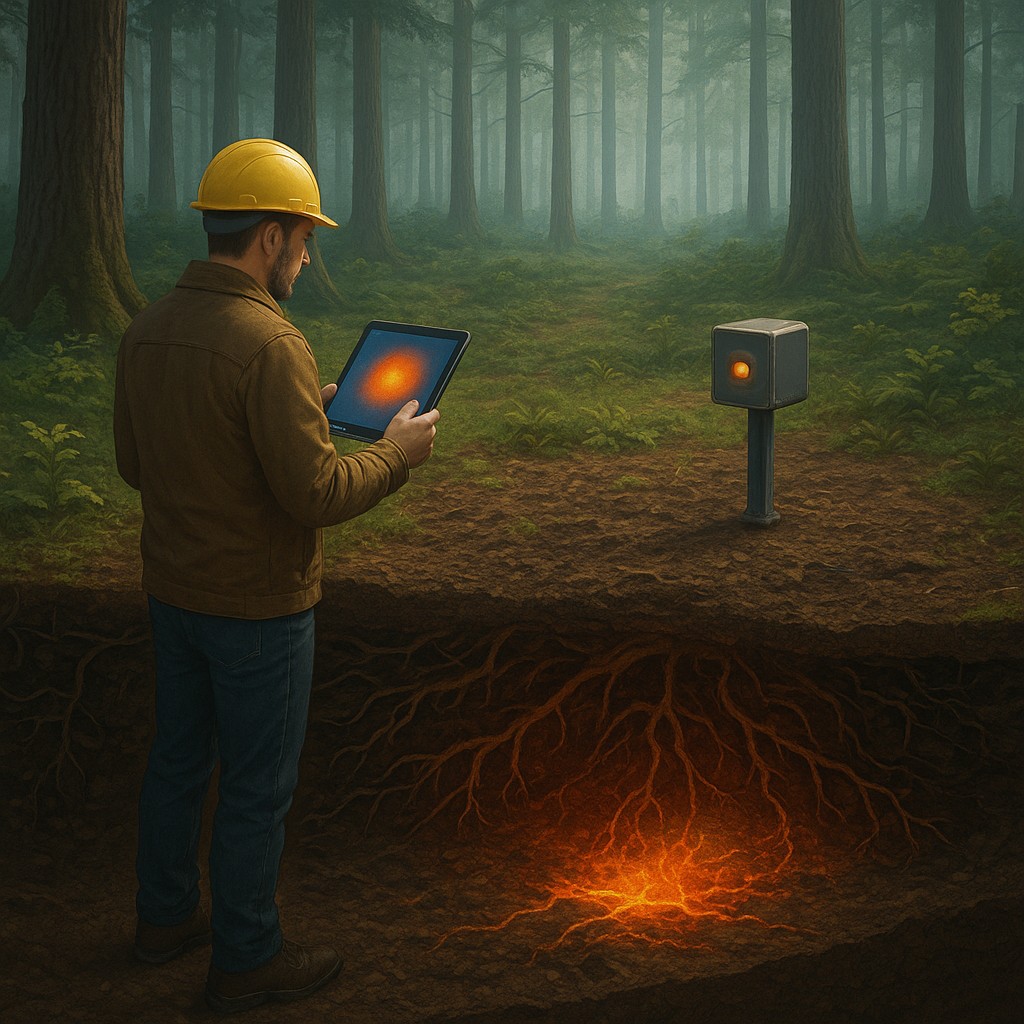
Imagine standing in a forest where the air is crisp, the smoke has drifted away, and the last red embers have been soaked by a heavy rain. To the naked eye, the danger is gone. News crews have packed up, firefighters are heading home for a well-earned rest, and the ecosystem is beginning the slow walk toward recovery. However, deep beneath your boots, a chemical ghost still haunts the land. In the maze of dried-out roots and thick layers of decaying vegetation known as peat, a fire is still breathing. It does not need high winds or fresh air to survive. It eats the earth itself, moving at a snail’s pace of just a few centimeters an hour, waiting for the ground above to dry out so it can burst through the surface once more.
These are the infamous "zombie fires," known technically as overwintering or subterranean fires. For decades, they have been the nightmare of forest managers because they are effectively invisible. A fire can travel hundreds of meters underground, slipping right under firebreaks and trenches, only to pop up in the middle of a "safe" zone weeks later. Traditional firefighting is a reactive game of whack-a-mole where you chase the flames you can see. But the arrival of thermal thin-film sensors and satellite tracking is shifting the strategy from visual defense to underground surveillance. We are finally learning how to check the planet's pulse before the heart of the forest skips a beat.
The Chemistry of the Hidden Smolder
To understand why a fire would go underground, we have to look at its fuel. In many northern forests, the ground isn't just dirt. It is a dense "duff" layer made of needles, twigs, and moss, often sitting on top of carbon-rich peat. When a surface fire sweeps through, it often dries out these lower layers without burning them completely. Because peat is packed so tightly, it limits the amount of oxygen available. Without enough air to create a roaring flame, the organic material begins "smoldering combustion." This is a low-temperature, flameless burn that is actually much better at consuming fuel than a bright orange blaze.
Smoldering is a self-sustaining cycle that is incredibly hard to break. As the peat burns, it releases heat that dries out the patch of earth immediately in front of it. This prepares the next section of "fuel" to catch fire. Because the soil acts as a massive insulating blanket, the heat stays trapped. While the surface might feel cool to the touch, just a few inches down, temperatures can hover between 200 and 600 degrees Celsius for months. In some cases, these fires have survived entire Arctic winters, tucked away under a thick layer of snow, only to reignite the forest floor the moment the spring thaw arrives.
This underground behavior creates a massive problem for the atmosphere. Peatlands are some of the world’s best carbon sinks, storing more carbon than all the world’s trees combined. When a hidden fire eats through a peat bog, it isn't just burning plants; it is releasing centuries of stored carbon back into the air. This creates a dangerous loop: climate warming leads to more dry peat, which leads to more zombie fires, which leads to even more warming. Finding a way to "see" these fires before they break the surface is no longer just about saving trees; it is about protecting the planet's carbon balance.
The Physics of Thermal Thin-Film Detection
Detecting a fire that lives under the dirt requires a total shift in sensor technology. Traditional smoke detectors or standard cameras are useless when the "smoke" is just a few trace gases filtered through several feet of soil. This is where thermal thin-film sensors come in. These devices are designed to pick up tiny heat signatures moving through the ground. Unlike bulky old thermometers, thin-film sensors use specialized layers of materials that change their electrical resistance in response to even the slightest change in temperature. These sensors are often deployed in small "dots" or thin strips that can be tucked into the top layers of the forest floor.
The genius of these sensors is how they spot "thermal anomalies." In a healthy forest, the ground temperature follows a steady daily cycle, warming up during the day and cooling at night. An underground fire breaks this rhythm. Even if the fire is several feet deep, it creates a "heat plume" that rises toward the surface. The thin-film sensors detect this steady, non-stop rise in the baseline temperature. When the data is mapped out, it doesn't look like a sudden spike; it looks more like a slow, glowing "bruise" on the screen. This allows foresters to see exactly where the heat is concentrating long before a single wisp of smoke appears.
To make this data useful, these sensors are increasingly linked to Low Earth Orbit (LEO) satellites. A single sensor in the middle of the wilderness is useless if it can't tell anyone what it found. By using long-range radio or satellite networks, these sensors can beam their reports from deep in the woods to a central station. Computers then cross-reference the ground temperature with infrared images from space. If the satellite sees a hot spot that matches the ground sensor’s warning, firefighting teams get a high-priority alert with GPS coordinates accurate to within a few meters.
Comparing Traditional and Next-Generation Fire Detection
Moving from eyes-on-the-ground to sensor-based monitoring is a fundamental shift in how we handle natural disasters. The following table shows the differences between reacting to fires and the proactive model using underground sensors.
| Feature |
Traditional Firefighting |
Subterranean Sensor Management |
| Primary Goal |
Put out active flames |
Prevent fires from starting or returning |
| Detection Method |
Lookouts, smoke, satellites |
Under-soil heat nodes and IR sensors |
| Timing |
Reactive (starts after a fire begins) |
Proactive (monitors hidden threats) |
| Energy Source |
High-intensity flame |
Low-intensity underground smoldering |
| Carbon Impact |
High (burns surface plants quickly) |
Higher (burns ancient peat and carbon) |
| Cost Basis |
Expensive air drops and labor |
Tech investment with lower labor costs |
The Logistics of Deployment and Maintenance
Setting up thousands of tiny sensors across millions of acres of rugged wilderness sounds like a nightmare, and in many ways, it is. You can't just walk through the woods like a gardener planting seeds. Modern agencies are testing "aerial seeding," using drones to drop tough, biodegradable sensor packages into high-risk areas. These spots are usually picked using historical data and "fuel mapping," which shows where the peat is thickest and most likely to hide a zombie fire. Once dropped, the sensors wedge themselves into the soil and begin their silent watch.
Maintenance is another hurdle. In the deep woods, you can’t exactly go out to change batteries. This has led researchers to develop energy-harvesting tech. Some thermal sensors are now designed to run on "thermoelectric" power, which uses the temperature difference between the warm soil and the cooler air to generate the tiny bit of electricity needed to send a signal. Others use small solar panels or long-life batteries that can last up to a decade. The goal is a "set it and forget it" network that protects the forest for years before the parts safely break down into the soil.
Furthermore, the software has to be smart enough to avoid false alarms. A sun-baked rock can look a lot like an underground fire to a simple sensor. Foresters use computer models trained on "thermal fingerprints." A rock will cool down significantly once the sun sets, but a root fire stays hot 24/7. By analyzing these cooling patterns, the system can tell the difference between a harmless hot stone and a simmering disaster. This ensures that firefighters aren't sent out into the middle of the night to "put out" a piece of granite.
Breaking the Cycle of Misconceptions
One of the biggest hurdles for this technology is the "out of sight, out of mind" problem. Many people believe that once a fire is "out," the soil is safe. In reality, the soil is often where the most dangerous part of the fire begins. Another common myth is that heavy rain or snow will automatically put out deep fires. Water is surprisingly bad at reaching deep peat; it often runs off the surface or gets soaked up by the top layer, leaving the fire below bone-dry. In fact, if a fire is hot enough, it can turn water into steam, creating underground pockets that actually give the fire more air.
Understanding why we need underground detection also means unlearning the idea that all fire is bad. For a long time, the goal was "total suppression," putting out every flame immediately. We now know this causes a dangerous buildup of dead wood and dry brush that makes future fires much worse. However, zombie fires in peat are never "good" fires. They are strictly destructive, releasing ancient carbon and ruining the very soil the forest needs to grow back. By targeting these hidden threats, we can allow healthy surface burns to happen while making sure the underground "zombies" don't turn a controlled burn into a long-term catastrophe.
Ground-level sensing also solves the "smoke signal" problem. Often, by the time a fire is big enough for a satellite to see the smoke, it is already too large to stop easily. By the time a neighbor smells smoke, the fire may have already traveled miles underground. Thin-film sensors don’t need to see smoke or flames. They look for the "fever" of the forest rather than its "cough." This allows for a surgical approach where a small team can be sent to a specific spot to dig a trench or pump water directly into the roots, killing the fire while it is still just a small, manageable ember.
The Future of Living Landscapes
As the climate changes and fire seasons get longer, our relationship with the wilderness has to change. We need to move from trying to conquer nature to partnering with it through observation. Using these sensors is a look into a future where we "tune in" to the forest, not to control it, but to understand its stress. We are building a digital map of our natural spaces, where foresters can look at a tablet and see the heat under the earth as clearly as the trees above it. It is a mix of old-fashioned ecology and high-tech tools, a way to listen to the whispers of the ground before they turn into a roar.
This shift represents a new kind of humility. We are admitting that we can't always see danger with our eyes and that some of the most powerful forces on Earth happen in the dark, beneath our feet. By investing in these invisible guardians, we aren't just stopping the next big blaze; we are protecting the air we breathe and the soil that keeps us alive. It is a quiet, high-tech revolution that ensures when we say a fire is "out," it really stays that way, letting the forest- and the people nearby- sleep a little soundly.