Imagine walking into a room filled with the world’s most powerful computers, the machines currently processing the complex math behind generative AI. In a typical data center, you would be met by the deafening roar of industrial fans and a whirlwind of chilled air. These systems work overtime to keep silicon chips from melting under the pressure of their own digital work. It is a frantic, wasteful battle between wind and fire. In these facilities, nearly 40 percent of the electricity is used just to move air around the room rather than for actual computing.
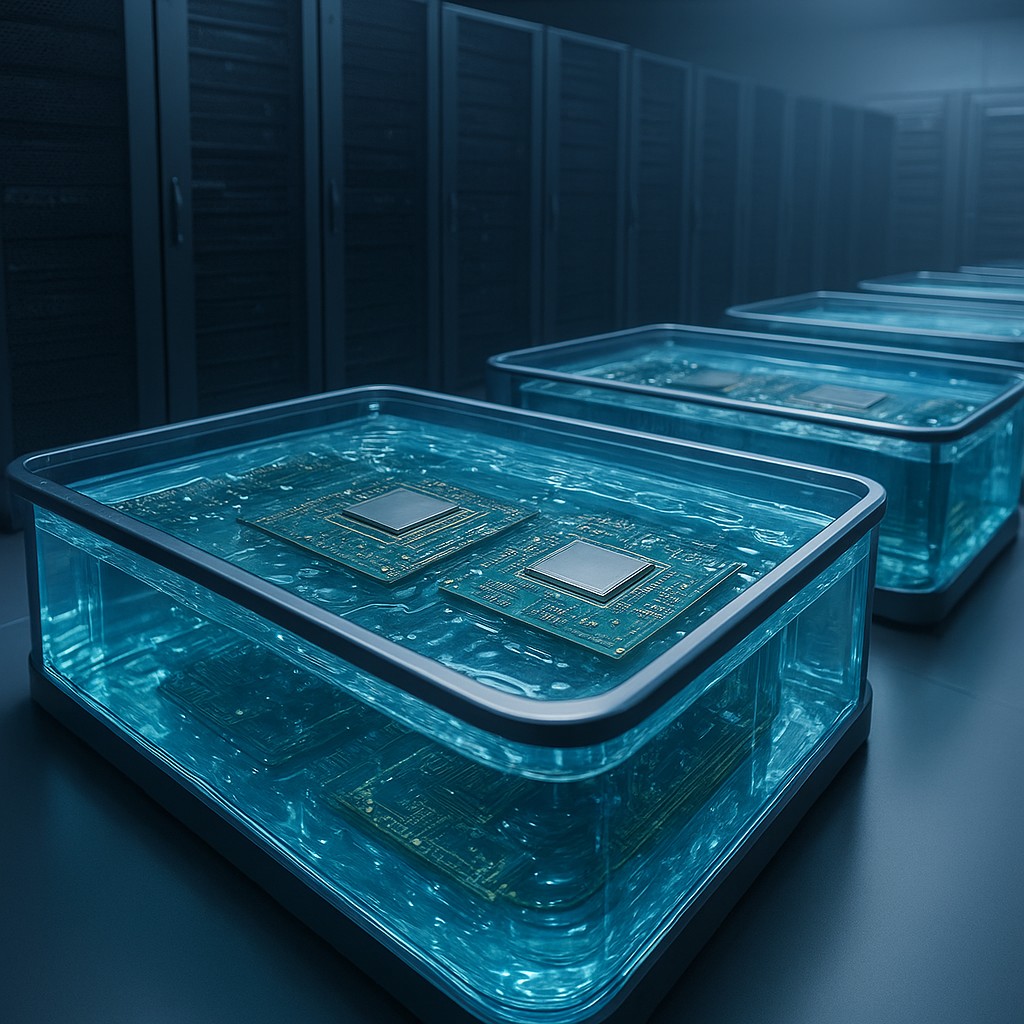
But in today’s most advanced "AI factories," the scene is eerily quiet. Instead of racks of loud fans, you find rows of sleek, horizontal tanks filled with a clear, shimmering liquid that looks like water.
Inside these tanks, millions of dollars' worth of high-end electronics are completely submerged. Normally, this would be a recipe for a catastrophic short circuit, yet there are no sparks or smoke. The liquid is a specially engineered synthetic oil called dielectric fluid, which does not conduct electricity. It sits in direct contact with red-hot processors, whisking heat away with a physical efficiency that air simply cannot match. This is the world of immersion cooling. It is a radical shift in engineering, moving away from cooling the air around a computer to cooling the exact atoms that generate the heat. As AI chips become more power-hungry and packed closer together, we are hitting a wall where air cooling is no longer just inefficient, it is physically impossible.
The Physical Speed Limit of Chilled Air
To understand why we are suddenly dunking computers into vats of oil, we have to look at the thermal wall facing the tech industry. For decades, the recipe for cooling a computer was simple: attach a metal heat sink to the chip, blow air over it, and hope for the best. This worked because chips were spread out and did not get that hot. However, the rise of Large Language Models has changed the shape of computing. To train these models, thousands of processors must be packed as tightly as possible to reduce the time it takes for data to travel between them. When you pack that much electrical resistance into a small space, you create a digital toaster oven.
Air is a surprisingly poor way to move heat. On a molecular level, air is mostly empty space. It takes a massive volume of air to absorb even a small amount of energy. In a modern, high-density data center, the fans needed to move enough air to cool a single rack of AI servers use so much power that they create their own heat problems. We are essentially trying to put out a forest fire with a fleet of battery-powered hand fans. Thermal conductivity measures how well a substance moves heat, and the synthetic liquids used in immersion cooling are roughly 1,200 times more effective at this than air. By switching from a gas to a liquid, we are upgrading from a dirt path to a ten-lane highway for heat removal.
Engineering the Magic of Non-Conductive Liquids
The most common question people ask when they see a server underwater is, "Why doesn't it explode?" We are taught from childhood that water and electricity are a fatal mix. The secret is the molecular structure of the fluid. These are dielectric liquids, meaning they do not allow electricity to flow through them. While water molecules allow electrons to move freely, these synthetic oils are engineered to act as insulators. You could technically drop a toaster into a vat of this liquid and it would keep browning your bread without ever tripping a circuit breaker.
There are two main ways this technology is used today. Single-phase immersion cooling uses a liquid that stays in liquid form the entire time. It is pumped through the server tank to absorb heat, then flows to a heat exchanger. There, it passes the heat to a secondary water loop before returning to the tank. Two-phase immersion cooling feels like science fiction. In this setup, the fluid has a very low boiling point. As the chips heat up, the liquid literally boils on the surface of the processor. The rising bubbles carry the heat away as vapor, which hits a cooling coil at the top of the tank, turns back into liquid, and rains back down. It is a self-contained, boiling weather system designed for a microchip.
A Comparison of Data Center Cooling Methods
| Feature |
Traditional Air Cooling |
Single-Phase Immersion |
Two-Phase Immersion |
| Cooling Medium |
Chilled, moving air |
Synthetic dielectric oil |
Low-boiling point fluid |
| Efficiency (PUE) |
High (1.5 - 2.0) |
Very Low (1.03 - 1.05) |
Lowest (near 1.01) |
| Noise Level |
Extremely loud (fans) |
Silent |
Silent |
| Space Required |
Massive (raised floors, AC) |
Compact (dense tanks) |
Most compact |
| Complexity |
Low (standard racks) |
Moderate (pumps and tanks) |
High (sealed pressure tanks) |
The Silent Death of the Mechanical Fan
One of the most overlooked benefits of immersion cooling is the "health" of the hardware. If you have ever opened an old laptop, you know that air cooling has a dirty secret: it acts like a vacuum cleaner. Fans pull in dust, humidity, and pollutants, depositing a thick layer of grime on sensitive parts. This dust acts as a blanket, trapping heat and eventually causing parts to fail. Furthermore, the constant vibration of high-speed fans and the way parts expand and shrink as air temperatures change put mechanical stress on the chips, leading to "thermal fatigue."
In an immersion tank, the hardware is sealed in a clean, stable environment. There are no moving parts on the server because there are no fans. The temperature remains steady because the liquid acts as a buffer, preventing the rapid heat spikes that happen when a processor starts a heavy task. It is effectively a spa day for a GPU. Engineers are finding that hardware submerged in these fluids lasts longer and has fewer errors. By removing fans, data centers also save a massive amount of physical space, allowing them to pack up to ten times more computing power into the same area.
Solving the Sustainability Paradox
The tech industry is facing a massive sustainability paradox. We need AI to help solve climate change and improve energy grids, yet the data centers required to run that AI use staggering amounts of electricity. Global data center power use is expected to double in the next few years. Immersion cooling is one of the most important tools we have to keep this growth sustainable. By getting rid of massive air conditioning units and high-powered fans, immersion cooling can reduce a data center's total energy footprint by nearly 30 percent.
Beyond saving electricity, immersion cooling changes how we think about waste. When you cool a room with air, the heat becomes "dilute." It is just warm air spread across a big space, which is very hard to reuse. However, when you capture heat in a liquid, that heat is "concentrated." The water leaving a heat exchanger in an immersion facility can be hot enough to pump into local heating systems, warming nearby homes or greenhouses. Instead of being a waste product we pay to get rid of, the heat from our digital lives becomes a resource we can harvest.
The transition from air to liquid cooling is more than a clever engineering trick; it is a fundamental shift in how we build the infrastructure of the future. As we move toward a world where every industry is powered by high-performance computing, we are learning that the best way to handle the heat of the digital age is to take a deep breath and dive in. This silent, shimmering revolution is what will allow our greatest technological goals to keep running, staying cool under pressure while the rest of the world moves at the speed of thought.