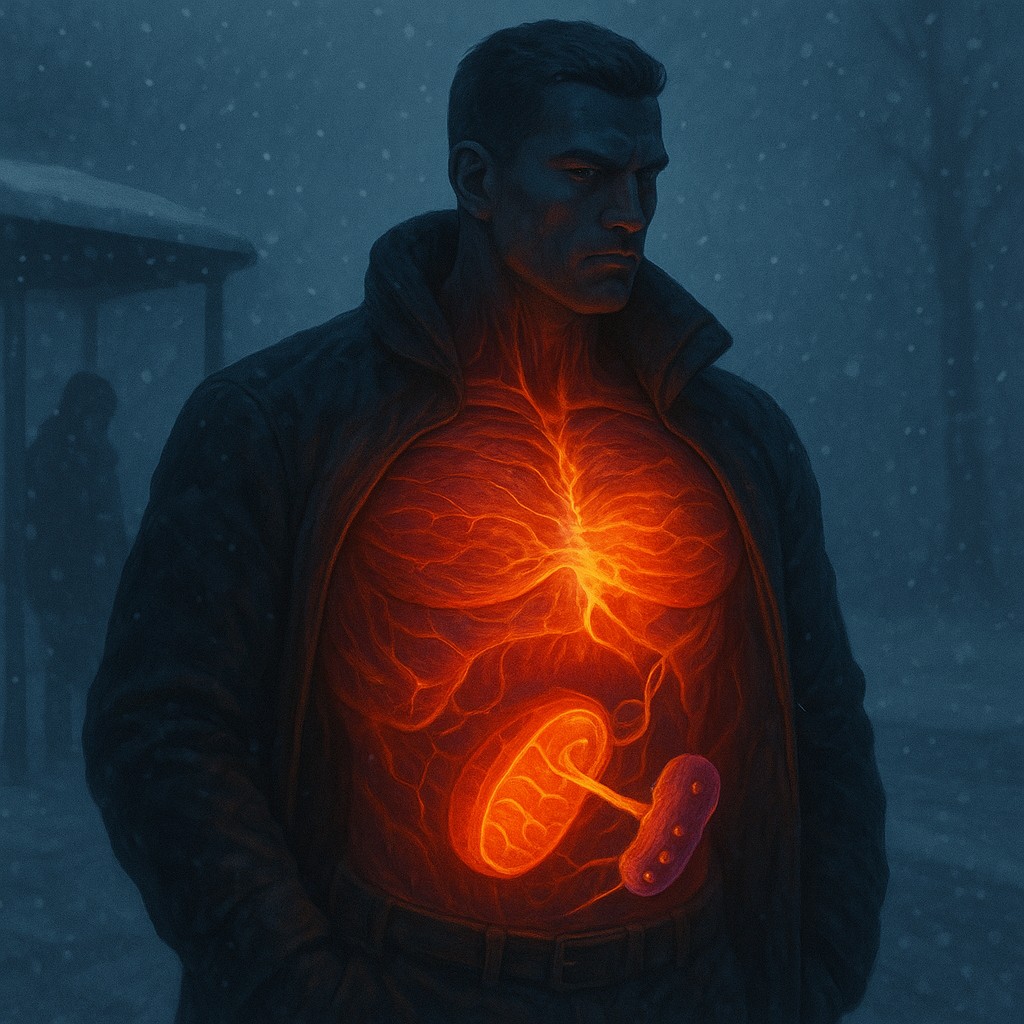
Imagine you are standing at a bus stop in the dead of winter. The wind is biting, your breath billows out like a fog machine, and despite your heavy coat, a creeping chill settles into your bones. Most people assume that if they aren't visibly shivering like a tuning fork, their body is losing the battle against the cold. We tend to view our muscles as biological pistons that only "turn on" when we decide to move or when involuntary tremors take over. However, beneath the surface of your skin, a silent and incredibly sophisticated chemical furnace is burning at full blast, keeping your core temperature steady without moving a single limb.
This hidden heat source is a masterclass in biological "inefficiency" used as a survival strategy. While we are taught from a young age that every system should aim for efficiency, your body intentionally breaks its own rules to keep you alive. By creating a deliberate "leak" in how cells handle minerals, your muscles can generate massive amounts of heat while you sit perfectly still. This process, known as non-shivering thermogenesis, transforms your skeletal muscle from a tool for movement into a dedicated radiator. Understanding how this works reveals why some people have a "naturally high metabolism" and how our bodies negotiate with the laws of physics to stave off the freeze.
The Microscopic Engine and the Calcium Gatekeeper
To understand how your body generates heat without moving, we have to look at the tiny machinery inside a muscle fiber. Every time you pick up a coffee cup or blink, your brain sends an electrical signal telling your muscle cells to release calcium ions. These ions act like a biological "go" signal, flooding the cell and causing the muscle fibers to slide past each other and tighten. Once the movement is done, the cell must clear that calcium immediately so the muscle can relax. This is where a specialized protein called the SERCA pump comes into play.
The SERCA pump is essentially a microscopic bouncer. It grabs calcium ions from the main floor of the cell and forcibly shoves them back into a storage closet called the sarcoplasmic reticulum. Moving these ions back into storage requires energy in the form of ATP, the body’s universal fuel. In a standard, efficient scenario, the pump moves the calcium, the door clicks shut, and the energy is used strictly for transport. However, when you are cold, your body introduces a "saboteur" protein called sarcolipin. This little protein latches onto the SERCA pump and forces it to work harder while accomplishing less. It makes the pump "slippery," causing the calcium to leak back out almost as soon as it is tucked away.
Embracing Inefficiency for Thermal Gain
In engineering, a machine that uses energy but doesn't produce work is usually considered a failure. If your car engine got hot but the wheels didn't turn, you would take it to a mechanic. But in human biology, "wasted" energy isn't truly wasted if the byproduct is heat. This is the heart of non-shivering thermogenesis. When sarcolipin interferes with the calcium pump, the pump begins to cycle rapidly, burning through ATP at an accelerated rate. Because the calcium keeps leaking back out, the pump never actually finishes its job. It just keeps spinning its wheels, and all that chemical energy is converted directly into warmth.
This "futile cycling" is incredibly effective. Unlike shivering, which is exhausting and makes it hard to perform delicate tasks like typing or holding a cup, this chemical heating happens silently in the background. It allows the body to maintain a high resting metabolic rate. This is one of the main reasons why people with more muscle mass often find it easier to stay lean. Their muscles are not just larger engines for movement; they are larger heaters that burn fuel even while they sleep. Your muscles are effectively "idling high," like a sports car at a red light, warming the body just by keeping the chemical pumps running in a circle.
The Battle of the Heat Sources: Muscle vs. Brown Fat
When scientists discuss biological heat, the conversation often centers on "brown fat." For a long time, we believed brown fat was the primary player in non-shivering heat. This is a specialized tissue packed with mitochondria (the cell's power plants) that acts like a biological space heater. While it is vital, especially for infants who cannot shiver, it turns out that skeletal muscle plays an equally important, if not larger, role in adults. Because muscle makes up such a large percentage of our total body mass, even a small calcium leak across all our muscles adds up to a massive amount of heat.
It is helpful to look at these two systems side by side to see how they differ in their approach to keeping you warm. While both avoid the physical shakes of shivering, they use different biological hardware to achieve the same result.
| Feature |
Brown Fat Heat Production |
Muscle Non-Shivering Heat |
| Main Mechanism |
Uncoupling protein 1 (UCP1) in mitochondria |
Calcium cycling (SERCA) triggered by sarcolipin |
| Location |
Small pockets around the neck and spine |
Throughout the entire skeletal muscle system |
| Fuel Source |
Mainly fatty acids |
ATP (from sugar and fats) |
| Physical Sensation |
No movement, purely chemical |
No movement, purely chemical |
| Total Mass in Adults |
Relatively low |
Very high (approx. 40% of body weight) |
| Main Benefit |
Quick heat for vital organs |
Constant core temp and metabolic balance |
While brown fat is like a high-intensity space heater placed near your central nervous system, muscle-based heat is like a heated floor that spans the entire house. Both work together, but the muscle-based system is what truly sets your baseline metabolism. If you have more muscle, you have more SERCA pumps. If you have more pumps being "sabotaged" by sarcolipin, you are burning more calories every second of every day, whether you hit the gym that morning or not.
Correcting the Myth of the "Fixed" Metabolism
One of the most stubborn myths in health and fitness is that your metabolism is a fixed number determined solely by your genes, like your height or eye color. While genetics certainly play a role, the discovery of how sarcolipin produces heat proves that metabolism is a dynamic, adjustable system. Your body can dial up its heat production based on your environment and your physical build. This means that "metabolic fire" isn't just something you are born with; it is something you can influence by changing the makeup of your muscle tissue.
When we talk about "muscle quality," we aren't just talking about how much weight you can lift. We are talking about the density of these calcium pumps and how easily your body can trigger this heat-generating leak. Studies show that people who are regularly exposed to cooler temperatures may actually become better at this process over time. Their bodies become "efficiently inefficient," getting faster at triggering the sarcolipin-calcium cycle. This is a form of metabolic flexibility, or the body’s ability to switch how it uses energy to meet the demands of the world around it.
The Evolutionary Logic of the Caloric Leak
You might wonder why evolution would favor a system that purposely "wastes" energy. From a survival standpoint, calories were historically hard to find, so a wasteful calcium pump seems like a liability. However, the risk of freezing to death was often a much more immediate threat than starvation. A body that could maintain a steady internal temperature while remaining perfectly still had a massive advantage. It allowed our ancestors to stay quiet and motionless to hide from predators or to hunt prey in cold climates without the loud, jerky movements of shivering.
Furthermore, this system acts as a release valve for energy. In an environment with plenty of food, the ability to "burn off" extra energy as heat helps prevent the body from storing unhealthy amounts of fat. This is why researchers are now looking into sarcolipin as a potential way to treat metabolic disorders. If we can understand exactly how to "flip the switch" on this calcium leak, we might be able to help people manage their weight and blood sugar by simply turning up their internal thermostat. It is a frontier where the science of staying warm meets the science of staying healthy.
As you move through your day, remember that your body is never truly "off." Even in moments of total stillness, a frantic, invisible dance is happening inside your cells. Millions of pumps are pushing, leaking, and pushing again, consuming energy and radiating warmth to ensure your heart keeps beating and your brain keeps thinking. This hidden furnace is a testament to the brilliance of biology, where even a "leak" is repurposed into a life-sustaining flame. You are not just a passenger in your body; you are the resident of a high-performance thermal machine, constantly negotiating with the cold to keep the fires of life burning bright.