Imagine for a moment that you are telling a friend about a chaotic dinner party. In English, you might say, "My cousin sat next to the host, and then his wife sat across from him, but the dog was under the table the whole time." To keep track of everyone, your friend has to build a shifting mental dollhouse. They are constantly updating the locations of the cousin, the host, and the golden retriever based on a long string of nouns and prepositions. If you get halfway through the story and say "he," your friend has to do a quick mental search to figure out if you mean the cousin or the host. It is an efficient system, but it relies heavily on the listener’s short-term memory to keep the scene straight.
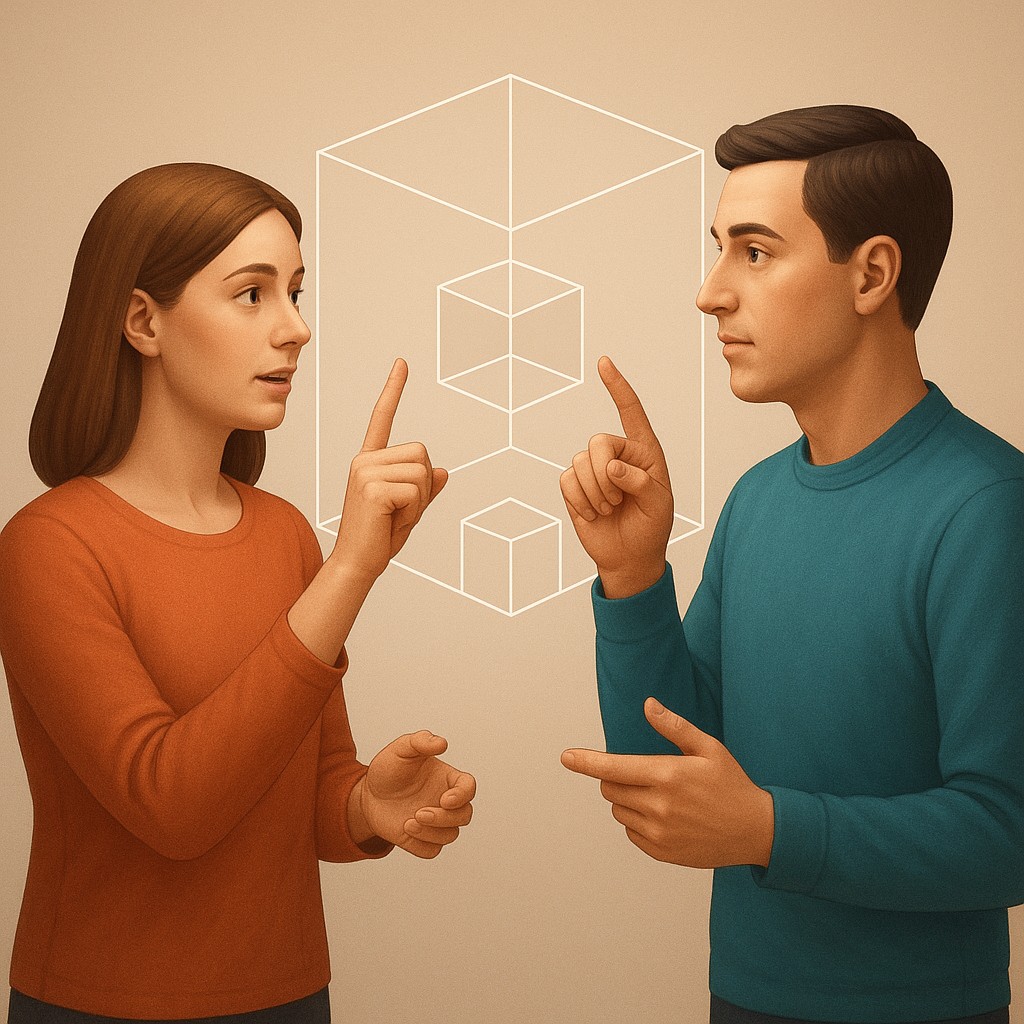
Now, imagine if you could actually build that house in the air between you and your friend. Imagine if the moment you mentioned the host, you "pinned" him to a specific spot in the air to your left. When you mentioned the cousin, you "clicked" him into place just to the right of that spot. From then on, you never have to use their names again; you simply point to those invisible points in space. If you want to say the cousin gave the host a glass of wine, you move your hand from the "cousin spot" to the "host spot." This is how sign languages work. It is a shift from the one-dimensional world of sound to a three-dimensional world where space itself carries the weight of grammar.
The Invisible Architecture of the Signing Space
When we watch American Sign Language (ASL) or British Sign Language (BSL), it is easy to assume we are just seeing a series of hand gestures. However, the hands are only part of the story. The air surrounding the signer, often called the "signing space," is a sophisticated canvas with its own strict rules. One of the most fascinating parts of this space is what linguists call topographic space. In this mode, the signer treats the area in front of them as a 3D map of a real or imagined environment.
This isn't just waving hands around to mean "over there." It is a precise physical layout. If a signer describes their childhood bedroom, they will place the bed, the desk, and the door at specific coordinates within their reach. Once these spots are set, they are "locked." If the signer talks about the desk for ten minutes and then wants to mention the door again, they must point to the exact same spot they used at the start. This consistency is not optional; it is a basic requirement for clarity. If the signer accidentally moves the door six inches to the left mid-sentence, the "sentence" becomes ungrammatical, much like saying "The door are blue" in spoken English.
This use of space creates a mental shortcut that spoken languages cannot match. In speech, we use prepositions like under, behind, or next to. In sign language, these words are often unnecessary because the relationship is physically shown. To say a cat is sitting on a fence, you don't need a word for "on." You simply establish a flat surface (the fence) with one hand and place the sign for "cat" directly on top of it. The grammar is built into the geography.
Spatial Indexing and Visual Pronouns
One of the most elegant features of these languages is how they handle people and objects using "referential loci," or anchored points in space. In spoken English, pronouns like "he," "she," and "it" are often confusing. If you say, "Bob told Jim that he was late," who was late? Bob or Jim? To fix this, we often have to repeat their names, which sounds clunky. In sign language, this confusion vanishes through spatial indexing.
When a signer introduces a person, they "index" them by pointing to a specific location in their signing space. This spot becomes that person’s "name tag" for the rest of the conversation. If the signer points to the right for "Sarah" and to the left for "Mark," any later point to the right means "she," and any point to the left means "he." This creates a visual pronoun system that is much stronger than the spoken version. We can compare the two systems to see how they manage the mental effort required of the listener.
| Feature |
Spoken Language (Linear) |
Sign Language (Topographic) |
| Medium |
Sound waves over time |
Light and shapes in 3D space |
| Referencing |
Pronouns (he/she/it) that can be confusing |
Anchored points in space (loci) |
| Prepositions |
Specific words (above, below, next to) |
Physical placement of signs |
| Perspective |
Requires mental reconstruction of the scene |
Direct visual mapping of the scene |
| Tracking Roles |
Heavy mental load to track names |
Low mental load; visual "slots" hold the info |
Because the subjects are physically anchored in space, the signer can move them like chess pieces. If Sarah (on the right) is shouting at Mark (on the left), the signer’s gaze and body tilt will shift toward the right-hand spot while signing the "shouting" verb. This allows the listener to see the interaction unfold as a scene rather than just a list of facts. It is like a private theater where the actors are invisible, but their positions are perfectly clear.
Moving Beyond Pantomime Through Strict Rules
A common mistake is thinking sign language is just a fancy version of charades or pantomime. While pantomime is a creative way of acting things out, sign languages have rigid grammar rules for how space is used. For example, there is a difference between "topographic space" and "abstract space." If you are describing a real room, you use topographic space, where the distance between your hands matches the distance in the real world. However, if you are talking about abstract ideas like "Justice" and "Mercy," you might still place them in space to compare them, but you are now using "referential" or abstract space.
In pantomime, you might mime opening a door with a big, sweeping arm motion. In a sign language, the sign for "door" is a specific, established movement using only the hands and wrists, performed in a "neutral" area near the chest. If you use too much "acting," it actually becomes harder for a fluent signer to understand you. You are essentially drowning out the linguistic signals with "noise."
Furthermore, these spatial rules vary between different sign languages. Just as French and English use different words for "house," American Sign Language (ASL) and French Sign Language (LSF) use different spatial patterns. The way a signer moves a verb between two locations to show who did what to whom - a process called "verb agreement" - follows specific paths that must be learned. You cannot simply point anywhere; you must follow the geometry of the grammar unique to that language’s history and culture.
The Cognitive Map in the Signer's Mind
How does this reliance on 3D space affect the brain? Research suggests that fluent signers often develop better spatial thinking. Because their primary way of communicating requires them to track coordinates, rotate mental images, and map physical environments onto the space in front of them, their "mental maps" are incredibly sharp. When a signer describes a route through a city, they aren't just giving directions; they are navigating a holographic projection.
This becomes especially interesting with "perspective shifting." A signer can describe a scene from their own point of view or "step into" the shoes of one of the characters they have placed in space. When they do this, the entire map rotates. What was on'the "right" for the storyteller might now be on the "left" for the character. The signer uses subtle shifts in their shoulders and head to signal these changes. The listener, in turn, must be able to mentally rotate these coordinates to keep the story straight.
This suggests that language is not just a way to share information; it is a way of organizing our very thoughts. If your "words" are points in a coordinate system, you likely perceive the world with a much stronger sense of spatial relationships than someone who processes language as a sequence of sounds. This doesn't mean one system is "better," but it shows that the human brain is remarkably flexible. It can turn something as abstract as "grammar" into something as tangible as a three-dimensional model.
Perspective and the Body as a Reference Point
In the topographic world, the signer's body often acts as the starting point on a graph. This is very clear in how time is handled. Many sign languages use a "time line" that runs through or past the signer's body. In ASL, for example, the space directly in front of the signer represents the present. Moving a sign forward, away from the body, indicates the future. Moving a sign backward over the shoulder indicates the past.
This spatial metaphor for time is so natural that we often forget it is a linguistic choice. By placing "yesterday" behind them and "tomorrow" in front of them, the signer treats time as a physical path. When combined with topographic mapping, this allows for incredibly dense storytelling. A signer can establish a house in the "past" space to the left, and then show how it has changed by "moving" it into the "present" space directly in front of them. The viewer sees the transformation happen across both time and space at once.
This geometric structure also allows for "classifier constructions." These are handshapes that represent categories of objects - like "long thin things" or "flat surfaces" - which can be moved through space to show exactly how an object traveled. Instead of saying "the car sped around the corner, narrowly missing the tree," a signer uses a handshape for "vehicle" and literally traces its path relative to a point in space representing the "tree." The speed, the curve, and the distance are all captured in one fluid movement. It is the linguistic equivalent of a high-definition video clip instead of a static photo.
Bridging the Gap Between Sound and Sight
Understanding the topographic nature of sign language changes how we think about human communication. For centuries, thinkers assumed that language was speech. They believed the structure of our thoughts was limited by our vocal cords and ears. But complex, spatial grammars prove that the "language center" in the brain does not care about the medium. Whether the information arrives through the ears as sound frequencies or through the eyes as geometry, the brain organizes it into a clear system of subjects, objects, and actions.
By moving beyond the "linear string" of sound and embracing 3D space, we discover a form of expression uniquely suited to how we actually experience the world. We don't live in a 1D world of sounds; we live in a 3D world of objects and movements. Sign languages take that reality and turn it directly into communication. It is a reminder that there are many ways to "speak," and sometimes, the most profound things we have to say are best expressed by carving them out of the very air around us.
Stepping into the world of topographic space is like gaining a new dimension of perception. It challenges us to stop thinking of language as something we merely hear and to start seeing it as something we build. When you watch a signer create a world between their hands, you aren't just seeing a translation of words; you are witnessing a feat of geometric engineering that turns empty space into a vibrant landscape of meaning. This reminds us of the incredible versatility of the human mind and the beautiful, invisible structures we build every time we connect with one another.