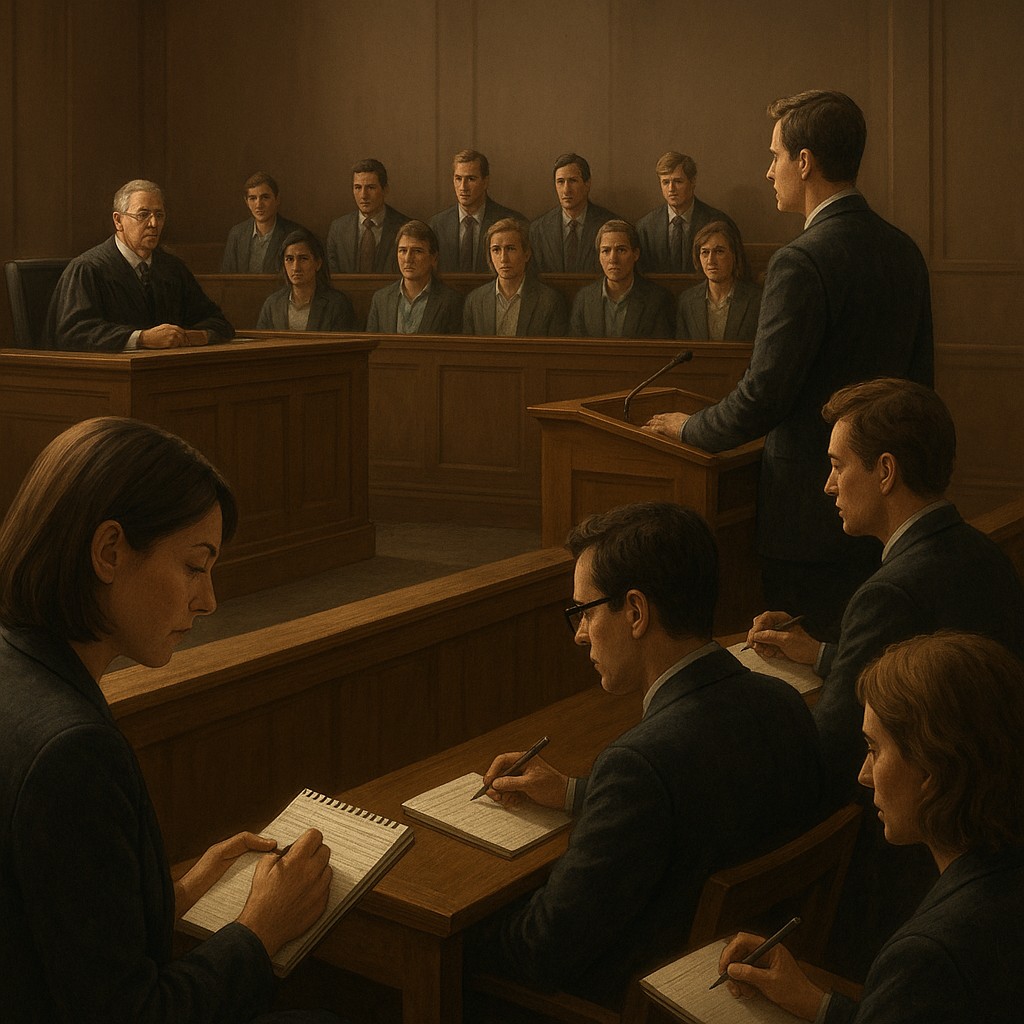
Imagine walking into a high-stakes courtroom where the air is heavy with tension and the future of an individual or a billion-dollar company hangs in the balance. You see the judge, the legal teams, and the twelve sworn citizens in the jury box who hold the power to deliver a verdict. But if you look toward the back of the room, tucked away in the public gallery, you might see a second group of people. They are taking diligent notes, reacting to every witness, and watching the lead attorney with an intensity that matches the actual jurors. These people are not family members or law students; they are the "shadow jury," a group of paid citizens recruited to provide an invisible, real-time mirror of the official proceedings.
This legal strategy is a blend of sociology, psychology, and high-stakes maneuvering. While the real jury is strictly forbidden from speaking to anyone about the case until the very end, the shadow jury is interviewed every night. They act as a human "dashboard" for the defense team, offering a snapshot of how the case is being received before it is too late to change course. By the time closing arguments arrive, the attorneys have already tested their best points on a representative sample of the public, which allows them to pivot their strategy based on the subtle emotional shifts and misunderstandings of their shadow counterparts.
The Architecture of the Human Mirror
Creating a shadow jury is not as simple as hiring twelve random people from the street. If the actual jury consists of three retired teachers, a young tech worker, two mechanics, and a nurse, the consulting firm will scour the local area to find individuals who match those exact demographic and psychological profiles. They look for similarities in age, education, political leanings, and even personality traits like authoritarianism or empathy. The goal is to create a biological simulation that processes information through the same cultural and personal filters as the people sitting in the jury box.
During the trial, these shadow jurors are instructed to act as if they were the real thing. They are told to listen to the judge, ignore outside media, and focus entirely on the evidence presented in court. Because they sit in the gallery, they see exactly what the real jury sees, including the body language of the defendant and the way the prosecutor scowls when a witness fumbles a question. This environmental consistency is vital. If the real jurors notice that the defense attorney’s tie is always crooked or that a specific expert witness sounds condescending, the shadow jurors will likely notice it too, providing the legal team with crucial, honest feedback on their likability and credibility.
Nightly Debriefs and the Art of the Pivot
The real magic of the shadow jury happens after the courthouse doors lock for the evening. While the real jurors go home to their families, the shadow jurors meet with a communications consultant for a structured debriefing. They are asked a series of pointed questions: Who was the most believable witness today? What part of the opening statement was confusing? If you had to vote right now, would you find the defendant guilty or innocent? These sessions are recorded and analyzed for changes in "emotional temperature." If the shadow jury suddenly sours on a defense witness who seemed perfect on paper, the lawyers know they have a looming disaster that needs immediate damage control.
This feedback loop allows for a "dynamic defense" that can adapt to the unpredictable flow of a trial. For example, if a shadow juror mentions they did not understand a complex scientific chart used by a ballistics expert, the defense attorney might spend the next morning asking a follow-up witness to explain that exact concept in simpler terms. It is essentially a live A/B test of legal arguments. Unlike a mock trial, which happens before the case begins and relies on a summary of evidence, the shadow jury experiences the trial's grueling pace and emotional fatigue in real-time. This provides much more detailed data.
| Feature |
Mock Trial |
Shadow Jury |
| Timing |
Weeks or months before the trial |
During the live trial |
| Scope |
Condensed version of the case |
The entire, day-by-day proceeding |
| Interaction |
Lawyers can pause and ask questions |
Jurors observe silently in the gallery |
| Goal |
Testing overall case themes |
Refining daily tactics and tone |
| Flexibility |
High (can change the facts) |
Low (must follow real court events) |
Reading the Room through Psychological Proxies
One of the most valuable aspects of a shadow jury is its ability to detect "jury drift." Human beings are not static processors of information; their opinions evolve as they bond with fellow jurors and react to the theater of the courtroom. If a prosecutor is particularly aggressive, a shadow jury might initially find it impressive but eventually grow to find it bullying. By tracking these shifts day by day, consultants can warn legal teams when they are losing the "likability war," allowing the lead counsel to soften their tone or humanize their client before the jury’s perception hardens into a final verdict.
Furthermore, shadow juries help identify "anchor" jurors. These are the individuals who, through charisma or expertise, are likely to lead the discussions during deliberations. If the nurse on the shadow jury is particularly vocal and persuasive, the defense team can assume the nurse on the actual jury might be doing the same. This allows the lawyers to tailor their language to appeal specifically to that demographic. If you can convince the shadow anchor, you have a much better chance of convincing the real one, who will then go into the jury room and fight your battles for you behind closed doors.
The Deliberation Black Box and the Limits of Data
Despite the incredible precision of matched demographics, there is one place a shadow jury can never go: the actual jury room. This is the "black box" of the legal system. Once the evidence is closed and the jurors are locked away to deliberate, a new set of social dynamics takes over. Power struggles, exhaustion, hunger, and even the "12 Angry Men" effect, where one stubborn person flips the entire room, are variables that no shadow jury can perfectly replicate. While the shadow jury might reach a unanimous "not guilty" verdict in thirty minutes, the real jury might take three days, struggling with a personal grudge between two members that consultants could never have predicted.
Research has shown that while shadow juries are excellent at predicting the general direction of a verdict, they diverge from the real jury roughly twenty-five percent of the time. This divergence often happens because the real jurors feel the immense weight of legal responsibility. A shadow juror knows their vote does not actually send someone to prison or bankrupt a company, which can lead to a different psychological approach than the person holding the official verdict form. Despite this limitation, the shadow jury remains the most sophisticated tool available for measuring the vibe of a courtroom, acting as a high-tech thermometer for the heat of justice.
The Ethical Landscape of Paid Observation
Critics of shadow juries often point to the wealth gap in the justice system. Because these groups are expensive to recruit and manage, they are almost exclusively the domain of wealthy individuals and massive corporations. This creates a scenario where one side has a psychological radar system while the other is flying blind. However, proponents argue that shadow juries simply represent an evolution of the public trial concept. Since the gallery is open to anyone, the defense has every right to fill their seats with observers who help them communicate more effectively. It is less about tricking the jury and more about ensuring the defense’s message is actually being heard and understood as intended.
From a teaching perspective, the shadow jury highlights the fragility of human communication. It reminds us that what we say is often less important than how it is received, and that our biases, backgrounds, and even the time of day we hear information can radically change our perception of the truth. In the world of high-stakes litigation, the shadow jury serves as a humbling reminder that facts do not speak for themselves; they are interpreted by humans, and humans are delightfully, frustratingly, and consistently unpredictable.
As you reflect on the invisible dance between the legal team and their shadow observers, consider how much of our own lives are spent performing for an audience we are trying to read. Whether in a boardroom, a classroom, or a simple conversation, we are constantly adjusting our frequency to match the people across from us. The shadow jury is simply that human instinct refined into a scientific tool. By understanding the emotional temperature of the room, we can move beyond mere data and connect with others on a level that truly resonates. The next time you find yourself in a high-stakes situation, remember the lesson of the shadow jury: the most important part of speaking is making sure you are truly being heard.