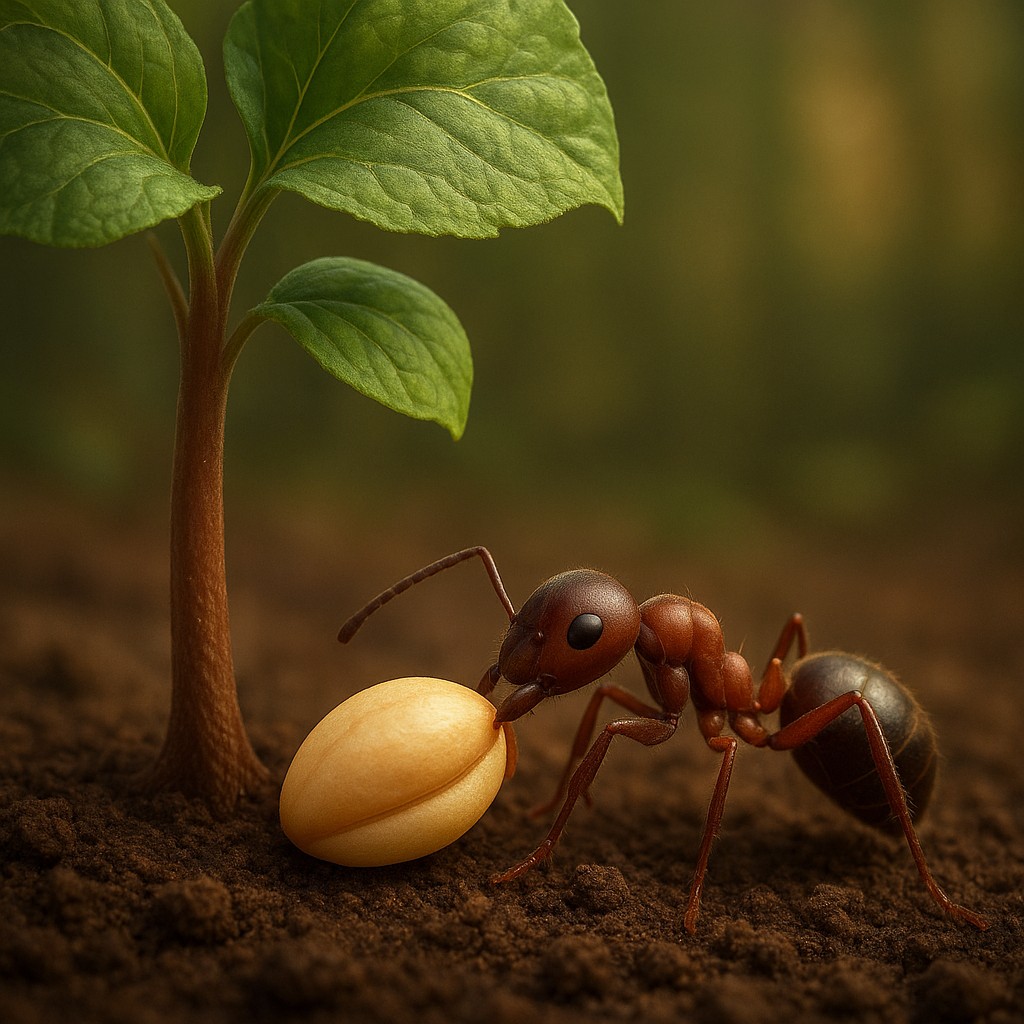
Imagine you are a plant. You are rooted firmly in the soil with no hope of ever taking a stroll or moving to a sunnier neighborhood. You have spent months pouring your biological savings into producing seeds, the tiny vessels that carry your genetic legacy. However, you face a serious logistical problem. If your seeds simply drop at your feet, they will have to compete with you for water and nutrients. Even worse, a hungry bird might spot them and turn them into a snack. To survive, your offspring need a one-way ticket to a safe, nutrient-rich bunker far away from your shadow.
Evolution, the ultimate problem-solver, has crafted a brilliant solution for thousands of plant species across the globe. Since plants lack legs, they have learned to hire the most industrious laborers in the animal kingdom: ants. This biological partnership is known as myrmecochory, a term taken from the Greek words for "ant" and "dispersal." It is a sophisticated, high-stakes trade agreement where the plant offers a gourmet, high-fat bribe in exchange for a professional moving service. By understanding how this tiny economy works, we can catch a glimpse into the complex web of interactions that keeps our forests and grasslands thriving.
The Science of the Botanical Bribe
At the heart of this ancient arrangement is the elaiosome. If you were to look at a seed from a plant like bloodroot or a woodland violet under a magnifying glass, you would see a small, fleshy, pale nub clinging to the hard outer shell. This isn't a random growth or a biological mistake. The elaiosome is a specialized structure packed with fats, proteins, and essential vitamins. To an ant, this isn't just a seed; it is a portable, high-calorie feast that looks and smells remarkably like insect prey.
The chemistry of the elaiosome is particularly clever. Many plants have evolved to include specific fatty acids, such as oleic acid, within these structures. These are the same chemicals found in the "blood" of many insects. When a foraging ant happens upon a seed with an elaiosome, its chemical sensors go into overdrive. The ant’s brain registers the "scent" of a high-value food source. Instead of ignoring the seed as if it were a heavy, useless pebble, the ant treats it like a prize kill. It grips the elaiosome with its powerful jaws and begins the long journey back to the colony.
This is where the magic of "directed dispersal" happens. The wind might blow a seed into a lake or onto a barren rock, and a bird might drop a seed in a random, exposed spot. The ant, however, has a very specific destination in mind. It is heading home to the nest, an underground fortress protected from predators and buffered against extreme weather. By attaching a fatty handle to its seeds, the plant has effectively hacked the ant’s natural instincts to ensure its offspring are delivered directly to a subterranean nursery.
Life Inside the Ant Bunker
Once the ant arrives at the nest with its cargo, the true benefits of this partnership begin to show. The seed is carried deep into the tunnels, often into the "brood chambers" where the queen and the larvae live. The worker ants do not eat the seed itself; the seed coat is usually far too hard for them to bite through. Instead, they delicately nibble away the elaiosome, feeding the nutritious fats and proteins to their growing sisters. The "handle" is eaten, but the "package" remains completely intact.
What happens next is perhaps the most critical part of the process for the plant. Ants are famously clean insects. They cannot have rotting organic matter or "trash" sitting in their living quarters, as this would attract fungi and parasites. Once the elaiosome is removed, the seed is essentially just a piece of garbage to the ants. They promptly carry the bare seed to their refuse piles, often called "middens." These middens are typically located in abandoned tunnels or deep within the nest where the colony dumps its waste, including nutrient-rich droppings and the remains of other insects.
For a tiny seed, the ant midden is like a five-star luxury resort. It is a pocket of soil that is much higher in phosphorus, nitrogen, and organic matter than the surrounding earth. Furthermore, because the seed is buried underground, it is hidden from "seed predators" like mice and finches who would love to eat it. Protected from fire, frost, and hungry mouths, the seed sits in its custom compost pile, waiting for spring rains to signal that it is time to sprout.
Balancing the Books of the Secret Economy
It is tempting to view this relationship as a heartwarming tale of cooperation, but in reality, it is a cold, calculated transaction. Every calorie the plant puts into an elaiosome is a calorie it didn't use to grow more leaves or make more seeds. Similarly, every minute an ant spends dragging a heavy seed across the forest floor is a minute it isn't hunting for real prey or defending the queen. For this relationship to last for millions of years, the benefits must strictly outweigh the costs for both parties.
The plant’s primary goal is escape. By moving away from the parent plant, the seedling avoids "crowding," which means it won't be choked out by its own siblings. The ant’s primary goal is efficiency. If a plant produces a "cheap" elaiosome with very little fat, the ants will eventually catch on and stop picking them up. Conversely, if an even better food source appears nearby, such as a fallen piece of fruit or a swarm of easy-to-catch aphids, the ants might abandon the seeds entirely.
| Feature |
Plant's Perspective |
Ant's Perspective |
| The Resource |
Elaiosome (High-energy fatty tissue) |
Portability and chemical attraction |
| The Service |
Transport to a nutrient-rich "trash" pile |
Removal of "garbage" after eating |
| The Risk |
Energy wasted if ants don't show up |
Energy wasted on a low-calorie load |
| The Reward |
Protection from fire and seed-eating birds |
High-quality nutrition for the larvae |
| The Result |
Future generation successfully planted |
A healthier, more energetic colony |
This table shows the give-and-take nature of the exchange. However, this system can be disrupted by "cheaters." Some ant species are seed predators rather than movers; they have jaws strong enough to crack the seed and eat the embryo, ending the plant's family line. Other ants might eat the elaiosome right where they find it without moving the seed at all. For this system to work, the plant must rely on specific "partner" ant species that are large enough to carry the seed but lack the tools to eat it.
Navigating the Dangers of a Changing World
While this partnership has survived for eons, it is currently facing modern challenges that highlight how fragile these relationships can be. One of the biggest threats is the arrival of invasive ant species. In many parts of the world, such as North America and Australia, the Argentine ant or the Red Imported Fire Ant has begun to push out native ants. These invasive ants often do not play by the same rules as the locals.
Native ants and plants have evolved a shared rhythm. The native ants are often smaller, more methodical, and highly tuned to the local seasons. Invasive ants, on the other hand, are often aggressive and eat almost anything. They might swarm a seed, eat the fatty tissue on the spot, and then leave the seed exposed on the surface. Or, they might be so effective at killing off the native ants that there is no one left to carry the seeds at all. When the "middleman" of the moving process changes or disappears, the entire reproductive cycle of the forest can grind to a halt.
Climate change also poses a threat by causing "timing mismatches." This happens when two biological events that used to happen at the same time start to drift apart. If a plant produces its seeds two weeks early because of a warm spring, but the ants haven't yet woken up from their winter sleep, the seeds will sit on the ground uncollected. This shows just how much these species rely on a perfectly timed dance that has been refined over millions of years.
How Tiny Feet Shape the Forest
The impact of this ant-tended garden isn't limited to individual plants; it actually shapes the physical landscape. If you walk through a forest in the springtime, you might notice that certain flowers, such as Trilliums, grow in dense clumps. Often, these patches are not random. They are frequently centered around the locations of old ant nests. Over decades, the "trash heaps" of various ant colonies become hotspots for life, where the soil is richer and the plants are more lush than the rest of the forest floor.
Scientists have found that in some ecosystems, up to 40 percent of the floor-level plants rely on ants to move their seeds. Without these six-legged couriers, the forest would look dramatically different. We might see a massive drop in the variety of flowers, as only the plants capable of using the wind or those with large fruits for birds would survive. The ants are, in effect, the silent landscapers of our planet, moving millions of tons of biological material every year without us ever noticing.
Furthermore, this relationship provides a fascinating look into how genes work. In a sense, the genes that tell a plant to grow a fatty elaiosome are also controlling the behavior of the ant. The plant is using the ant's brain and body as an extension of its own reproductive plan. It is a reminder that in nature, no living thing is truly an island; we are all tied to one another through a complex web of physical and chemical needs.
Looking Closer at the Ground Beneath Our Feet
The next time you are out for a walk and you see a line of ants scurrying across the path, take a moment to look at what they are carrying. It might not just be a bit of leaf or a dead beetle. If you see an ant struggling with a seed that looks much too large for it, you are witnessing one of the most sophisticated logistical operations on Earth. You are watching a plant pay a tiny worker to ensure that life continues in a specific, chosen patch of soil.
Learning about this hidden world invites us to appreciate the dramas playing out beneath our feet every single day. It challenges the idea that plants are passive just because they cannot move. They are, in fact, master manipulators of their environment, capable of recruiting an army to do their work. This secret economy of fat and labor is a testament to the brilliance of life and the incredible ways that different species find to help one another.
By understanding these connections, we become better protectors of the natural world. We start to see that saving a forest isn't just about the big trees or the famous animals; it is also about protecting the humble ant and the tiny, oily seeds it carries. Every time an ant drags a seed into its nest, it is planting the future. In that small act of labor, we can find profound inspiration: the idea that even the smallest actions, when repeated by millions of individuals over millions of years, can literally change the face of the Earth.