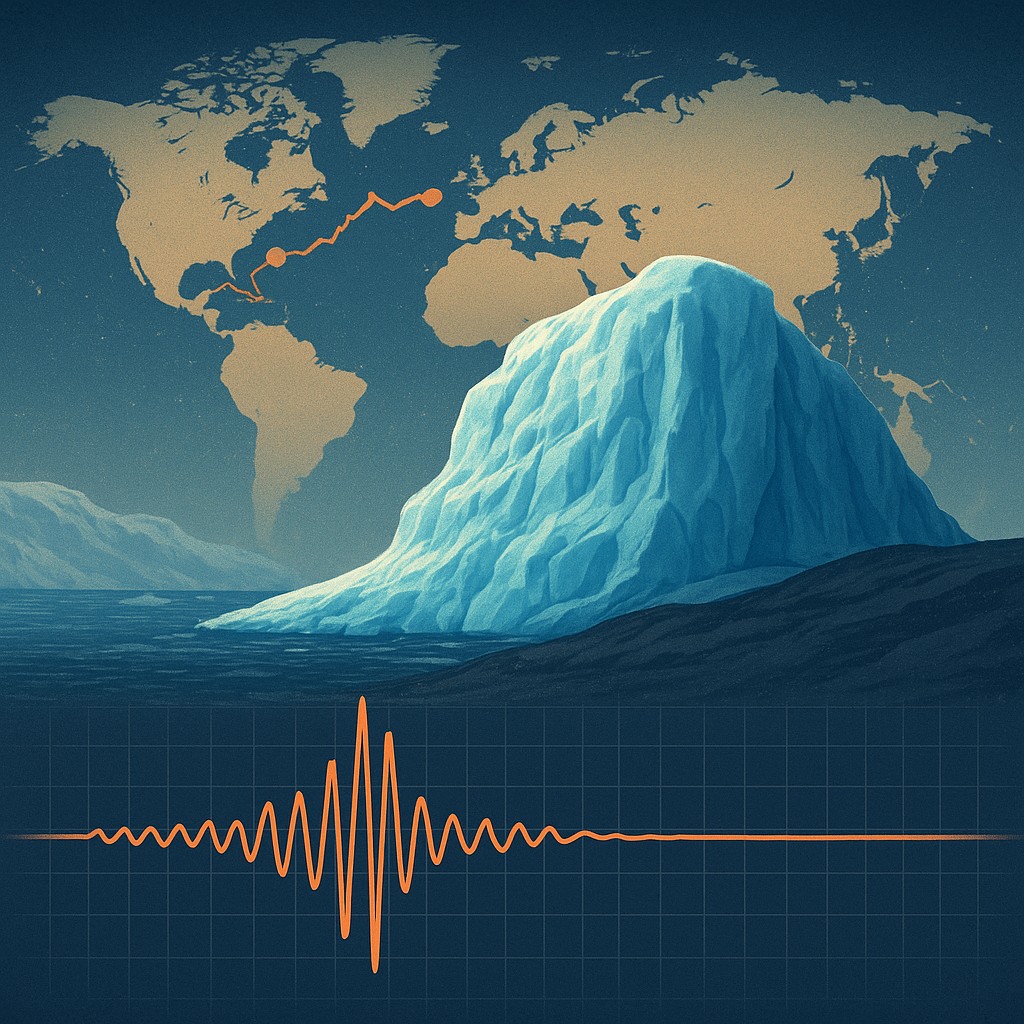
Imagine a map of the world’s earthquake hotspots. Most people would instinctively point to the "Ring of Fire" or those jagged lines where the Earth’s great tectonic plates slam into one another like bumper cars in slow motion. We are usually taught that the ground trembles because these massive puzzle pieces of the Earth’s crust are snagging on one another. However, a completely different type of seismic activity is happening at the far ends of the globe that has nothing to do with the crust. In the frozen reaches of Greenland and Antarctica, the ground is shaking with the force of thousand-ton hammers. The culprits aren't rocks, but massive rivers of ice known as glaciers.
These events, called glacial earthquakes, were ignored or dismissed as background noise for a long time because they look and "sound" different from traditional tectonic quakes. While a standard earthquake is a sudden, sharp snap, a glacial earthquake is a long, low, rhythmic groan that can last for several minutes. Think of a standard earthquake like the high-pitched crack of a whip, while a glacial earthquake is more like the deep, window-rattling bass of a passing car stereo. These signals are so powerful that sensors thousands of kilometers away can detect them, providing a secret diary of how the world’s ice is collapsing in real-time.
The Mechanical Grinding of Frozen Giants
To understand a glacial earthquake, we have to look at the physics of friction on a massive scale. Most glaciers are not just static cubes of ice sitting in a freezer. Instead, they are heavy, flowing rivers that push toward the sea under the relentless pressure of their own weight. As they move, they act like a giant piece of sandpaper, grinding down the bedrock beneath them. This constant resistance creates a steady "hum," but the real fireworks happen when the glacier reaches the ocean and begins "calving," the dramatic process where massive chunks of ice break off to become icebergs.
When a block of ice the size of a skyscraper detaches from the main glacier, it doesn't always drift away peacefully. As the ice snaps, the remaining glacier suddenly loses a massive amount of weight that was helping to hold it steady. This causes the entire glacier to lurch forward or tilt backward, much like a person stepping off a small boat causes the boat to bob and sway. As the glacier recoils, it scrapes its jagged underside against the rough valley floor with unimaginable force. This massive "shove" against the Earth's crust is what creates the low-frequency waves that geologists are now tracking across the globe.
Why These Quakes Don't Act Like the Rest
If you were standing near a glacial earthquake, you might feel a slow, swaying motion rather than the jarring jolts of a famous tremor like one in San Francisco. This is because the source of the event is fundamentally different. In a tectonic earthquake, stress builds up until the rock finally breaks, releasing energy in a sudden burst of fast, sharp waves. In contrast, a glacial earthquake is a drawn-out event. Ice is much softer than rock, so when it grinds against the seabed or valley floor, it moves more slowly and releases its energy over a longer period.
This difference in frequency is why these events stayed hidden for decades. Early monitoring equipment was tuned to listen for "p-waves" and "s-waves," which are the fast-moving signals that define tectonic movements. The long, low signals of the ice were often filtered out as "noise," much like how a person might tune out the hum of an air conditioner. It wasn't until scientists began looking at the data differently that they realized the Earth was singing a very deep song. This discovery has turned the study of earthquakes into a vital tool for climate science, allowing us to "hear" the ice melting even when we can't see it.
Comparing the Rhythms of the Earth
It is helpful to see how these two types of tremors differ in their physical impact and how scientists study them. While both result in a shaking surface, the internal mechanics tell two very different stories about our planet's stability.
| Feature |
Tectonic Earthquake |
Glacial Earthquake |
| Primary Cause |
Tectonic plates shifting or faulting |
Ice loss and glacier recoil |
| Duration |
Seconds to a few minutes |
Minutes to several minutes |
| Wave Frequency |
High frequency (sharp and fast) |
Low frequency (slow and rumbling) |
| Location |
Plate boundaries and fault lines |
Glacial edges (Antarctica, Greenland) |
| Tsunami Risk |
High (in specific ocean zones) |
Low (waves stay within the local bay) |
| Primary Material |
Solid rock and crustal plates |
Ice grinding against bedrock |
As the table shows, the risks are quite different. Because glacial earthquakes are caused by ice sliding or tilting horizontally rather than the seafloor moving up and down, they don't typically push enough water to send a tsunami across an entire ocean. They might create a big splash or a coastal wave within a fjord, but they won't threaten cities thousands of miles away. Their real "danger" is what they signal: they serve as a pulse-check for the world's disappearing ice sheets.
A Secret Weapon for Climate Monitoring
One of the most exciting parts of tracking glacial earthquakes is that they provide a clear window into parts of the world that are otherwise hard to watch. We usually rely on satellites to tell us how much ice is disappearing, but satellites have limits. They struggle to see through thick clouds, and they only fly over certain areas at specific times. If a massive chunk of ice breaks off during a three-week-long Arctic storm, a satellite might miss the exact moment it fell into the sea.
Seismic waves, however, don't care about clouds. They travel through the solid Earth at incredible speeds, reaching stations in Europe or North America within minutes of an event in Greenland. By analyzing the "signature" of these waves, scientists can calculate exactly how much ice was lost and how much force hit the ground. This allows for a nearly real-time count of ice loss. When researchers see a spike in glacial earthquakes, they know the "conveyor belt" of ice is speeding up, even if the region is currently in the middle of a dark, six-month polar winter.
Correcting the Myth of the Silent North
There is a common idea that the great ice sheets are quiet, frozen, and still. We tend to imagine them as giant, unmoving blankets of white. Glacial science has shattered this myth. The ice is actually incredibly noisy and active. Beyond the large earthquakes, there are also "icequakes," which are smaller pops and cracks caused by the ice splitting. You can think of a glacier like a giant house that groans and settles as the temperature changes, except this house is the size of a continent and the "settling" involves millions of tons of ice snapping under its own weight.
Another misconception is that these earthquakes are "causing" the ice to melt. In reality, it is the other way around. Warming oceans and air are thinning the ice and melting the "ice tongues" that act as brakes for the glaciers. As these brakes fail, the glaciers move faster, leading to more ice breaking off and, as a result, more glacial earthquakes. The quakes are the symptoms, not the cause. They are the sound of the world's refrigeration system breaking down.
The Future of Living on a Shifting Planet
As we get better at listening to the Earth's frozen edges, we are gaining a better understanding of the massive forces at work. These glacial earthquakes represent some of the most powerful physical processes on the planet. They remind us that the Earth is not a static rock, but a living system where the air, the oceans, and the solid ground are in a constant conversation. The fact that a piece of ice breaking off a cliff in Antarctica can be felt by a machine in Hawaii shows just how interconnected our world really is.
By paying attention to these low-frequency whispers, we are effectively giving the glaciers a voice. Scientists are now working on automated systems that can alert researchers the moment a major ice-break begins. This "early warning system" for ice loss is critical for building better models of sea-level rise. Every time the Earth shakes from the movement of a glacier, it gives us the data we need to prepare for a future where our coastlines might look very different than they do today.
The next time you hear about an earthquake, remember it might not be a tectonic plate sliding or a volcano rumbling. It might just be the Earth’s frozen giants taking another heavy step toward the sea. These rhythmic groans are more than just a scientific curiosity; they are a vital heartbeat for us to monitor. As we continue to listen, we find that the planet has a lot to say about its own transformation. The more we understand how the ice moves, the better we can navigate the challenges of a warming world. Standing on "solid ground" feels a bit different when you realize that even the most remote ice can make the entire world tremble.