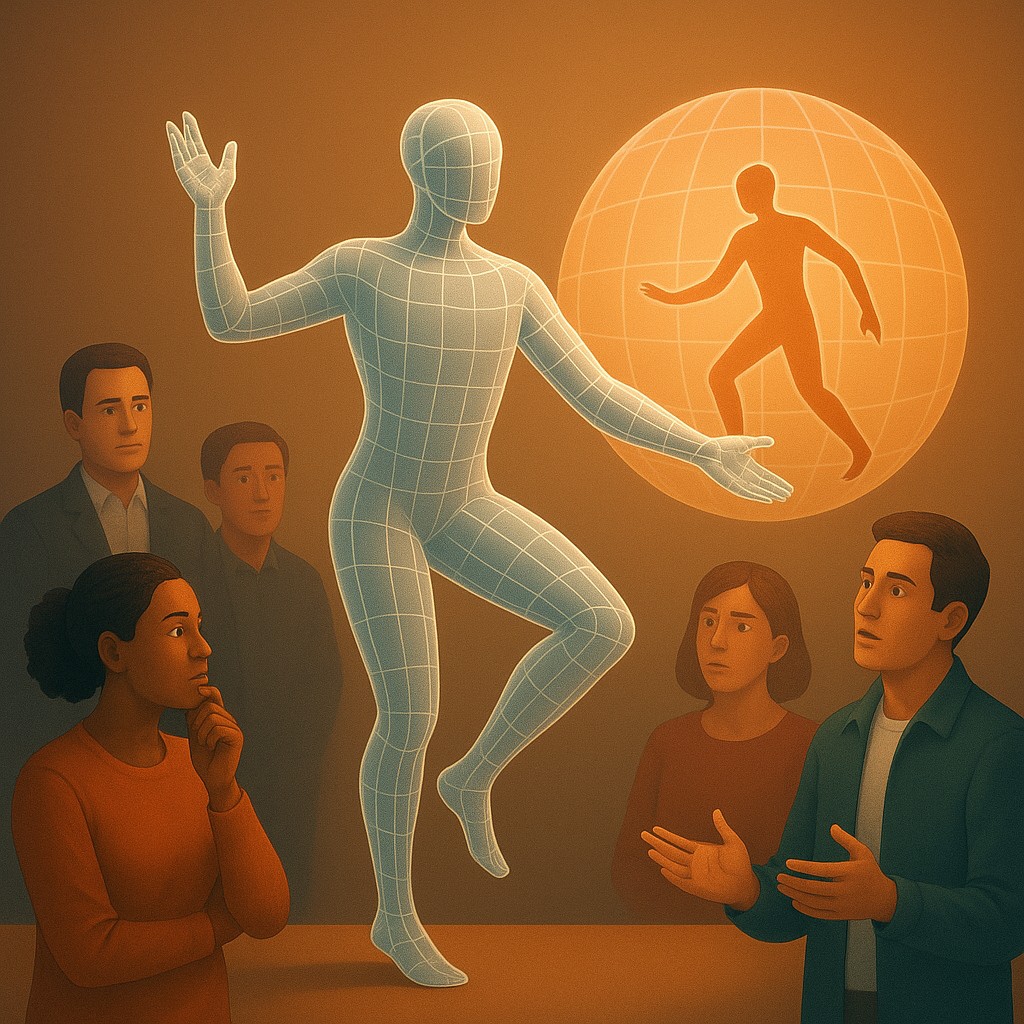
Imagine walking into a crowded room and instantly knowing which person is the boss, who is the nervous newcomer, and which two people are in the middle of a silent argument. You aren't psychic, and you aren't eavesdropping on their conversations. Instead, you are instinctively reading a language that everyone speaks but few can actually translate. This "silent" language is made up of the subtle tilt of a head, the speed of a handshake, and the way a person occupies the air around them. Most of us perceive these things as "vibes" or "instincts," but there is a precise, scientific way to decode them that has been used by actors, dancers, and psychologists for decades.
This system is known as Laban Movement Analysis (LMA). Named after Rudolf Laban, a visionary who looked at human movement the way a chemist looks at the periodic table, LMA provides a framework for breaking down every single physical action into its core parts. By understanding the four pillars of Body, Effort, Shape, and Space, we stop seeing movement as a blurry series of events and start seeing it as a structured expression of what we feel inside. Whether you are trying to command a stage, improve your presence in a boardroom, or simply understand why your best friend looks "off" today despite saying they are fine, LMA offers a toolkit for seeing the invisible threads of physical communication.
The Physical Architecture of the Self
The first pillar of the Laban system is common to every living creature: the Body. This is the "what" of movement. It identifies which parts of the anatomy are moving, how they are connected, and the order in which the movement happens. When we look through the lens of the Body, we are observing the structural mechanics of an action. Does a movement start in the core and ripple outward to the fingertips, or does it start with a sudden twitch of the pinky finger? These distinctions might seem tiny, but they fundamentally change how other people see us.
A person who moves from their center often appears grounded, confident, and powerful. In contrast, someone whose movements start only from the edges, such as the hands or the feet, can appear frantic or scattered. This pillar also explores "connectivity," or how different body parts support one another. If you pick up a heavy suitcase using only your arm muscles, the movement looks strained. If you engage your legs and core, the movement looks fluid and coordinated. By focusing on the Body pillar, performers and observers can identify where physical tension is held and how to reorganize the body to move with more efficiency and grace.
The Flavor of Intention and Effort
If the Body is the "what," then Effort is the "how." This is perhaps the most famous and psychologically revealing part of Laban's work. Effort describes the quality of a movement, or the inner attitude of the person toward the action. Laban identified four "Effort Factors," each of which exists on a spectrum between two extremes. These factors are Space (Direct vs. Indirect), Weight (Strong vs. Light), Time (Sudden vs. Sustained), and Flow (Bound vs. Free). By mixing and matching these qualities, we create the unique "flavor" of our actions.
Think about the act of closing a door. You could close it with a "Direct-Strong-Sudden" effort if you are angry, resulting in a loud slam. Or, you could close it with an "Indirect-Light-Sustained" effort if you are trying not to wake a sleeping baby, resulting in a gentle, lingering glide. The physical result, a closed door, is the same, but the internal meaning communicated to anyone watching is worlds apart. Understanding Effort allows us to diagnose our own habits. If you find that people often think you are aggressive when you believe you are just being efficient, you might be over-relying on "Strong" and "Sudden" efforts without realizing it.
| Effort Factor |
Polar Extremes |
Practical Example |
| Space |
Direct vs. Indirect |
Threading a needle (Direct) vs. waving away a fly (Indirect) |
| Weight |
Strong vs. Light |
Pushing a stalled car (Strong) vs. dusting a shelf (Light) |
| Time |
Sudden vs. Sustained |
Swatting a mosquito (Sudden) vs. stretching in the morning (Sustained) |
| Flow |
Bound vs. Free |
Carrying a full cup of hot coffee (Bound) vs. a child running in a park (Free) |
Shaping the Relationship with the World
The pillar of Shape describes how the body changes its form in relation to the environment or other people. It is not just about the static pose you are in, but the process of "forming" yourself. Shape is the bridge between our inner world and the outer world. It answers the question: how are you relating to the space around you? Laban practitioners look at whether a person is "shrinking" away from an interaction, "advancing" toward a goal, or "spreading" to occupy more room.
There are three primary ways we change shape. "Shape Flow" is the most basic, involving the body’s internal relationship with itself, like the way your chest rises and falls as you breathe. "Directional" movement is about reaching out toward something specific in the world, like pointing at a map. Finally, "Shaping" is the most complex, involving a three-dimensional molding of the body to interact with the volume of the environment, like a hug or the way a sculptor moves around a piece of clay. When you "Shape," you are effectively saying that you are engaged with the world in a deep, meaningful way. Conversely, someone who stays in "Shape Flow" might look self-absorbed or disconnected from their surroundings.
Navigating the Geometry of the Kinesphere
Every person exists inside a "bubble" of reachable space known as the Kinesphere. The pillar of Space in LMA is the study of how we navigate this bubble and the larger environment beyond it. It involves geometry, pathways, and levels. Are you moving in straight lines, or are you moving in curves? Are you focused on the high space above your head, or are you crouched low to the ground? The way we use Space is a massive indicator of our social and emotional state.
In a professional setting, people who use "High Space" and "Direct Pathways" are often seen as authoritative. When we are sad or defeated, our Kinespheres tend to shrink, and our movement pathways often pull downward. Interestingly, the Space pillar also teaches us about "Spatial Pulls." Imagine there are invisible magnets in the corners of the room pulling your limbs in different directions. By consciously choosing to move toward the "High-Right-Forward" diagonal, an actor can project a sense of optimistic reaching. By analyzing Space, we can learn to "read the room" literally, noticing how people position themselves to either invite interaction or create invisible barriers.
Beyond Performance and Toward Connection
One of the most common misconceptions about Laban Movement Analysis is that it is a set of rules for "correct" movement. In reality, Laban intended it to be a descriptive language, not a list of instructions. There is no such thing as a "wrong" movement in LMA; there is only a movement that communicates something you might not have intended. By learning this system, you don't become a rigid robot. Instead, you gain a massive vocabulary for your physical self. You start to see that "heaviness" is just a high degree of Weight, and "urgency" is just a specific way of using Time and Flow.
This awareness transforms daily life into a rich, layered experience. You begin to notice that a tense conversation isn't just about the words being said, but about the stiff, "Bound Flow" in a colleague's shoulders or the "Indirect Space" in their gaze. You can use these insights to calm a situation by consciously adopting "Sustained" and "Light" efforts in your own body to mirror and then lead another person toward a calmer state. LMA teaches us that we are always communicating, even when we are standing perfectly still, because the way we hold our weight and occupy our space tells a story of its own.
Embracing the Laban framework is like finally opening your eyes to a spectrum of light you previously couldn't see. It invites you to be more curious about the "how" of your life rather than just the "what." As you move through the world, remember that your body is a finely tuned instrument of expression, capable of incredible nuance and power. Every step you take and every gesture you make is an opportunity to practice this art. By becoming a student of your own motion, you unlock a deeper understanding of yourself and a more profound connection to everyone around you.