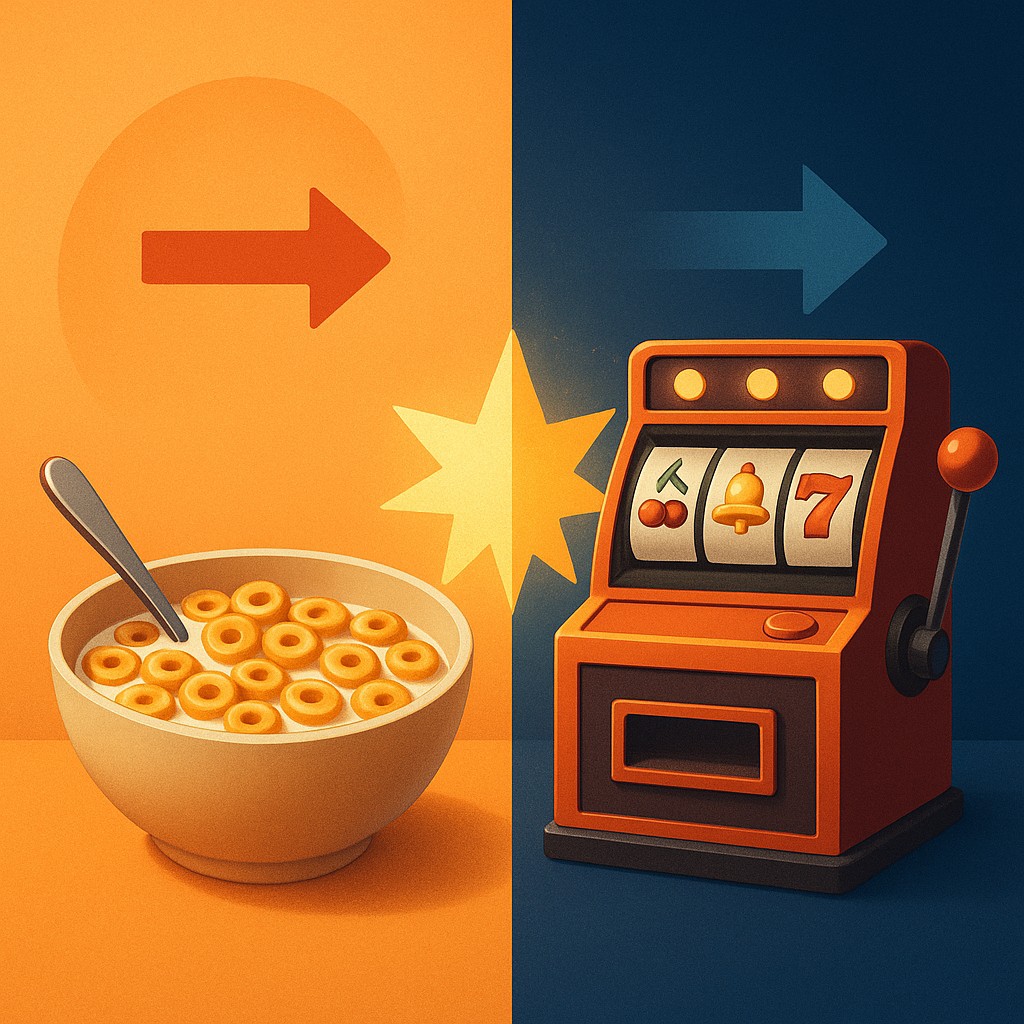
Imagine waking up every morning to find the exact same bowl of cereal waiting for you, simply because you liked it once. At first, it feels like great service. The breakfast is ready before you even ask, the milk is the perfect temperature, and you don’t have to waste any energy making a choice. But by day ten, you might start to wonder if toast, eggs, or breakfast burritos even exist anymore. Your world has shrunk to the size of a cereal box - not because you lost your appetite for other foods, but because the system serving you decided that your "past behavior" is the only thing that matters.
This same invisible tug-of-war happens every time you unlock your phone or refresh a social media feed. Digital platforms are constantly playing a high-stakes game of "hot or cold." They are trying to figure out if they should give you more of what you already love or take a risk by showing you something completely new. This tension is known as the exploration-exploitation tradeoff. It is the core logic that prevents your digital life from becoming a stale loop of repetition. It acts as a bridge between the person you were yesterday and the person you might become tomorrow, if only you had the chance to see something different.
The Mathematical Art of Taking a Wild Guess
To understand how an algorithm "thinks," we have to look at the "Multi-Armed Bandit" problem, a famous puzzle in probability. Imagine you are in a casino standing in front of a row of slot machines. Each machine has a different payout rate, but those rates are a mystery to you. To make the most money, you have two choices:
- Exploitation: You pull the handle of the machine that has paid out the most so far.
- Exploration: You try a machine you’ve never touched to see if it holds a bigger jackpot.
If you only exploit what you know, you might miss the best machine in the room. If you only explore new things, you might waste all your money on losers and go home broke.
Social media platforms are essentially digital casinos where your attention is the currency. When an algorithm "exploits," it shows you another video of a golden retriever because it knows, with 99 percent certainty, that you will watch it. It is a safe bet. However, if the system only ever sticks to what it knows you like, it eventually runs out of data. It stops learning about you. By "exploring," the system intentionally shows you a video about high-altitude gardening or 1920s jazz. It knows there is a high chance you will scroll right past it, but if you happen to click, the system has just discovered a brand-new "arm" to pull - expanding the map of your digital identity.
This balance is delicate because humans are fickle. If a platform explores too much, the feed feels like a chaotic mess of random content, leading to frustration. If it exploits too much, the feed becomes a "filter bubble," where you are trapped in a loop of your own existing opinions and hobbies. This stagnation isn’t just boring; it is mathematically inefficient. A system that stops exploring eventually becomes obsolete because users grow tired of the same patterns, even if those patterns were originally their own favorites.
Navigating the Spectrum of Digital Discovery
Different algorithms use various strategies to decide when to take a risk. Some use a method called "Epsilon-Greedy," where the system chooses the best known option most of the time but reserves a small, fixed percentage of the time (the "epsilon") to try something totally random. Others use "Upper Confidence Bound" (UCB) strategies, which prioritize content that has the highest potential for interest even if the system is uncertain about it. It is like the algorithm saying, "I don’t know much about your interest in underwater welding, but because I’m so unsure, the potential reward for testing this is very high."
| Strategy |
Primary Goal |
The "Vibe" for the User |
Risk Level |
| Pure Exploitation |
Maximize immediate clicks |
Comforting but eventually very repetitive |
Low |
| Pure Exploration |
Gather maximum data |
Random, confusing, and feels broken |
High |
| Epsilon-Greedy |
Steady results with a little variety |
Mostly familiar with a random surprise |
Moderate |
| UCB (Optimism) |
High-growth discovery |
Focused on finding your next big obsession |
Moderate-High |
This table shows that there is no single "right" way to build a feed. A music streaming service might lean toward exploitation when you are at the gym, assuming you want a predictable beat. However, that same service might lean toward exploration on a Friday morning, betting that you are in the mood to discover a new artist for the weekend. The algorithm acts like a digital mood ring, trying to sense whether you want the comfort of a warm blanket or the thrill of a blind date.
Breaking the Bubble and the Power of the Random Click
One of the biggest dangers of a system that plays it too safe is the "echo chamber." When an algorithm only shows you content that reinforces your current worldview, it creates a feedback loop. You see a post that reflects your opinion, you engage with it, and the algorithm concludes you should see even more of that specific perspective. Over time, the "exploration" side of your digital world withers away. You may begin to believe that your narrow slice of the internet represents the entire world. This isn't just a social problem; it is a technical one called "data stagnation," where the system stops being an engine for discovery and becomes a mirror of your own biases.
You actually have a lot of power in this relationship. Every time you interact with an "exploratory" piece of content, you are sending a loud signal to the machine. If you purposely click on a video about a topic you know nothing about, you force the algorithm to update your profile. You are effectively telling the system, "I am more complex than the data you have on me."
Think of it as digital cross-training. If you only ever do bicep curls, your overall fitness suffers. If you only ever watch political commentary, your intellectual fitness suffers. By seeking out the "random" content and engaging with it, you prevent the algorithm from trapping you in a corner. The system is designed to learn from you, but it can only learn if you give it new, varied evidence to work with. If you act predictably, the algorithm will treat you like a predictable person. If you act with curiosity, the algorithm has no choice but to fuel that curiosity.
The Technical Burden of Long-Term Happiness
Modern recommendation engines are moving toward "fiduciary" models - a fancy way of saying they should act in your best interest. Engineers are realizing that maximizing for "clicks today" often leads to user burnout tomorrow. If an algorithm realizes that showing you five sensationalist news stories will get you to click now, but make you feel miserable and close the app in ten minutes, it might choose to "explore" by showing you a thoughtful long-form article instead. This is a shift from short-term greed to long-term satisfaction.
Creating this sense of "serendipity" - finding something wonderful by chance - is actually very hard to code. How do you distinguish between a "good" risk and just annoying noise? If the algorithm shows you something you hate, you might leave the app. Developers use complex "reinforcement learning" models, where the algorithm is "punished" for bad guesses and "rewarded" for successful exploration. The goal is to find the "Goldilocks Zone," where the content is different enough to be fresh but familiar enough to be relevant. It is a mathematical tightrope walk that happens in milliseconds, millions of times a day.
This process also helps solve the "cold start" problem. When a new user joins a platform, the system has zero data to exploit. It has to explore like crazy, throwing everything at the wall to see what sticks. This is why a new account often feels chaotic for the first hour. As you interact, the system builds its database, but a healthy system never stops being curious. It always keeps a small percentage of its power dedicated to the "what if?" question, ensuring the platform remains a place of discovery rather than a museum of your past self.
Stepping Beyond the Digital Mirror
Understanding the balance between the familiar and the unknown gives you a new kind of digital literacy. You can start to recognize when a platform is playing it too safe and when it is trying to push your boundaries. When you see something "weird" in your feed, don’t immediately dismiss it as a glitch. See it as an invitation to expand your horizons. It is the algorithm’s way of asking if you are ready for a new hobby, a new perspective, or a new favorite song.
By embracing the exploration phase, you reclaim control over your digital growth. You are not just a passive consumer of a pre-set list of interests; you are an active participant in an ongoing experiment. The next time you see a post that feels entirely out of place, consider it a lucky break. Click on it, read it, or watch it just to see where the rabbit hole leads. In doing so, you break the cycle of stagnation and ensure that your digital world remains as vast and unpredictable as you are. Keep exploring, stay curious, and never let an algorithm convince you that you have already seen everything worth seeing.