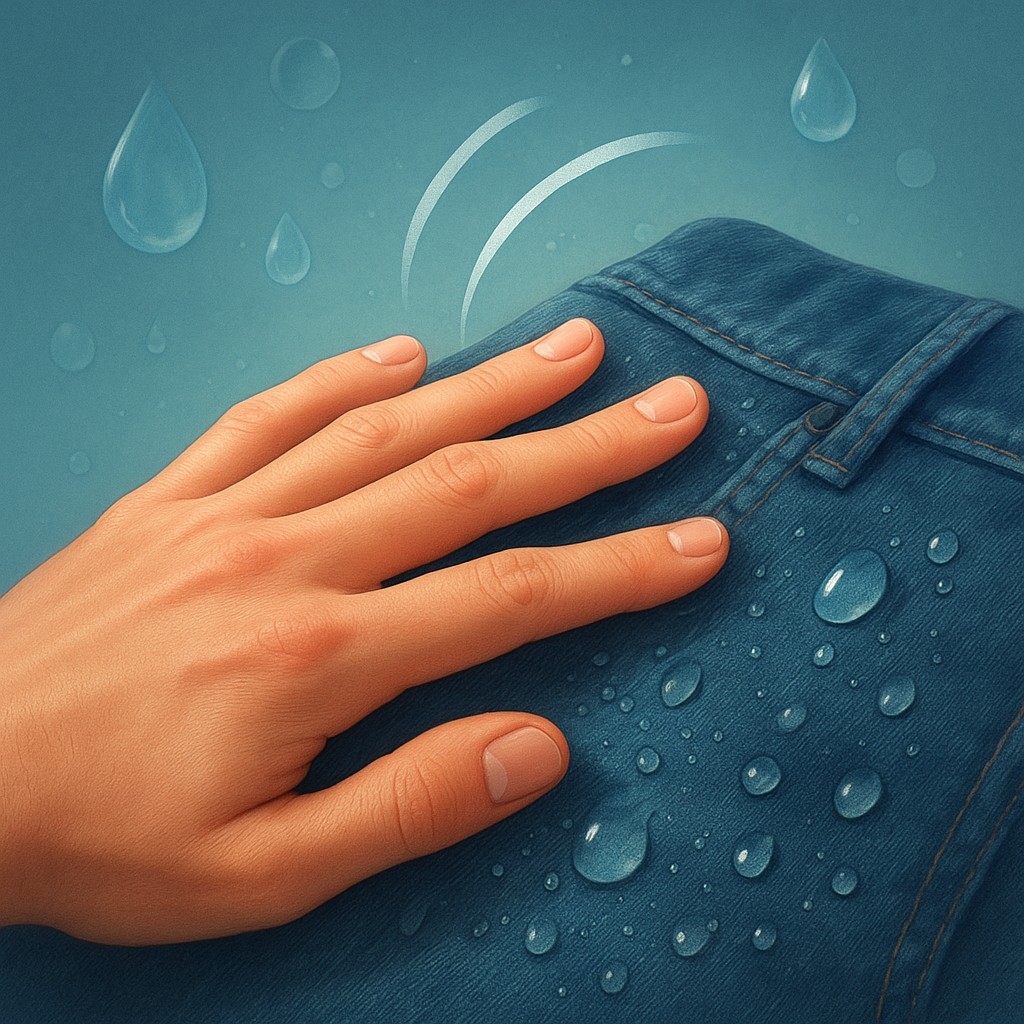
Imagine reaching into a laundry basket and pulling out a pair of jeans that have been sitting in a cold room. You press your hand against the denim, and for a split second, you feel a wave of frustration because you can’t tell if the pants are actually damp or just very, very cold. You rub the fabric between your fingers, trying to catch a hint of moisture, but the physical data remains stubbornly unclear. It feels like a glitch in your biological hardware, a moment where your body’s sophisticated surveillance system fails to give you a straight answer about a simple physical state.
The reason for this confusion is both elegant and slightly absurd: your body is a masterpiece of evolution, yet it completely lacks a dedicated sensor for "wetness." While you have specific receptors for heat, cold, vibration, and pressure, there is no biological "hygroreceptor" (a moisture-sensing nerve) on human skin to detect liquid. When you feel that something is wet, your brain is actually performing a complex act of translation. It takes separate streams of data and knits them into a single illusion. You don't "feel" wetness so much as you "calculate" it based on a recipe of temperature and touch.
The Recipe for a Sensory Illusion
To understand how your brain manufactures the sensation of wetness, we have to look at the specific inputs it uses to build the experience. The primary ingredient in this sensory cocktail is thermal transfer, specifically how fast the skin cools down. Water is an incredible conductor of heat, far more efficient than air. When your skin touches moisture, the liquid begins to evaporate or simply soak up your body heat, causing a quick drop in temperature. Your cold receptors, known as Krause end bulbs, fire off a signal to the brain saying, "Attention, we are losing heat rapidly in this specific patch of the forearm."
However, cold alone isn't enough to trick the brain into thinking something is wet. If you stand outside in a dry, freezing wind, you feel cold, but you don't necessarily feel soaked. To complete the "wet" profile, the brain looks for mechanical cues. This involves your mechanoreceptors, which detect pressure, texture, and friction. When a liquid sits on the skin, it changes how your surface nerves interact with the world. It might feel smooth, slippery, or slightly heavy. When the brain receives a simultaneous signal of "colder than baseline" and "low friction or smooth pressure," it reaches into its library of experiences and concludes that the only logical explanation for this combination is water.
Why Metal and Wind Can Lie to Your Brain
Because wetness is an educated guess rather than a direct measurement, our nervous system is surprisingly easy to prank. This is why a smooth, cold piece of polished metal can often feel damp when you first touch it. Metal is a great thermal conductor, just like water, so it pulls heat away from your fingertips instantly. If the metal is smooth enough, your brain sees the "cold" signal and the "smooth" signal and announces, "This is damp," before you have a chance to realize it’s actually dry as a bone. This phenomenon is known as a "perceptual illusion of wetness," and it highlights just how much of our reality is reconstructed by the mind rather than recorded by the senses.
The same thing happens with a sharp, chilly breeze on a dry day. As the wind moves over your skin, it speeds up the evaporation of the microscopic layers of natural oils and moisture always present on your body. This creates a cooling sensation that the brain occasionally misinterprets as a light mist or spray. You might find yourself wiping your face, expecting to find droplets, only to realize the air is perfectly dry. Your brain is essentially a detective working with circumstantial evidence; it sees a footprint and a shadow and assumes a person is there, even if it’s just a trick of the light.
| Sensory Input |
Physical Trigger |
Brain's Interpretation |
| Rapid Heat Loss |
Evaporation or conduction |
"This must be cold liquid absorbing my heat." |
| Low Friction |
Lubrication of the skin surface |
"This surface is slippery or smooth like water." |
| Rhythmic Pressure |
Moving droplets or flow |
"Something is flowing across the skin's surface." |
| Static Pressure |
Weight of soaked fabric |
"The skin is being compressed by a heavy, wet medium." |
The Evolutionary Trade-off of Missing Sensors
You might wonder why evolution left us out in the rain, so to speak, failing to provide us with a specific moisture sensor when insects and other animals have them. Many insects possess specialized receptors that can detect humidity levels in the air, which is vital for their survival in environments where they might easily dehydrate. For humans, however, the "calculation" method seems to have been "good enough." From an evolutionary standpoint, building a brand-new type of receptor is expensive in terms of genetic space and biological energy. If the brain can already figure out what’s wet by using the sensors it already has, there is no survival pressure to evolve a dedicated moisture detector.
This "good enough" approach works perfectly well about 95 percent of the time. We can tell when the ground is slippery, when our clothes are soaked through, or when we are stepping into a bath. The few instances where we get confused by cold jeans or metal plates are minor glitches that don't typically lead to a life-threatening error. Our ancestors didn't need to know the exact moisture percentage of a leaf; they just needed to know if the ground was muddy enough to leave tracks or if the rain was heavy enough to seek shelter. This way of processing wetness is a testament to the brain's ability to multitask, using a limited set of tools to understand a complex environment.
The Role of Friction and the Fingerprint
While temperature is the heavy lifter in the wetness equation, friction plays a fascinating secondary role. Scientists have found that the ridges of our fingerprints actually help us perceive moisture. When your skin is slightly damp, the friction between your finger and a surface increases because the water acts like a bridge, creating "capillary bridges" that make the skin stickier. However, when the skin is fully wet, that friction drops as the water acts as a lubricant. Your brain is tuned into these subtle shifts in "drag."
If you run your hand over a surface and feel a certain type of "tugging" followed by a cooling sensation, your brain is almost certain it has encountered water. This is why researchers in the field of haptics (the science of touch for VR or prosthetics) focus so much on temperature. To make a robot hand "feel" like it is touching a wet sponge, you don't necessarily need to give it water sensors; you just need to make the fingertips get cold quickly and adjust the mechanical resistance as the hand moves. We are surprisingly susceptible to these "sensory hacks" because our hardware is so reliant on blending different inputs.
Overcoming the Cold Jeans Dilemma
So, how do we solve the mystery of the cold laundry? Since our brain is easily fooled by the initial combination of cold and smooth pressure, we usually have to introduce a third variable to get the truth: movement and heat. When you rub the fabric vigorously, you generate a small amount of friction heat. If the fabric is truly wet, that heat will disappear almost instantly, and the sensation of wetness will stick around or even get stronger as you press the water closer to your nerves. If the fabric is just cold, the material will eventually warm up under your touch, and the "wet" illusion will vanish as the temperature evens out.
Another trick is to touch the questionable fabric to a more sensitive or warmer part of your body, like the back of the hand or the cheek. By changing the baseline temperature and the density of receptors, you give your brain a second set of data points to compare. We are essentially scientists in our own daily lives, running quick experiments to verify what our senses are telling us. It turns out that living in a human body requires a constant state of fact-checking against the creative interpretations of our own nervous systems.
The realization that wetness is a mental construct rather than a direct sensation changes how we perceive our interaction with the physical world. It serves as a reminder that our experience of reality is shaped by layers of biological processing. Everything we feel, see, or hear is a curated version of the truth, filtered through sensors that have their own limits and quirks. The next time you find yourself doubting whether your sleeve is damp or just chilled, take a moment to appreciate the incredible calculating your brain is doing to even present you with the question. You aren't just a passive observer of the world; you are an active creator of your own sensory experience, stitching together heat and touch to navigate a world that is sometimes cold, sometimes dry, and occasionally, authentically wet.