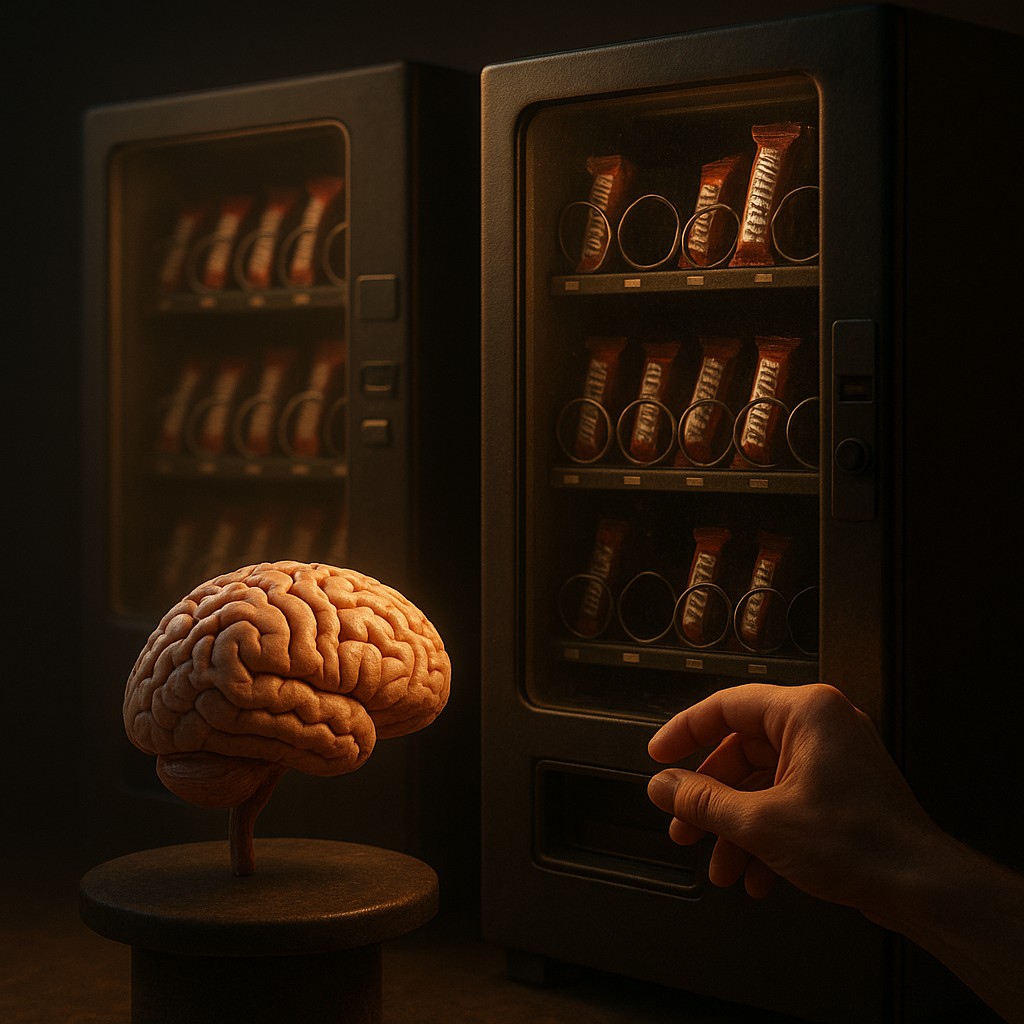
Imagine standing in front of a vending machine, craving a chocolate bar. You drop in your coins, press the button, and the machine gives you exactly what you expected. This is a predictable world where effort directly equals reward. Now, imagine a different machine. Sometimes you get nothing; sometimes you get one bar; and occasionally, three bars tumble out at once for the price of one. Even if you aren't particularly hungry, you might find yourself walking past that second machine more often, digging through your pockets for spare change just to see what happens. This shift from a guaranteed outcome to a game of chance is where the brain stops being a logical processor and turns into a dopamine-fueled seeking machine.
The human brain is an ancient piece of hardware. It was designed for survival in worlds where resources were scarce and unpredictable. In the wild, animals do not find food every time they look under a rock, but they must keep looking because the next rock might hide a feast. This evolutionary programming has left us with a neurological quirk: we are far more motivated by the possibility of a reward than by the guarantee of one. When a reward is uncertain, our brains release higher levels of dopamine, the chemical messenger of anticipation. This is the secret engine behind our most persistent, and sometimes most frustrating, habits. It is not how often we win that keeps us hooked, but the tantalizing mystery of when the next win will arrive.
The Chemistry of "Maybe" and the Dopamine Spike
To understand why uncertainty is so addictive, we have to look at the difference between pleasure and anticipation. many people mistakenly believe that dopamine is a "pleasure chemical" released when we finally get what we want. In reality, dopamine is much more concerned with the pursuit. It is the fuel for the hunt. When a reward is 100 percent predictable, the dopamine spike actually begins to flatten out over time because there is no new information to process. Your brain recognizes the pattern, files it away as "reliable," and stops wasting precious energy on it. The excitement dies because the outcome is a foregone conclusion.
However, when you introduce a variable or "intermittent" schedule, the brain enters a state of high alert. Because the reward might or might not happen, the brain stays locked in a loop of "just one more try." If you check your phone and see a notification that makes you feel good, you get a hit of dopamine. If you check it again and find nothing, your brain doesn't just give up; it builds tension. That tension makes the next successful check feel even more rewarding. This creates a powerful psychological "hook" that makes a habit very hard to quit. This is why you can walk away from a broken vending machine after one failed attempt, yet someone might spend hours at a slot machine that hasn't paid out in a while.
Navigating the Four Quadrants of Reinforcement
In the 1950s, psychologist B.F. Skinner conducted groundbreaking research on how different reward patterns affect behavior. He discovered that the timing of a reward is often more important than the reward itself. To categorize these methods, he developed four primary schedules of reinforcement. Understanding these is like having a blueprint for human and animal motivation. While some schedules encourage steady work, others create frantic, high-speed activity that can be nearly impossible to stop.
The most powerful of these is the Variable Ratio schedule. In this setup, a reward is delivered after an unpredictable number of actions. One time it might take three tries, the next time twenty, and the next time only one. This is exactly how slot machines and social media feeds are designed. Because you never know how many "scrolls" or "pulls" it will take to hit the jackpot of an interesting post or a big win, you keep up a high, steady pace. Contrast this with a Fixed Interval schedule, where you get a reward after a set amount of time, like a monthly paycheck. On a fixed schedule, people often do the bare minimum until just before the reward is due, resulting in a "scalloped" pattern of productivity rather than a consistent habit.
| Schedule Type |
How It Works |
Behavioral Result |
Real-World Example |
| Fixed Ratio |
Reward after a set number of actions |
High response, brief pause after reward |
A punch card where every 10th coffee is free |
| Variable Ratio |
Reward after a random number of actions |
Very high, steady activity; hard to stop |
Slot machines and social media "likes" |
| Fixed Interval |
Reward after a set amount of time |
Activity increases only as the deadline nears |
Checking the mail at the same time every day |
| Variable Interval |
Reward after a random amount of time |
Slow, steady activity; persistent behavior |
Checking for a reply to an important email |
The Social Media Scroll and the Digital Jackpot
If you have ever caught yourself mindlessly scrolling through an app for twenty minutes when you only meant to check the time, you have been a victim of intermittent reinforcement. These platforms are masterfully designed to act as portable slot machines. When you pull down to refresh a feed, that short pause with the loading icon is the digital version of spinning reels on a Vegas machine. The "reward" might be a funny video, a message from a friend, or breaking news. Most of the time, however, the content is just average.
It is specifically the "filler" content that makes the "winner" content so addictive. If every single post in your feed was the best thing you had ever seen, you would eventually grow bored. By mixing in boring ads, repetitive memes, and uninteresting updates, the platform ensures that the high-quality posts remain a surprise. This unpredictable delivery keeps your dopamine levels high and prevents "hedonic adaptation," which is the process where we get used to constant pleasure and stop valuing it. You are not scrolling for the content you see; you are scrolling for the content you might see next.
Breaking the Cycle of Unpredictable Cravings
Recognizing the power of intermittent reinforcement is the first step toward reclaiming your focus. Because these habits are built on uncertainty, they are notoriously difficult to break. If you try to quit cold turkey, a single "slip-up" where you get a reward can reset the entire cycle, making the habit even stronger than before. This is why people in "on-again, off-again" relationships find them so difficult to leave; the occasional "good day" acts as a powerful reinforcement that outweighs months of bad ones.
To fight back, you must introduce "friction" and "predictability." If you want to stop checking your phone, turn off non-human notifications. By removing the "ding" that signals a potential reward, you take away the trigger for the dopamine spike. Another strategy is to turn your variable rewards into fixed ones. Instead of checking your email whenever you feel an itch, set a specific schedule to check it only at 10:00 AM and 4:00 PM. By making the reward predictable, you tell your brain there is no need to stay on high alert. You are essentially boring your brain back into submission by removing the element of surprise it craves.
Engineering Positive Habits Through Surprise
While intermittent reinforcement is often discussed alongside addiction, it can also be a powerful tool for self-improvement. If you are trying to build a new habit, like exercising or studying, you can use the "chemistry of maybe" to your advantage. Most people try to reward themselves every single time they finish a task. While this helps at first to create a positive association, it eventually becomes predictable and loses its charm.
Once a habit starts to take root, try a "reward lottery." Instead of having a treat after every workout, put three different rewards on pieces of paper in a jar, along with three blank pieces of paper. After your workout, draw one out. Some days you get a fancy coffee, some days you get a new book, and some days you get nothing but the satisfaction of finishing. This uncertainty mimics the variable ratio schedule that makes gambling so "sticky." By turning your discipline into a game, you can use the brain's obsession with the unknown to turn a difficult chore into a challenge you actually look forward to.
Armed with the knowledge of how the brain processes the "jackpot," you are no longer just a passenger in your own mind. You can start to see the invisible strings being pulled by apps, games, and even your own routines. Whether you want to reclaim your attention or build a better version of yourself, the secret lies in mastering the space between the action and the prize. Use this biological quirk to your advantage, intentionally designing a life fueled not just by the rewards you get, but by the exhilarating pursuit of what is coming next.