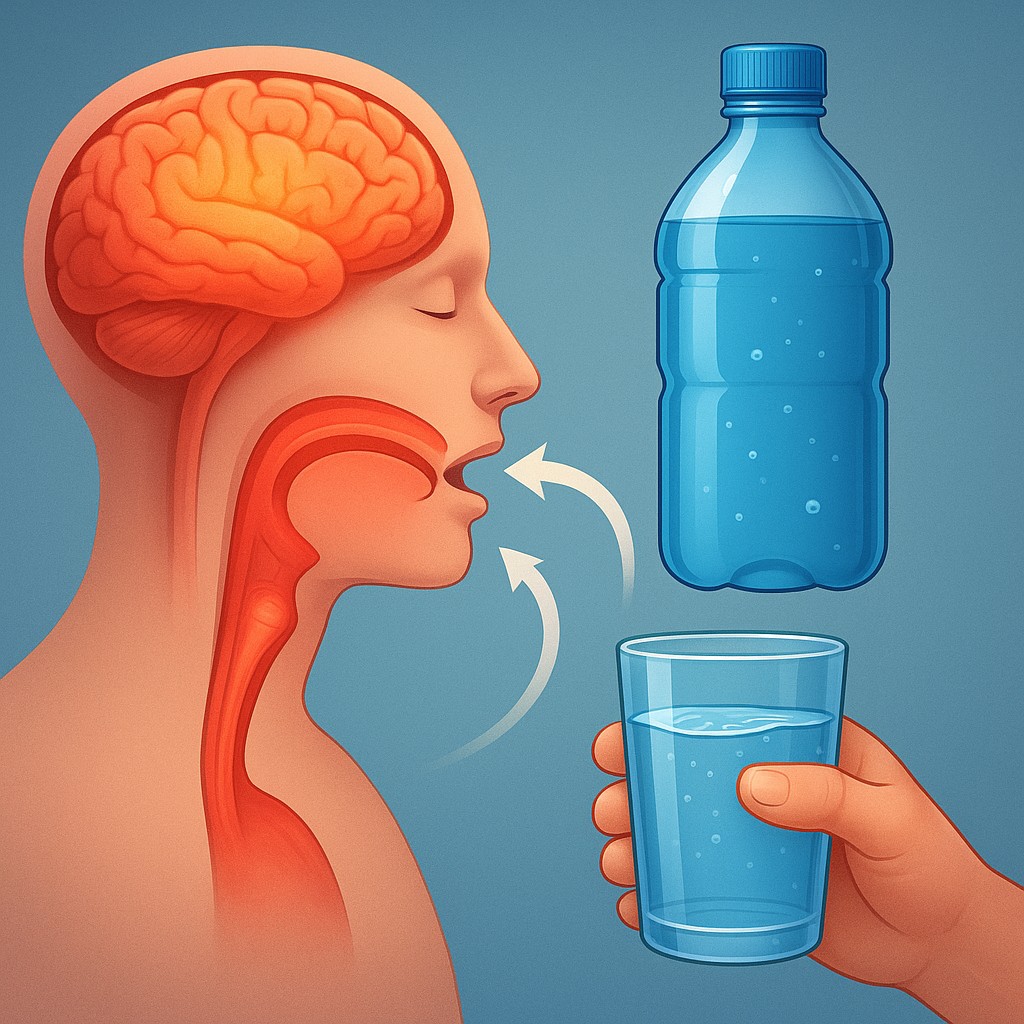
Imagine you are trekking through a sun-baked desert or finishing a grueling hour on the treadmill. Your mouth feels like it is lined with cotton, your tongue is heavy, and your brain is screaming a single, primal command: Drink. You find a bottle of ice-cold water and take a long, desperate gulp. Almost instantly, before the liquid has even left your throat, a wave of profound relief washes over you. The frantic urge to guzzle more water vanishes, and you feel "quenched." It feels like magic, but if you look at the clock, something does not add up.
Biologically speaking, that water is still sitting in your stomach or moving through your upper digestive tract. It has not reached your intestines yet, and it certainly has not been absorbed into your bloodstream to lower your salt levels or increase your blood volume. In fact, it takes about fifteen to twenty minutes for water to actually penetrate your tissues and hydrate you at a cellular level. If your brain waited for the blood to signal that the thirst was gone, you would spend those twenty minutes drinking continuously. By the time your blood finally sent the "all clear" signal, you would have consumed liters of unnecessary fluid, potentially putting your entire system in mortal danger.
The Body’s Predictive Braking System
To solve the problem of the twenty-minute delay, evolution has equipped us with a sophisticated early-warning system. Think of it like a smart thermostat that does not wait for a room to hit seventy degrees before it turns off the furnace; instead, it calculates how much heat is already in the pipes and shuts down early to prevent overheating. Your brain performs a similar calculation every time you take a sip of water. The moment water touches your tongue and slides down your food pipe, a countdown begins.
This process is governed by a specialized group of nerve cells in the brain, specifically in a region called the SFO (subfornical organ). These cells are the "thirst masters" of the body. When you are dehydrated, they fire rapidly, creating that uncomfortable sensation of being thirsty. However, recent brain research has shown that these cells actually stop firing almost the second you start drinking. They do not wait for the blood chemistry to change. Instead, they listen to the "glug-glug-glug" of your throat.
Your throat and esophagus are lined with high-speed sensors that act like a liquid flow meter. As you swallow, these sensors count the volume of liquid passing through and send rapid signals to the brain. This is a predictive loop: the brain estimates how much water matches the current level of thirst and shuts off the desire to drink long before the water is actually "useful." This prevents you from overdoing it and drinking so much that you overwhelm your internal balance.
The Hidden Danger of Dilution
You might wonder why the body is so aggressive about stopping you from drinking. After all, water is life, so why not have a little extra? The answer lies in the delicate chemistry of your cells, specifically the balance of sodium and water. Your cells live in a salty environment, and that salt is what keeps the water inside them at the right level through a process called osmosis. If you drink too much water too quickly, you can trigger a dangerous condition called hyponatremia.
In hyponatremia, the sodium in your blood becomes so watered down that its concentration drops below safe levels. When the fluid outside your cells becomes too "watery" compared to the fluid inside, physics takes over. Water rushes into the cells to try and balance the concentration, causing the cells to swell up like overfilled balloons. While most tissues can handle a bit of swelling, your brain is trapped inside a rigid skull. If brain cells swell, they have nowhere to go, leading to headaches, confusion, seizures, and in extreme cases, death.
By shutting off your thirst at the throat, the brain acts like a strict bouncer. It acknowledges that the "guests" (water molecules) are at the door and ensures that no more are invited inside until the current crowd has been processed and accounted for. This preventive measure is a masterpiece of biological engineering that prioritizes safety over the immediate satisfaction of a dry mouth.
A Two-Stage Verification Process
The throat is the first line of defense, but it is not the only one. Your body actually uses a two-stage verification system to ensure you have had enough to drink. The first stage, as we have discussed, is the signal from the mouth and throat. This provides the immediate "reward" of quenching your thirst, but it is temporary. If you were to drink a few gulps of water and then spit it out before swallowing, or if you drank through a tube that bypassed your stomach, the thirst would eventually return because the second stage of the system was never triggered.
The second stage happens in the gut, specifically the small intestine. Scientists have discovered that the lining of the intestine contains sensors that can "taste" the salt-to-water ratio of the fluids passing through. Once the water you swallowed moves from the stomach into the intestine, these sensors send a secondary signal to the brain saying, "Confirmed: the liquid we counted at the throat is actually water, and it is now entering the system."
| Phase of Hydration |
Mechanism Involved |
Timing |
Primary Function |
| Immediate |
Throat "Flow Meters" |
0 - 60 Seconds |
Shuts off thirst to prevent over-drinking. |
| Intermediate |
Gut Water Sensors |
5 - 10 Minutes |
Confirms the fluid is water and keeps thirst away. |
| Final |
Blood Chemistry Change |
15 - 25 Minutes |
Real hydration occurs as water enters the blood. |
This two-step verification is why drinking a glass of water is much more satisfying than simply wetting your mouth. The brain is looking for both the physical sensation of swallowing and the chemical confirmation from the gut. Only when both signals align does the brain provide a lasting feeling of hydration. This is also why "gulping" feels different than "sipping." Large, steady swallows provide a clearer count for the brain’s flow meters, leading to a faster sense of relief.
Why Cold Water Feels More Refreshing
Have you ever noticed that a glass of ice-cold water feels significantly more "thirst-quenching" than a glass of lukewarm water, even if the amount is exactly the same? This is not just a mental preference; it is a direct result of how our internal sensors operate. The cold temperature actually boosts the signals being sent from the throat to the brain.
The sensors in your mouth and throat are sensitive to temperature as well as pressure. Cold water creates a stronger sensory "ping" on the nerves, which the brain interprets as more effective hydration. In a way, cold water "tricks" the brain into thinking you have consumed more than you actually have, or at least that the water you drank is high quality. From an evolutionary perspective, cold water in nature is often safer and fresher than warm, stagnant water, so our brains are wired to prioritize it and reward us more for finding it.
This also explains why people who are severely dehydrated often crave ice. Cooling the mouth and throat provides a panicked brain with the quickest possible evidence that the "fire" of dehydration is being put out. However, because this is just an early signal, it also means you can feel refreshed by cold water even if your cells are still technically dehydrated. It is a temporary truce between your brain and your body while the actual plumbing catches up.
Correcting the Myth of the Eight-Glass Rule
Understanding this "predictive braking" system helps debunk one of the most common myths in health: the idea that you must drink eight glasses of water a day regardless of whether you are thirsty. If our brains are this good at monitoring fluid intake using high-speed sensors in the throat and gut, why would we need an arbitrary rule? For most healthy people, thirst is an incredibly reliable guide.
The "count" performed by your throat is part of a balancing loop that has been refined over millions of years. When your body needs water, it makes you thirsty. When you have had enough to balance your blood chemistry, it shuts that thirst off. Forcing yourself to drink past the point where your throat sensors feel "satisfied" is essentially trying to override a highly tuned biological computer. Unless you are exercising intensely, in extreme heat, or dealing with specific medical issues, your brain's "stop signal" is the most accurate indicator of your needs.
Interestingly, this system can weaken as we age. In older adults, the sensitivity of the throat receptors and the brain's thirst cells can decline, which is why the elderly are at a higher risk of dehydration. They might not feel thirsty even when their blood is becoming too concentrated. But for the average person, the "glug" count is a perfectly timed dance between physics, chemistry, and nerves that keeps us in a state of perfect balance.
The Wisdom of the Swallow
Every time you reach for a drink, you are participating in one of the most elegant feedback loops in nature. Your brain is not just a passive observer of your body's needs; it is a proactive manager that uses real-time data to predict the future. By "counting" your swallows and shutting down your thirst before the water ever hits your blood, your nervous system shows a level of foresight that prevents you from literally drowning your own cells.
It is a reminder that our bodies are not just collections of organs, but high-speed communication networks where the throat talks to the brain, and the brain talks to the gut, all in the span of a few seconds. The next time you enjoy that first, cold sip of water after a long day, take a moment to appreciate the silent "meter" in your throat. It is working tirelessly to ensure you get exactly what you need, exactly when you need it.