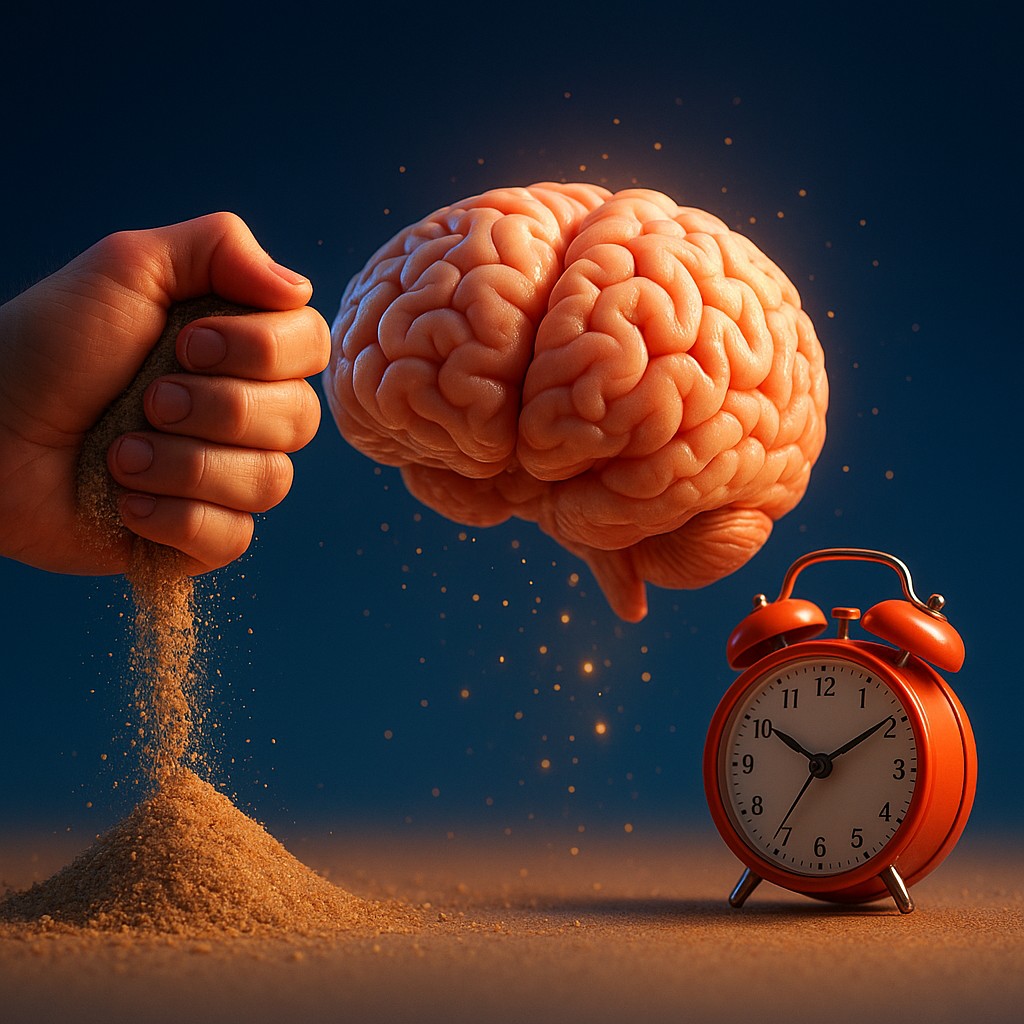
Imagine you are trying to hold a handful of dry sand. If you squeeze too hard too early, the grains slip through your fingers before you can settle them. If you wait too long and keep your palm open, the wind simply blows the pile away. Memory works on a surprisingly similar principle. We often treat our brains like buckets that we can fill with information through sheer volume, but the reality is more biological and follows a specific rhythm. To truly lock a word or a concept into long-term storage, you don't need a bigger bucket; you need a better sense of timing.
Language learning platforms have moved beyond simple flashcards into an era of mathematical precision. They no longer just show you words at random intervals. Instead, they hunt for your unique "forgetting threshold," that exact, fragile moment when a memory is about to dissolve into the white noise of your subconscious. When an algorithm catches you at this precise cliffside, it forces your brain to perform a "high-effort retrieval." This isn't just a digital trick; it is a metabolic signal to your neurons that this specific piece of data is vital for survival, triggering the physical strengthening of your brain’s wiring.
The Architecture of Fading Memories
Every time you learn a new word, like the French pamplemousse or the Japanese komorebi, your brain creates a fleeting chemical trace. In the late 19th century, psychologist Hermann Ebbinghaus discovered that this trace follows a predictable, if brutal, path called the Forgetting Curve. Without intervention, information drops out of our reach with exponential speed. We lose about 50 percent of new information within twenty-four hours and nearly 80 percent within a month. However, Ebbinghaus also discovered a loophole: every time you successfully recall that information, the curve flattens out. This means it takes longer for you to forget it the next time.
Modern platforms use a system called Spaced Repetition (SRS), but the latest versions are far more aggressive and personalized than earlier models. Older systems might have used a fixed schedule, perhaps showing you a word after one day, then three days, then seven. Current algorithms are much more suspicious of how well your brain is working. They monitor the micro-seconds it takes for you to press a button and any slight hesitation in your typing. If you answer "Cat" in 0.5 seconds, the algorithm realizes the memory is still stable and leaves you alone. If you take 2.5 seconds and get it right, the algorithm breathes a sigh of relief because it caught you right at the forgetting threshold, the "sweet spot" for maximum mental growth.
The Power of Desirable Difficulty
It seems backwards to want learning to feel difficult. We generally prefer things to feel smooth, fast, and easy. However, in the world of neuroscience, "easy" is often the enemy of "permanent." If you review a word while it is still fresh in your short-term memory, your brain recognizes that the information is already there and decides not to waste energy building a more permanent home for it. This is why "cramming" for an exam works for the next morning but leaves you completely blank a week later. You never actually challenged your brain to work, so it never saw a reason to invest in long-term storage.
This concept is known as "Desirable Difficulty." By waiting until you are on the verge of forgetting, the algorithm forces your brain to "dig" for the answer. That internal struggle, the moment where you can almost feel the word on the tip of your tongue before it finally clicks, is the signal your hippocampus - the brain's memory hub - needs. It tells your nervous system that this information was hard to find but necessary. The brain responds by wrapping the relevant neurons in more myelin, a fatty substance that speeds up electrical signals. You are quite literally thickening your thoughts through the act of struggling.
Decoding the Algorithm Strategy
The magic happens through a feedback loop between your performance and the machine. To understand how these platforms choose what to show you next, we have to look at the variables they track. Most modern systems are built on an evolution of the SM-2 algorithm, which calculates the "Interval" (the time between reviews) based on your "Ease Factor" (how easy the word is for you specifically). If you consistently find a word easy, the interval grows exponentially, moving from days to weeks to months. If you struggle, the interval shrinks back down until you have mastered the recall process again.
| Learning Element |
Role in the Algorithm |
Impact on Your Brain |
| Stability |
How long a memory lasts without review. |
Sets the "base" time for the next study session. |
| Retrievability |
The odds of you recalling the word right now. |
Lower retrievability creates higher "Desirable Difficulty." |
| Complexity |
How hard the word is (length, sounds). |
Adjusts how quickly the intervals grow. |
| Lapse Count |
How many times you have forgotten the word. |
Forces a reset to treat the word as brand new. |
This table shows the hidden gears turning behind your screen. If you tell the app a word was "Easy," you are telling it to increase the gap significantly. If you say it was "Good," the gap grows moderately. If you say "Hard," the algorithm might only wait a few hours before testing you again. This is why honesty is your most important tool. If you lie to the algorithm to feel better about your progress, you are actually sabotaging the physics of your own memory. You are preventing yourself from reaching that forgetting threshold where real growth happens.
The Myth of Total Hours vs. Timing
One of the most persistent myths in education is that the total time spent studying is the main driver of success. We have all heard the "10,000 hours" rule, and while volume matters, efficiency matters more when it comes to vocabulary. Two students could both spend 500 hours studying Spanish over a year. Student A spends those 500 hours in massive, five-hour blocks once a week. Student B spends those 500 hours in fifteen-minute bursts, three times a day, guided by a spaced repetition algorithm.
By the end of the year, Student B will almost certainly have a vastly better vocabulary and faster recall. This is because Student B gave their brain more "opportunities to forget." Every time Student B walked away and came back, they were testing the durability of their neural pathways. Student A, on the other hand, spent most of their time "over-learning," reviewing words they had already seen minutes ago. This creates a false sense of fluency. You feel like you know the material because it is sitting in your short-term "cache," but you haven't yet proven that you can pull it out of deep storage.
Strategic Honesty and the Self-Rating Framework
Most personalized language platforms rely on your own feedback to function. After you see the answer to a card, you usually have to rate how difficult it was to remember. This is where many learners stumble. It is tempting to mark every card as "Easy" because we want to see the progress bar move forward or want to feel smart. However, the algorithm doesn't care about your ego; it only cares about the strength of your synaptic connections.
To get the most out of these systems, you need a strict internal code. If the word came to you instantly without any doubt, that is "Easy." If you had to pause for a second but the answer was clear, that is "Good." If you had to really search your mind for three to five seconds - perhaps even visualizing where you first saw the word - that is "Hard." And if you got even a single letter wrong or hesitated for more than ten seconds, you must mark it as "Again" or "Wrong." By being ruthlessly honest, you allow the algorithm to pin your forgetting threshold with sniper-like accuracy.
The Biological Limit of Daily New Data
There is a final, vital piece to the puzzle: the daily limit. Because these algorithms are designed to keep you at the edge of your forgetting threshold, they can be mentally exhausting. Every session is a series of small, high-intensity workouts for your brain. Unlike passive reading or watching a movie, this type of active retrieval consumes a significant amount of glucose. If you try to learn 100 new words a day, the "review pile" will eventually snowball and become unmanageable.
The most successful learners focus on a low number of "new" cards but never miss their "review" cards. The algorithm calculates the perfect moment for you to see a word, and if you skip that day, you miss the threshold. The memory slips too far down the curve, and instead of a strengthening session, it becomes a re-learning session. Consistency is the fuel that allows the algorithm to do its job. When you show up every day, you give the machine the data it needs to map your mind's unique landscape.
Your brain is the most sophisticated adaptive system on the planet, but it is also remarkably efficient. It will not keep information it doesn't think it needs. By using these tailored gaps, you are essentially "hacking" your brain's priority list. You are proving, through the rhythmic struggle of retrieval, that these words are essential. As you embrace the challenge of the threshold, you will find that fluency isn't about being a genius; it is about being a disciplined navigator of your own forgetting. Trust the process, be honest with your ratings, and let the algorithm turn fleeting thoughts into permanent knowledge.