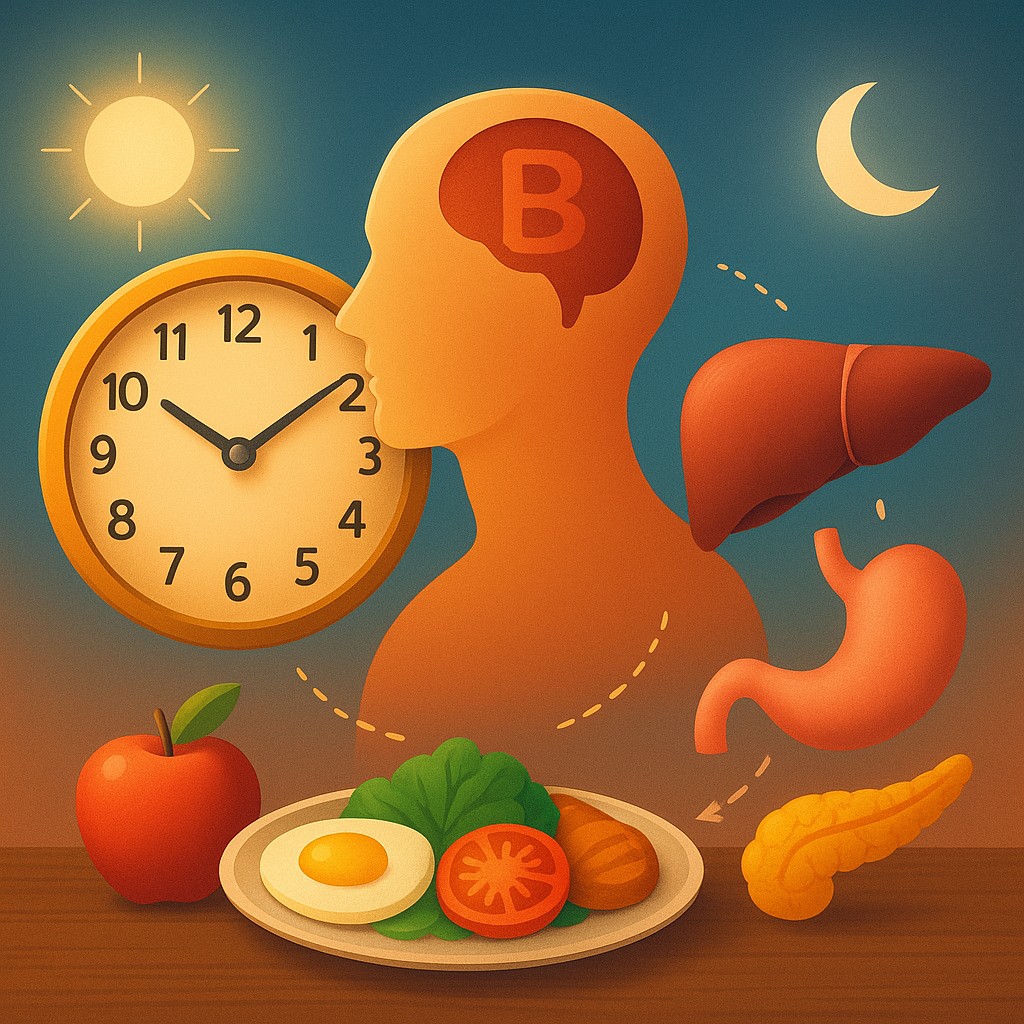
You may have heard that your body is governed by a master clock, a bundle of nerve cells behind your eyes that tracks the rising and setting of the sun. This central timekeeper, known as the suprachiasmatic nucleus, is obsessed with light. It uses the blue light of the morning sky to tell your brain when to wake up and the amber glow of evening to prepare for sleep. However, recent breakthroughs in the study of body rhythms have revealed a twist that changes everything we thought we knew about jet lag, metabolism, and midday slumps. While your brain is looking at the sky, your liver, gut, and pancreas are looking at your plate.
Imagine your body not as a single clock, but as a vast orchestra. The conductor is busy watching the light, but the individual musicians are actually taking their cues from the caterer. This creates a fascinating, and often frustrating, internal tension. When you take your first bite of the day, you aren't just consuming calories. You are sending a loud, clear signal to your metabolic organs that their workday has begun. If that signal comes at 7:00 AM on Monday but 11:30 AM on Saturday, your internal organs spend the weekend in a state of confused "metabolic jet lag," struggling to coordinate the complex dance of releasing insulin and absorbing nutrients.
The Tale of Two Different Biological Clocks
To understand why your breakfast time dictates your energy levels, we have to look at how timekeeping is organized within your cells. Evolution was clever enough to realize that different systems need different cues. Your brain needs to know if it is safe to go out and move around, so it prioritizes light. Your liver, however, has a very specific job: processing food. It would be highly inefficient for the liver to keep its enzymes on high alert all night when food isn't coming. Therefore, the liver and other digestive organs have evolved "peripheral clocks" that are almost entirely separate from the brain’s light-dark cycle.
Instead of responding to the sun, these secondary clocks respond to "Zeitgebers," a German word for time-givers. For the gut, the ultimate time-giver is the first arrival of sugars and proteins. When you stray from a consistent first mealtime, you create a biological rift. Your brain might think it is 8:00 AM because of the sunlight hitting your eyes, but if your liver hasn't received its customary "first bite" signal, it remains in a dormant, nighttime state. This mismatch is why you can feel mentally awake but physically heavy, a sensation often called metabolic grogginess.
The Chemistry of the First Bite Reaction
The moment you swallow your first morsel of food, a chemical chain reaction ignites. The arrival of nutrients triggers the release of hormones like insulin and GLP-1, which do more than just manage blood sugar. They act as the "starting gun" for your cells. Within minutes, the genes responsible for metabolism, which were turned off during your sleep, begin to activate. This is essentially your body’s way of powering up its factories, turning on the assembly lines that convert food into fuel and clearing out the toxins that built up overnight.
This system is remarkably rigid because it was designed for a world where food wasn't available 24/7. In the distant past, the first meal was a signal that a period of activity and plenty had begun. Today, we accidentally override this ancient programming. When we grab a midnight snack, we aren't just adding calories; we are effectively telling our liver that a new "day" has started at 11:30 PM. This forces the digestive system to reboot right when the brain is trying to enter deep-sleep maintenance mode. The result is a chaotic internal environment where no organ is sure which shift it is supposed to be working.
Comparing the Master Clock and the Hunger Clock
To visualize how these two systems interact (or fail to), consider how they respond to different triggers and which parts of your body they control.
| Feature |
The Master Clock (Brain) |
The Hunger Clock (Liver/Gut) |
| Primary Trigger |
Blue and white light |
Food intake / Calories |
| :--- |
:--- |
:--- |
| Location |
Behind the eyes |
Liver, Pancreas, Gut, Fat |
| :--- |
:--- |
:--- |
| Primary Outputs |
Melatonin and Cortisol |
Insulin and Enzymes |
| :--- |
:--- |
:--- |
| Main Function |
Sleep-wake cycles and alertness |
Energy storage and digestion |
| :--- |
:--- |
:--- |
| Impact of Change |
Slow to adjust (Jet Lag) |
Resets quickly every morning |
| :--- |
:--- |
:--- |
| Nighttime State |
High Melatonin (Rest) |
Low Insulin sensitivity (Repair) |
The High Cost of the Midnight Snack
We often think of late-night eating as a simple matter of extra calories, but the timing is far more damaging than the amount. Because the liver and pancreas are timed by your first meal, they expect to be "off the clock" about twelve to fourteen hours after breakfast. When you eat late at night, you are catching these organs at their weakest point. Your sensitivity to insulin naturally drops in the evening because your body expects to be fasting and sleeping. Consequently, that late-night slice of pizza causes a much higher and longer spike in blood sugar than it would have at noon.
Furthermore, this late-night eating "drags" your metabolic clock into the next day. By forcing your digestive system to work until 2:00 AM, you delay the repair processes that only happen when the gut is empty. This is why you often wake up feeling tired even if you got eight hours of sleep. Your brain rested, but your liver was pulling a double shift. The "hangover" feeling many people experience after a large late meal isn't just about the food quality; it is the result of your internal organs being physically exhausted from working against their natural schedule.
Realigning Your Internal Orchestra
The good news is that the hunger clock is incredibly responsive. Unlike the brain's master clock, which can take a week to adjust to a new time zone, your metabolic organs can be snapped back into alignment in just a few days. The secret lies in the "First Bite Anchor." By choosing a specific time for your first meal and sticking to it within a thirty-minute window every day, even on weekends, you provide a stable foundation for your metabolism. This consistency tells your body exactly when to start producing enzymes and when to begin winding down.
This doesn't necessarily mean you must eat the moment you wake up. If you prefer to fast in the mornings and your first meal is at noon, that is perfectly fine, as long as it is always at noon. The goal is to avoid the "metabolic drift" that happens when we eat at 7:00 AM during the week and 11:00 AM on Sunday. When you anchor that first bite, your body begins to anticipate it. You will likely find that you start to get naturally hungry about thirty minutes before your scheduled mealtime, as your liver begins pre-heating the "oven" in anticipation of the day's first energy shipment.
Breaking the Cycle of Metabolic Grogginess
If you currently feel like you are dragging yourself through the first few hours of the day, you are likely suffering from a synchronization error. You are essentially asking your body to run a marathon while half of its systems are still in power-save mode. To fix this, try to view your first meal as a biological contract. By eating at the same time, you are promising your organs a predictable schedule. In return, they will reward you with steady energy, better digestion, and a sharper mind.
It is also helpful to set a "sunset" for your digestion. Just as you might dim the lights to tell your brain that sleep is coming, you should "dim" your calorie intake two to three hours before bed. This allows the hunger clock to complete its daily cycle and hand the reins back over to the master clock for a night of deep, restorative sleep. When these two systems are in harmony, you stop fighting your own biology and start riding the wave of your natural rhythms.
Every morning presents a fresh opportunity to reset your internal chemistry. Your first bite is more than just fuel; it is a command to your body to wake up, stand tall, and move into the world with purpose. By respecting the rhythmic needs of your liver and gut, you unlock a level of vitality that caffeine alone can never provide. Start tomorrow by picking a time, grabbing that first bite, and watching as the rest of your biology finally falls into place.