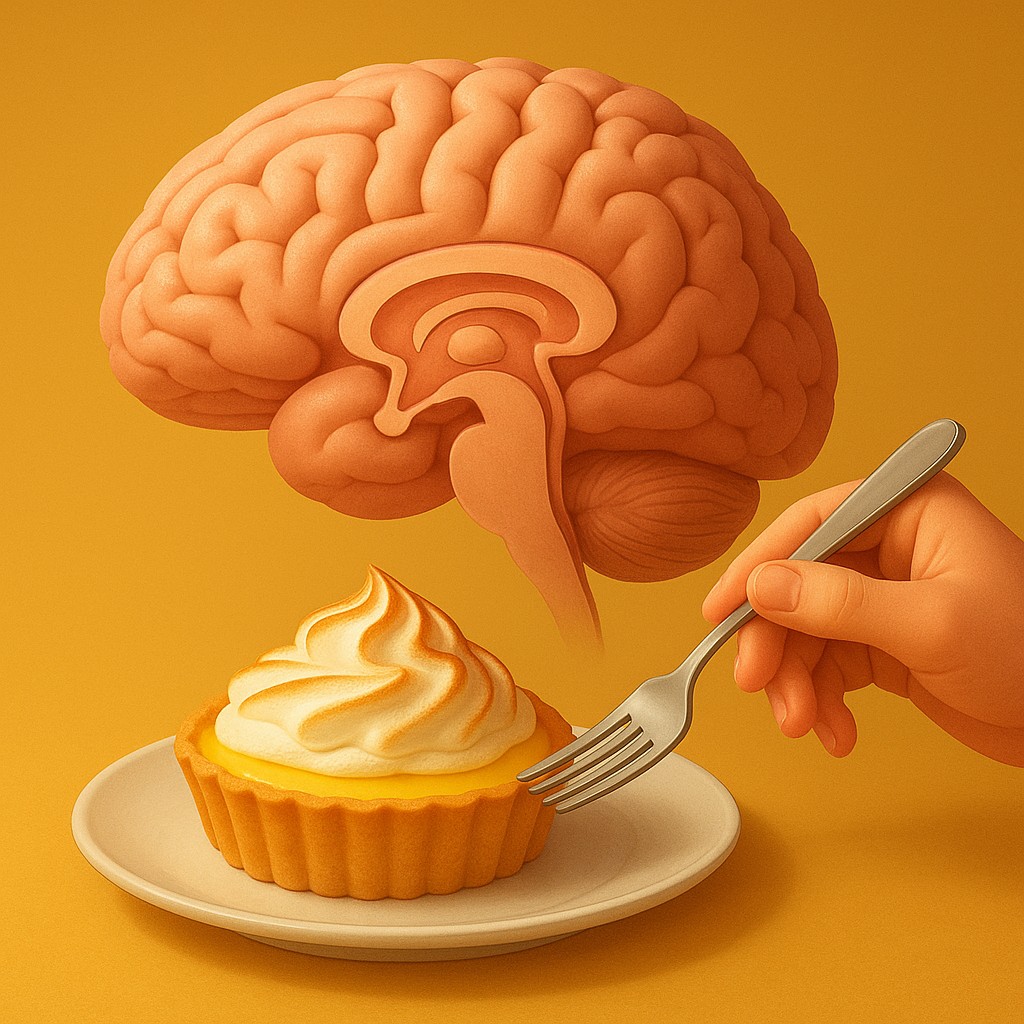
Imagine you are sitting at a lavish dinner party, having just finished a heavy, savory plate of slow-roasted prime rib with garlic mashed potatoes and buttery green beans. You lean back, pat your stomach, and tell those at the table that you couldn't possibly manage another bite. By any physical measure, you are completely full. Then, the host walks out with a shimmering, chilled lemon tart topped with toasted meringue. Suddenly, that feeling of fullness evaporates. A miraculous second wind arrives, and you find yourself picking up a fork to enjoy a large slice.
This isn't a lack of willpower or a biological glitch. It is a sophisticated neurological process known as sensory-specific satiety. Your brain is not just a passive accountant that tracks calories; it is a flavor-driven gatekeeper that monitors the chemical and sensory profile of every bite. While your stomach might be sending signals that it is physically stretched, your brain’s reward centers have simply become bored with savory notes like salt, fat, and umami-the savory taste found in meat and mushrooms. By introducing a new sensory profile, such as the sharp acidity of lemon and the sweetness of sugar, you effectively trick the brain into resetting its appetite. This creates what we usually call the "dessert stomach."
The Brain's Appetite Switch
The magic of sensory-specific satiety happens largely within the hypothalamus and the orbitofrontal cortex, the regions of the brain responsible for reward and motivation. When you begin eating a specific food, your brain reacts intensely to its taste and smell. Each bite provides a hit of dopamine, the chemical that tells you this food is valuable and necessary. However, as you keep eating that same flavor, the brain cells in the orbitofrontal cortex that respond to that taste begin to fire less often. This is common across most of our senses, a process called habituation. Just as you stop noticing the smell of your own house after five minutes, your brain begins to tune out the pleasure of a repeated flavor.
This decline in "reward value" is very specific. If you are eating salty pretzels, the neurons sensitive to salt and the crunch of starch will gradually go quiet. This makes the pretzels taste less exciting and eventually even unappealing. Crucially, the neurons responsible for sweetness or sourness remain fully alert and ready to be stimulated. This creates a state of "selective fullness." You are tired of the pretzels, but you are not tired of eating in general. If someone offers you a piece of chocolate, your brain responds with a fresh burst of dopamine because the sensory input is new. This mechanism ensures you don't just stop eating because you are bored; it pushes you to keep seeking out different flavors until your nutritional needs are met.
Evolution and the Quest for a Balanced Diet
You might wonder why our ancestors benefited from a brain that encourages us to keep eating even when we are full. The answer lies in the harsh reality of the paleolithic landscape. For a hunter-gatherer, survival wasn't just about total calories; it was about getting a diversity of nutrients. If an early human found a patch of wild berries and ate until they were stuffed, their body would have plenty of sugar and vitamin C but might still be dangerously low on protein or healthy fats. Sensory-specific satiety acted as a biological nudge, making the berries taste less appealing after a while so the individual would feel motivated to go hunt a rabbit or dig for tubers.
By muting the pleasure of a single food source, our brains forced us to become generalists. This "flavor boredom" discouraged our ancestors from eating only one type of food, which can lead to malnutrition. In a world of scarcity, this was a brilliant survival strategy. However, in our modern world of abundance, this same mechanism can work against us. We are now surrounded by ultra-processed foods designed to hit multiple sensory points at once. Our ability to hop from one flavor to another allows us to bypass the physical cues of fullness that would otherwise stop us from overindulging.
The Buffet Effect and the Illusion of Choice
One of the clearest examples of this principle in daily life is the "Buffet Effect." Researchers have consistently found that people eat significantly more calories when offered a wide variety of foods compared to a meal with only one dish. In one experiment, subjects offered three different flavors of pasta ate much more than those offered a large portion of just one flavor, even when the nutritional content was exactly the same. Because each new flavor profile resets the sensory-specific satiety clock, the brain never sends the "boredom signal" that would usually end the meal.
This is why complex meals with many side dishes often lead to a feeling of being overstuffed. Every time you switch from a bite of salty ham to a bite of sweet glazed carrots or acidic cranberry sauce, you are refreshing your palate and your brain's appetite. To better understand how this works, look at the table below, which shows how sensory-specific satiety affects our perception of common flavors over time.
| Sensory Category |
Primary Taste Signal |
Rate of Satiety |
Common Reset Flavor |
| Savory/Umami |
Meat, broths, mushrooms |
Moderate |
Acidic or Sweet (Lemon, Fruit) |
| Salty/Starchy |
Bread, potatoes, chips |
Fast |
Sweet (Chocolate, Caramel) |
| Sweet |
Sugar, honey, syrup |
Slow |
Salty or Bitter (Coffee, Nuts) |
| Fatty/Rich |
Butter, cream, cheese |
High |
Acidic (Vinegar, Pickles) |
Notice that sweet foods often have a slower rate of satiety. Researchers believe this is because, in nature, sweetness was a reliable sign of safe, high-energy calories. Because sugar was rare and valuable to our ancestors, the brain is more hesitant to "mute" the reward of sweetness. This explains why we can almost always find room for dessert, even after a massive meal.
Navigating the Trap of Palatability
While sensory-specific satiety is a fascinating biological trait, it is also a primary cause of modern overeating. The food industry is well aware of this phenomenon. Product developers often aim for what is known as "vanishing caloric density," where a food provides a quick hit of flavor that fades fast enough to keep you reaching for the next bite without ever feeling satisfied. Think of a bag of potato chips; the flavor is strong, but the physical density is low, and the salty-fatty-crunchy profile is just complex enough to keep the brain engaged much longer than it would be with a plain boiled potato.
Understanding this mechanism gives you a powerful tool for managing your own eating habits. If you find yourself overeating at large dinners, you can consciously limit the variety on your plate. By sticking to one or two main flavor profiles, you allow sensory-specific satiety to kick in earlier, making it easier to stop when you are actually physically full. Similarly, if you are a parent trying to encourage a child to eat a more diverse diet, introducing small amounts of varied flavors can help keep their interest in the meal high.
Why the Palate Cleanser Matters
The culinary world has intuitively understood sensory-specific satiety for centuries, long before neuroscientists gave it a name. The tradition of the "intermezzo" or palate cleanser-usually a small scoop of tart sorbet served between heavy courses-is designed specifically to exploit this brain function. The cold, acidic, and sharp flavor of the sorbet clears away the lingering fats and salts from the previous course, essentially "rebooting" the reward centers of the hypothalamus. This prevents the diner from feeling too full or tired of the meal, allowing them to start the next course with the same enthusiasm as the first.
This also explains why we find certain pairings so satisfying. The classic combination of sea salt and caramel, or a sharp pickle on a greasy burger, works because the contrasting flavors prevent your brain from getting used to either one too quickly. The salt cuts the sweetness, and the acid cuts the fat. While this makes for a delicious meal, it also keeps the "reward" signal firing for much longer than a single-flavor dish would. We are, quite literally, wired to seek out the tension between different tastes.
Master Your Biology Through Awareness
Recognizing the role of sensory-specific satiety changes the way you look at your plate. It turns the "dessert stomach" from a guilty pleasure into a predictable biological response. Once you realize that your desire for a post-dinner treat is just your brain asking for a sensory change rather than a physical need for fuel, you can make better choices. You might choose a piece of fruit or a cup of herbal tea to provide that sensory "reset" without the heavy calories of a traditional dessert.
Using this knowledge allows you to satisfy your natural drive for variety while staying in tune with your body’s actual energy needs. Nature gave us this mechanism to ensure we thrived on a diverse range of nutrients. By understanding the "why" behind our cravings, we can honor that ancient wisdom without overindulging. Your brain is a brilliant, flavor-seeking machine; once you know how it operates, you can take control and navigate your meals with a clear mind.