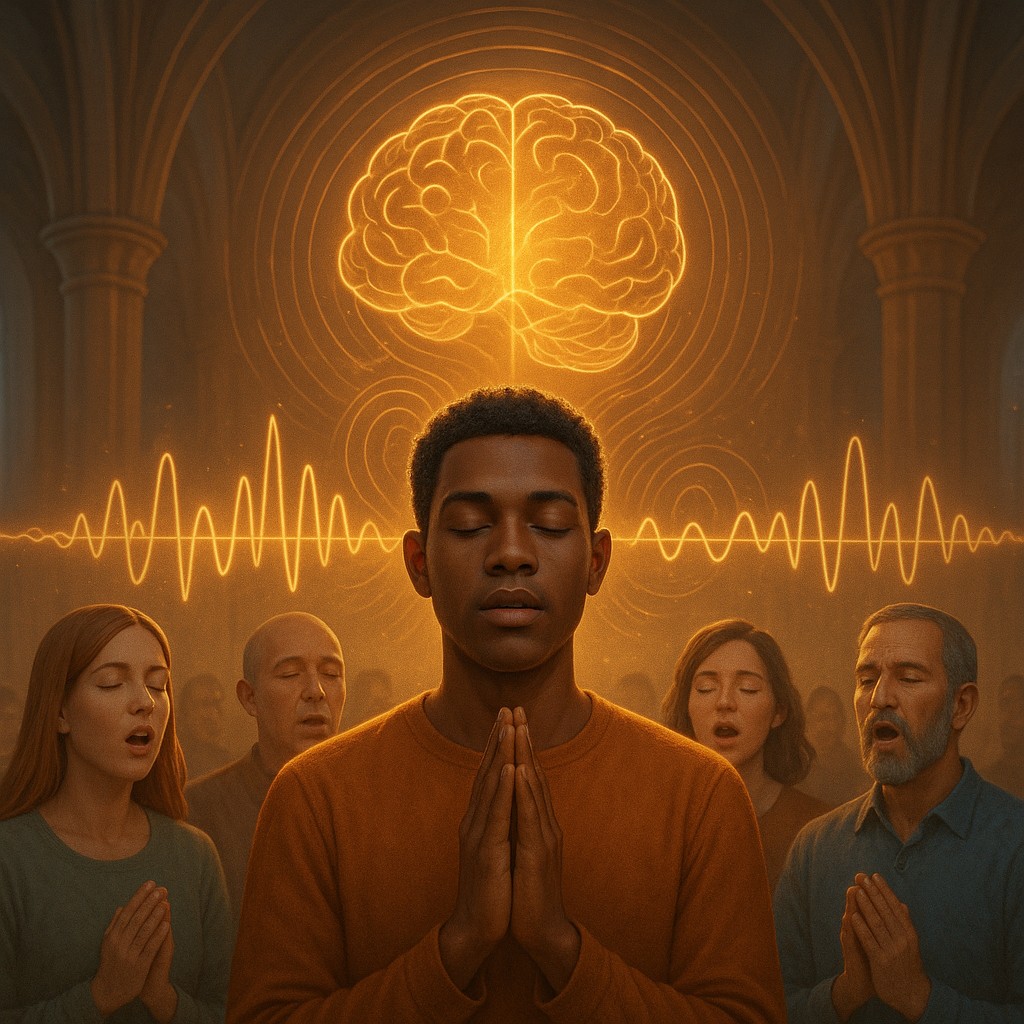
Imagine standing in a vast cathedral, a quiet monastery, or a packed stadium. Suddenly, a low hum starts. It begins as a small ripple and swells into a steady, rhythmic chant. You might feel your skin start to tingle, your breathing slow down to match the person next to you, and your sense of being an "I" begin to melt into a powerful sense of "we." This isn't just a spiritual moment or a catchy tune; it is a sophisticated biological hack. Humans have used it for tens of thousands of years to weld individuals into a single, tight-knit group.
While we often focus on the religious or political meaning of the words, the true power of the chant lies in its mechanics. Our bodies are surprisingly sensitive to the rhythms of those around us. When we speak or sing in unison, we aren't just sharing an idea. We are entering a state called "entrainment," where our body's internal rhythms sync up with an outside source. This process rewires our brain chemistry, calms our nervous systems, and quietens the inner critic that usually keeps us guarded and separate from the crowd. To understand how this works, we have to look past the theology and into the ancient machinery of the human brain.
The Biological Tug of Entrainment
At the heart of every rhythmic ritual is a phenomenon called entrainment. In physics, entrainment happens when two vibrating systems, like two pendulum clocks on the same wall, eventually start to swing in perfect harmony. Human beings are essentially a collection of vibrating systems: our hearts beat, our lungs expand and contract, and our brains pulse with electrical activity. When we join a group in a rhythmic chant, we provide a powerful external "pacemaker" for these internal rhythms.
As you chant a repetitive phrase at a specific tempo, your breathing naturally adjusts to fit the beat of the words. Because your heart rate is closely linked to your breath, your heart begins to sync with the rhythm of the chant as well. When an entire room of people does this together, the result is a massive, collective pulse. Scientists have noticed that during group rituals, the heart rates of participants often rise and fall together, creating a biological "web" that connects everyone in the room. This physical alignment sends a powerful signal to the brain that you are no longer an isolated person, but a part of a larger organism.
Silencing the Skeptic in the Frontal Lobe
While your heart is busy syncing up with your neighbor's, something even more dramatic is happening inside your skull. The human brain has a highly developed prefrontal cortex. This is the area right behind your forehead responsible for complex decisions, self-awareness, and critical thinking. This is the part of you that asks, "Is this true?" or "Do I look silly right now?" In a healthy person, this "skeptic" is always active, maintaining the boundaries of the self and checking for threats or lies.
Rhythmic, repetitive chanting acts as a bypass for this mental gatekeeper. The sheer repetition and the focus needed to keep the beat create a heavy "mental load" on the brain's control center. As you pour your attention into the rhythm, activity in the prefrontal cortex begins to dim. This leads to a state called "de-individuation." When the frontal lobe takes a backseat, your self-consciousness fades and your ability to weigh the facts of what you are saying decreases. This is why shared beliefs feel so much more profound and "right" during a ritual than they might when you are reading them alone in a book. The brain has literally turned off the equipment used to doubt them.
The Chemistry of Communal Survival
Evolution does nothing for free. The reason our brains are wired to respond this way to rhythm is rooted in our history as a social species. For early humans, survival depended entirely on the strength of the tribe. A divided tribe was a dead tribe. Therefore, nature favored groups that could quickly turn from a collection of arguing individuals into a single, motivated force. Rhythmic chanting and movement served as the "social glue" that made this change possible by triggering a flood of feel-good chemicals in the brain.
When we sync our movements or voices with others, our brains release a cocktail of endorphins and oxytocin. Endorphins are the body’s natural painkillers. This is why people in high-energy rituals can often perform feats of endurance or ignore physical pain that would be impossible to handle alone. Oxytocin, often called the "bonding hormone," builds feelings of trust and safety. This chemical rewards us for being part of the group, making the experience of "losing oneself" feel intensely pleasant rather than terrifying.
| Feature |
Individual State |
Chanting/Synchronized State |
| Heart Rate |
Variable and independent |
Synchronized with the group (Entrainment) |
| Frontal Lobe Activity |
High (Active skepticism and self-awareness) |
Reduced (Lowered critical thinking) |
| Dominant Hormones |
Cortisol/Adrenaline (High alertness) |
Endorphins/Oxytocin (Bonding and bliss) |
| Primary Identity |
"I" (Personal boundaries and self-interest) |
"We" (Loss of self and group unity) |
| Perception of Beliefs |
Evaluated and questioned |
Felt as absolute and undeniable |
The Mechanics of Presence and Repetition
If you look at different traditions around the world, you will find that the specific words of a chant are often less important than how they are delivered. Many traditions use "seed syllables" or mantras that have no literal meaning in everyday language. This is intentional. When words have too much meaning, the analytical brain tries to take them apart, check the grammar, and debate the logic. By using repetitive, melodic, or even nonsensical sounds, the ritual keeps the listener in a "flow" state rather than a "thinking" state.
This mechanical approach to making sound is why many people find chanting so effective for reducing stress. By forcing the body into a slow, rhythmic breathing pattern and giving the mind a simple task, you kick the nervous system out of "fight or flight" mode and into "rest and digest" mode. Even in everyday life, this explains why team cheers, military cadences, and even the "Olé, Olé, Olé" at a football match feel so energizing. They satisfy a deep-seated biological craving for coordination and the comfort of knowing we are not alone.
Moving Beyond the Individual
Understanding the science of rhythmic chanting doesn't take away the beauty of the experience. Instead, it shows how social our biology truly is. We are not just thinking machines; we are rhythmic machines. Our ability to bypass our own skepticism and merge with a crowd is a superpower. it allowed our ancestors to build civilizations, defend their homes, and create cultures that lasted for generations. It reminds us that our "self" is much more flexible than we often believe.
The next time you find yourself caught up in a rhythmic moment, whether it’s a solemn prayer, a concert sing-along, or a crowded protest, take a second to notice what’s happening in your body. Notice how your breath hitches in time with those around you and how the noise of your personal worries starts to fade away. You are experiencing an ancient, beautiful piece of human hardware doing exactly what it was designed to do: reminding you that you are part of something much larger than yourself. Embrace the rhythm and let your inner skeptic take a well-deserved nap.