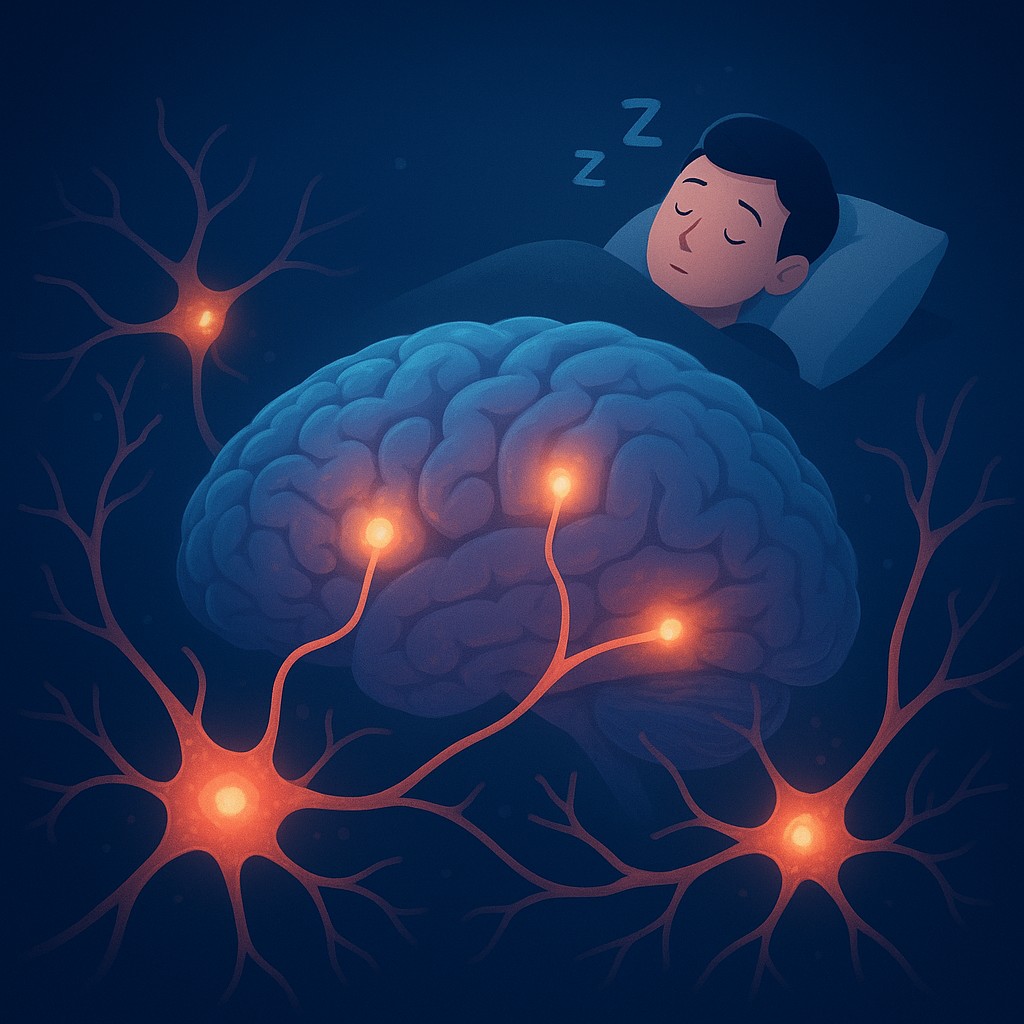
Imagine your brain as a rowdy, high-energy music festival that has been roaring for sixteen hours straight. In the morning, the gates opened to a clean, quiet field. As the day went on, however, more stages went up, amplifiers were stacked higher, and the crowds surged. By 10:00 PM, every speaker is cranking at max volume, the pyrotechnics are blinding, and the noise is so overwhelming that you cannot hear the person standing right next to you. This is essentially what happens to your neurons during a productive day. As you learn new names, master software shortcuts, or simply remember where you parked, your brain strengthens the connections between its nerve cells, called synapses. This process, known as Long-Term Potentiation, is the cornerstone of memory, but it comes with a physical cost that your brain cannot sustain forever.
By the time you brush your teeth and collapse into bed, your neural circuits are "redlining." Your synapses have grown physically larger and are burning through huge amounts of cellular energy. If this continued for another twenty-four hours without a break, your brain would reach total saturation. You would lose the ability to tell meaningful information apart from background neurological "static," much like how a photo becomes a useless white square if the exposure is too high. To prevent this system failure, your brain performs a spectacular feat of biological engineering called synaptic scaling. This nightly "re-zeroing" of your cognitive hardware ensures you wake up with the mental bandwidth to do it all over again.
The Physical Weight of a Thought
To understand why the brain needs to scale down, we have to look at the physical reality of a memory. We often talk about memories as digital files stored in a cloud, but in the human brain, a memory is a physical change in structure. When you learn something new, the gap between two neurons (the synapse) becomes more efficient at passing signals. The "sending" neuron might release more chemical messengers, while the "receiving" neuron might grow more receptors or even sprout larger "dendritic spines" (tiny branches) to catch those signals. This growth is essential, but it is also incredibly resource-intensive. Neurons are the hungriest cells in the body, and maintaining these connections is the most expensive item on their menu.
If we never slept, these connections would keep growing until every neuron in your head was firing at its maximum capacity. In engineering, this is a "signal-to-noise" problem. If every connection is "loud," then nothing stands out. You would lose the ability to think complex thoughts because your brain would be stuck in a permanent scream. Synaptic scaling acts as a master volume knob, slowly turning down the gain on the entire system while you are in deep sleep. It is the silent maintenance crew that moves in after the festival to clean up the trash and reset the stages so the music can start again tomorrow.
Normalizing the Neural Network
The magic of synaptic scaling lies in its balance. The brain does not just go in with a chainsaw and cut all connections equally. Instead, it uses a balancing mechanism to turn down the strength of all synapses by a consistent percentage. Think of it like a teacher grading on a curve, or a photo editor lowering the brightness of every pixel in an image by exactly 20 percent. The brightest pixels stay the brightest and the dimmest stay the dimmest, but the overall energy of the image is lowered. This preserves the relative differences between your memories, ensuring that important information about your job remains stronger than a trivial fact you heard on the radio.
Scientists call this process "re-normalization." By lowering the baseline activity of the entire network, the brain creates "synaptic space" for the next day. This is why you feel a sense of clarity after a good night’s sleep that caffeine cannot replicate. Caffeine masks tiredness, but it cannot perform the structural reset required to make your neurons receptive to new information. Without this reset, your learning efficiency plummets. After just a few days of sleep deprivation, the brain becomes so saturated that it literally cannot form new long-term connections, leading to "brain fog" that makes simple tasks feel like wading through waist-deep molasses.
| Feature |
Daytime Learning (Potentiation) |
Nighttime Scaling (Downscaling) |
| Synaptic Strength |
Increases as info is recorded |
Decreases to a sustainable level |
| Energy Usage |
High and accelerating |
Low and restorative |
| Primary Goal |
Specificity and memory formation |
Stability and system capacity |
| Physical Effect |
Growth of dendritic spines |
Shrinkage of dendritic spines |
| Cognitive Result |
Gaining knowledge |
Integration and a "fresh start" |
The Power of the Slow Wave
The real work of synaptic scaling happens during the deepest stages of sleep, marked by slow, rhythmic electrical pulses known as delta waves. These waves act like a giant metronome for the brain. As they sweep across the outer layer of the brain, they coordinate the firing of millions of neurons in unison. This synchronized activity is believed to trigger the molecular machinery of scaling. While your conscious mind is off exploring dreams, your neurons are performing a choreographed dance of contraction. Molecular signals help facilitate the physical shrinkage of the synaptic connections.
Interestingly, this process also filters what is worth keeping. While scaling is mostly uniform, the strongest connections (the ones reinforced through repetition or emotion) are often protected. They are "tagged" as vital, allowing them to resist the downscaling better than weak, accidental associations. This is why sleep does not just refresh you; it helps you prioritize. It prunes away the noise of the day, like the color of a stranger's shirt, while solidifying the "signal," such as the new vocabulary words you practiced for hours.
Correcting the Myth of Passive Sleep
One of the most stubborn myths about sleep is that it is a period of inactivity, a time when the brain "shuts off." In reality, the brain is often just as active during sleep as it is when we are awake; it is simply doing a different kind of work. We often view sleep as a luxury or a "pause button" on life, but biologically, it is a vital maintenance phase. If your brain is a high-performance engine, wakefulness is the race, but sleep is the pit stop where the oil is changed and the parts are recalibrated. You cannot have the race without the pit stop.
Another common myth is that we can train ourselves to need less sleep or that "sleep is for the weak." Science suggests the opposite: the more you learn and the more active you are during the day, the more "sleep pressure" your brain builds up. In fact, research shows that the parts of the brain you use most intensely during the day show the most intense slow-wave activity at night. If you spent the day learning to juggle, the motor cortex of your brain would show deeper scaling activity that night. Your brain knows exactly where the saturation is highest and works overtime to clear those specific circuits.
Designing a Life for Neural Plasticity
Understanding synaptic scaling gives us a framework for how to approach learning and productivity. If we view the brain as a vessel with a limited daily capacity, we realize that "cramming" for twelve hours straight is a recipe for diminishing returns. There comes a physical point where your synapses can no longer grow effectively. This is why "spaced repetition," or learning in short bursts over several days, is so much more effective than marathon sessions. By spreading your learning out, you give your brain multiple sleep cycles to scale down, consolidate, and reset, effectively expanding your total storage capacity.
Furthermore, this highlights the danger of our "always-on" culture. When we cut sleep short to gain two hours of work, we are sabotaging the very hardware we need for that work. We wake up with circuits that are still partially saturated, meaning we start the day with less room for new ideas. Over time, this lack of scaling leads to burnout, low creativity, and a loss of mental flexibility. To be truly brilliant, you must be a brilliant sleeper. You must respect the reset as much as you respect the hustle.
Embrace the fact that your brain is a masterpiece with physical limits and sophisticated self-care routines. When you lay your head down tonight, do not think of it as "clocking out." Instead, imagine your neural circuits quietly resetting, turning down the noise, and carving out space for tomorrow’s breakthroughs. You aren't just resting; you are restoring the very architecture of your mind. By respecting the rhythm of synaptic scaling, you ensure that your brain remains a sharp, vibrant, and expanding landscape of possibility for decades to come.