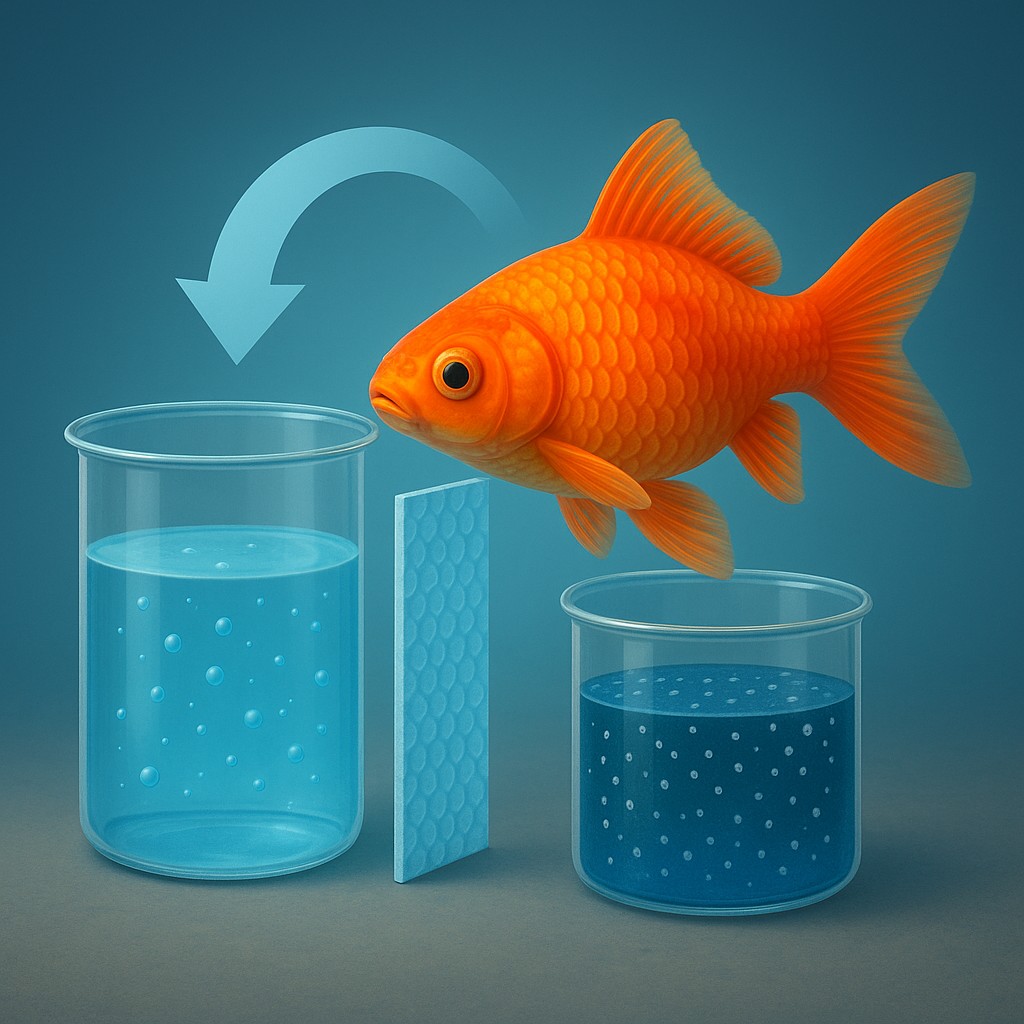
Imagine for a moment that you are a goldfish suddenly dropped into the middle of the Atlantic Ocean. Beyond the initial shock of the new scenery, your body would immediately enter a state of biological panic. Despite being surrounded by millions of gallons of water, you would actually begin to die of thirst as the ocean literally pulls the moisture out of your cells. It sounds like a cruel irony, but for aquatic creatures, staying hydrated is less about finding a drink and more about winning a high-stakes chemical tug-of-war against their own environment.
This invisible battle is governed by the laws of physics, specifically a process called osmosis. While humans simply turn on a tap when we feel parched, a fish’s life is a 24/7 exercise in precision engineering. They must constantly balance the salt inside their bodies with the salt in the water around them. It is a task that requires specialized organs and a relentless commitment to either drinking like a fish or, quite literally, peeing like a fountain. Understanding how they manage this feat reveals one of the most elegant survival strategies in nature.
The Invisible Magnet of Salt and Water
To understand why a saltwater fish is constantly thirsty, we first need to look at how osmosis works. In the simplest terms, nature hates an imbalance. If you have two containers of water separated by a thin, semi-permeable membrane (a barrier that allows liquid but not solids to pass through), and one side is saltier than the other, the water will instinctively move toward the saltier side. It is as if salt acts as a microscopic magnet, pulling water molecules toward it until the concentration is equal on both sides. This is why a garden slug shrivels up if you sprinkle salt on it; the salt on its skin draws the internal water out with terrifying efficiency.
Fish are essentially porous bags of fluid swimming through a liquid world. Their skin, and more importantly their gills, act as that semi-permeable membrane. Gills must be thin and delicate to allow oxygen to pass from the water into the bloodstream, but this thinness also makes them a perfect highway for osmosis. In the ocean, the water is much saltier than the internal fluids of a fish. Consequently, the ocean is constantly "stealing" water from the fish's body through its gills. Without a counter-strategy, a tuna or a snapper would eventually turn into a piece of fish jerky while still swimming in the deep blue.
To fight this constant dehydration, saltwater fish have evolved to be aggressive drinkers. They gulp down seawater throughout the day to replace what they lose. However, this creates a secondary problem: by drinking the ocean, they are also swallowing massive amounts of salt. If that salt stayed in their system, their kidneys would fail and their cells would stop working. To solve this, they use specialized cells in their gills called chloride cells. These cells act as tiny, high-powered pumps that grab salt molecules from the blood and forcibly shove them back out into the ocean. It is an energy-intensive process, but it is the only way to stay hydrated in a world that is thirstier than they are.
Life in a Diluted World
Freshwater fish like bass, trout, and goldfish face the exact opposite crisis. The water in a lake or river is much "purer," or less salty, than the blood and fluids inside the fish. Because osmosis always moves water toward the saltier area, water is constantly forcing its way into the fish's body. These animals are under permanent threat of being flooded from the inside out. If a saltwater fish is a sponge being squeezed dry, a freshwater fish is a balloon being overfilled every second of its life.
Because water is already barging in through their gills and skin, freshwater fish almost never drink. If they did, they would only speed up their own demise. Instead, their entire biological mission is to get rid of water as fast as possible. Their kidneys are massive and highly efficient, working overtime to produce a constant stream of very watery urine. In fact, some freshwater fish can produce a volume of urine equal to nearly a third of their body weight every single day. If humans did this, we would spend twenty hours a day in the bathroom just to keep our cells from bursting.
While saltwater fish are busy pumping salt out of their bodies, freshwater fish are desperately trying to keep it in. Since they are constantly urinating, they run the risk of losing vital electrolytes and minerals. To compensate, their gills work in reverse compared to their saltwater cousins. Instead of pumping salt out, their gill cells are designed to "snatch" whatever limited salt molecules they can find in the lake water and pull them into the bloodstream. They are the ultimate salt hoarders, cherishing every milligram to ensure their internal chemistry remains stable.
Mapping the Great Aquatic Divide
The differences between these two survival strategies are so profound that most fish are strictly confined to one environment or the other. A fish built to pump salt out would quickly die in a lake where salt is scarce, as its gills would continue to pump out what little salt it has left, leading to a total system collapse. To help visualize these different biological paths, we can compare the primary functions of their hydration systems.
| Feature |
Saltwater Fish (The Drinkers) |
Freshwater Fish (The Eliminators) |
| Water Salinity |
Higher than the fish's body |
Lower than the fish's body |
| Osmotic Threat |
Constant water loss (Dehydration) |
Constant water gain (Over-hydration) |
| Drinking Habits |
Drinks seawater constantly |
Rarely or never drinks |
| Gills' Main Job |
Pumps excess salt out of the body |
Absorbs scarce salt into the body |
| Kidney Function |
Minimal, concentrated urine |
Massive production of watery urine |
| Relative Energy Cost |
High (pumping salt out is hard work) |
Moderate (producing urine is constant work) |
The Masters of Both Worlds
While most fish are specialists, staying in either salt or fresh water, there are a few biological superstars known as euryhaline fish. These creatures, such as salmon, eels, and even some species of sharks, possess the incredible ability to move between both environments. This is a feat equivalent to a human being able to breathe air on Monday and switch to breathing underwater on Tuesday. It requires a complete cellular overhaul that happens over the course of days or weeks as the fish migrates.
When a salmon prepares to leave the ocean and enter a freshwater river to spawn, its body undergoes a radical transformation. It must "reprogram" its gill cells to stop pumping salt out and start pulling it in. It also has to signal its kidneys to switch from conservation mode to high-production mode. This transition is incredibly taxing, which is why many migratory fish spend time in estuaries, where the salt and fresh water mix. These brackish waters act as a "waiting room," giving their bodies the time needed to flip the biological switches required for their new environment.
Bull sharks are perhaps the most famous example of this flexibility among predators. They have been found hundreds of miles up the Mississippi River, far away from the salty Gulf of Mexico. They achieve this by using specialized rectal glands and kidneys that can adjust the concentration of salt in their blood on the fly. This adaptability gives them a massive evolutionary advantage, allowing them to hunt in areas where other large sharks simply cannot survive.
The Delicate Chemical Balance of Life
It is easy to look at a fish and see a simple creature, but beneath those scales is a sophisticated laboratory managing a complex series of chemical reactions. This process of water regulation is a reminder that living things are never truly separate from their environment. Every breath a fish takes and every movement it makes is influenced by how salty the water is. Even a slight change in the chemistry of our oceans or lakes can have devastating effects on these animals because their survival is tuned to such a specific frequency.
The engineering required to exist in the ocean is a testament to the resilience of life. Whether it is a tiny reef fish pumping salt out of its gills or a massive sturgeon producing gallons of urine to stay balanced, these animals have solved a problem that would baffle the world's best human engineers. They live in a state of constant, dynamic balance, fighting a war against physics every second of their lives and winning.
Next time you see a fish in an aquarium, or perhaps on your dinner plate, take a moment to appreciate the invisible work its body was doing. It wasn't just swimming; it was acting as a high-tech desalination plant, a master of fluid dynamics, and a dedicated guardian of its own internal chemistry. The ocean may be vast and powerful, but the fish has found a way to drink from it without losing itself, balancing the salt of the earth with the water of life in a dance that has continued for hundreds of millions of years.